Assessing Hazards Builds Resilience
by Stacy Rinella | December 12, 2024 7:20 am
 [1]
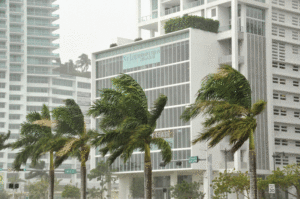
[1]Hurricanes Helene and Milton are estimated to have caused more than $300 billion in combined losses, most of that uninsured. These storms also caused hundreds of fatalities and left millions of homes and businesses without electricity and water for weeks. In addition to the heartbreaking losses suffered by individual families, these storms also disrupted businesses and institutions that are the backbone of local communities and economies. It will take years for hard-hit communities like Asheville, N.C., and Sarasota, Fla., to recover. Some parts of these communities, like the River Arts District in Asheville, swept away by floodwaters, may never come back, and gone with it a major tourist attraction and the local jobs it supported.
According to the National Oceanographic and Atmospheric Administration (NOAA), the U.S. set a record for natural hazard events in 2023, with 28 separate events with losses of one billion dollars or more. This broke the previous record of 22 set in 2020, and far exceeded annual averages from previous decades. As of this writing, 2024 is sadly on pace to challenge this record.
 [2]
[2]These direct and indirect climate change impacts create risks for commercial real estate investors, building owners, and lenders. Building owners also face increasing insurance costs, and potentially significant capital costs for damage repair, extended business disruption, or complete loss of property value after hazard events. Tenants also face risk, as power outages and post-hazard repairs could limit or prohibit the use of their workspaces for extended periods. With insurance companies pulling back and investors seeking information on climate-related financial risks, new regulations are beginning to require disclosures.
Many of these regulations now address double materiality, including both transitional risks and physical risks. Transitional risks arise from a company’s impacts on the natural world and the legal and regulatory mechanisms pushing impact reductions like carbon pricing, building performance standards, and climate litigation. Physical risks come from the impacts that nature has or will have on a company in the form of current natural hazards (hurricanes, floods, etc.) and future climate hazards (sea level rise, extreme heat, etc.).
Internationally, the European Union (EU) and other countries are beginning to require companies to disclose these risks to investors, usually focused on greenhouse gas (GHG) emissions and climate-related financial risks. The U.S. Securities and Exchange Commission (SEC) and the State of California will both be requiring similar disclosures in the near future.
Companies subject to these disclosure regulations will need to conduct resilience assessments of their assets. ASTM will soon release its new Standard Guide for Property Resilience Assessment (PRA). The PRA guide was developed as a companion to existing standards for property condition assessments and environmental site assessments to support real estate transaction due diligence, but it also provides a standardized three-stage process for resilience assessment in support of physical risk disclosures, pre-develop risk reduction planning, and existing facility capital improvement planning.
The PRA process starts with a hazard screening to identify which current natural hazards and future climate-related hazards pose the greatest threat to a subject property or asset. In many cases, current and future physical risks due to natural hazards and climate change are very localized, so risks are best assessed at the asset level. A minor difference in topography or location could significantly change the potential impacts from flooding, storm surge, sea level rise, wildfires, or other hazards. Importantly, thorough hazard screening pulls from multiple quality data sources. For example, current FEMA flood maps only address fluvial (riverine) flooding and are based on historic rather than current and future flood risks. Other sources, like Fathom’s global flood maps, cover all flooding risks, fluvial, pluvial (heavy rainfall runoff), and coastal flooding.
With primary hazards identified, the second PRA stage assesses the vulnerability of the subject property. Vulnerability is a factor of exposure, sensitivity, and adaptive capacity. These are influenced by the position, size and configuration of the asset and the equipment and infrastructure that serve it, as well as the uses of the facility and the type of occupants it supports. For example, an oceanfront tower has greater exposure to hurricane winds and storm surges than a low-profile building a short distance inland, and a building with electrical equipment in the basement has greater exposure to flood risk than a similar building with elevated equipment. Similarly, an office building where tenants have a workforce equipped for remote work and with critical digital files stored in the cloud may have low sensitivity and high adaptive capacity. In contrast, an assisted living facility with elderly and infirm residents in ground floor rooms may have high sensitivity and low adaptive capacity.
Based on the hazards and vulnerabilities revealed, the third PRA stage is focused on the identification of feasible capital improvements and operational changes to mitigate risks. Building professionals and hazard-specific experts can identify practical resilience measures and integrate them into capital and operational improvement plans. This could include:
- Choosing between wet floodproofing or dry floodproofing with permanent or deployable flood-barriers
- Selecting wind-resilient roofing systems and impact-resistant glass in high wind hazard zones
- Adding high-efficiency filters and special ventilation operating modes for wildfire smoke mitigation
- Sizing on-site renewable energy and backup energy generation and storage
For new construction and major renovation projects, the PRA can inform design and engineering requirements to create a resilient building from the start. In some cases, the implementation of risk mitigation measures could also be used to negotiate more favorable insurance rates or could be a selling point to attract buyers or renters. In other cases, resilience measures, like on-site energy generation and storage to provide backup power for continuity of operations or thermal enclosure improvements to increase extreme heat resilience, will also reduce utility costs and cut GHG emissions, providing ongoing sustainability benefits. The forthcoming LEED version 5 will include a prerequisite requiring projects to conduct a PRA to inform sustainable and resilient building design.
Budgets are always limited. A property resilience assessment will help building teams to prioritize resilience investments where they are most needed. Businesses, institutions, and governments need to simultaneously address both mitigation of climate impacts through GHG emission reduction and adaptation to current and future climate-related hazards though asset-level resilience investments. Assessing and addressing climate-related financial risks is becoming a legal requirement for many companies and an expectation of investors, insurance companies, and regulators.
Alan Scott, FAIA, LEED Fellow, LEED AP BD+C, O+M, WELL AP, CEM, is an architect and consultant with over 36 years of experience in sustainable building design. He is director of sustainability with Intertek Building Science Solutions in Portland, Ore. To learn more, follow him on LinkedIn at
linkedin.com/in/alanscottfaia/.
- [Image]: https://www.metalarchitecture.com/wp-content/uploads/2024/12/bigstock-Hurricane-Sandy-39184150.gif
- [Image]: https://www.metalarchitecture.com/wp-content/uploads/2024/12/Alan-Scott_headshot_2024_cropped.gif
Source URL: https://www.metalarchitecture.com/articles/columns/assessing-hazards-builds-resilience/