Construction outlook: Little growth, plenty of challenges in 2027
by anthony_capkun_2 | November 18, 2026 11:35 am
 [1]
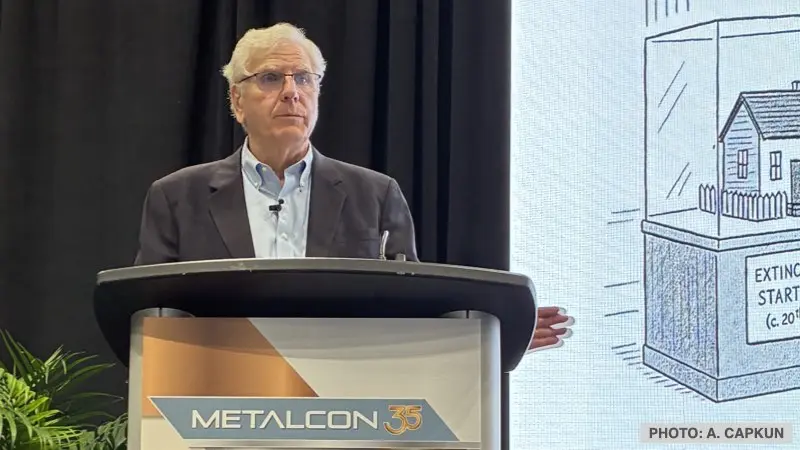
The U.S. economy continues to face significant challenges, but a recession does not appear imminent, according to Kermit Baker, former chief economist of the American Institute of Architects[2] (AIA), while delivering his keynote address at Metalcon 2026[3].
During his keynote address, Baker presented an economic and construction industry outlook shaped by inflation, weak architectural billings, labor challenges, slowing population growth, and uncertainty over construction costs.
While data centers remain a bright spot, the overall construction outlook is subdued, with nonresidential spending expected to remain essentially flat in 2026 before posting modest gains in 2027.
Economic uncertainty persists
Among the indicators Baker discussed were weak consumer sentiment, rising inflationary pressures, and interest rates that continue to challenge the economy.
The U.S. has added only about 500,000 jobs over the past year, compared to roughly 2 million net new jobs that Baker would consider “healthy” annual growth.
Baker also pointed to elevated 10-year U.S. Treasury yields and ongoing uncertainty surrounding economic growth. Nevertheless, he indicated that the National Bureau of Economic Research (NBER) does not anticipate a recession in the near term.
Population growth presents another challenge. With immigration returning to more traditional levels of approximately 1 million people annually, and natural population growth slowing, Baker expects reduced demand for new housing over time.
This naturally raises questions about how much new housing—and how many schools and other community facilities—the country will require in the coming decades.
Housing affordability: A national problem
While there are questions about how much new housing we will really need in the coming years, there is absolutely no disagreement when it comes to affordability.
According to figures presented during his keynote:
- The average price of a home sold has increased more than 50% since early 2020.
- The qualifying household income needed to purchase a median-priced home is approximately $110,000.
- 3/4 of American households can afford only homes priced below $300,000, well below the national median.
- The median age of first-time homebuyers has climbed to 40 years, compared to 30 years in 2008.
These statistics underscore the growing disconnect between housing prices and household purchasing power.
Data centers dominate the growth story
Baker warned us not to be fooled by nonresidential statistics that show growth in the “Office” sector, explaining that government statisticians lump data centers together with offices. When you see apparent growth in “Office” construction, what you are likely seeing is growth in DCs, not traditional office buildings.
For their part, data centers continue to expand rapidly, driven by growing demand for artificial intelligence and digital infrastructure. Of the 5,500 data centers in the nation (operating, under construction, or planned), 2,700 are located in these 10 states:
- Texas: 606
- Virginia: 477
- California: 355
- Ohio: 244
- Georgia: 219
- Illinois: 175
- Arizona: 162
- New York: 162
- Florida: 148
- Pennsylvania: 143
But the industry is encountering resistance. Baker cited survey results in which over 70% of Americans would be opposed to a data center being built near their homes. In the same survey, only about half said they would oppose the construction of a nuclear power plant.
Can you imagine? Today, the public’s anxiety toward artificial intelligence surpasses that of nuclear power!
Workforce pressures
Baker sees a few weaknesses on the labor front. For starters, “Construction has been very unsuccessful in attracting women.”
Also, foreign-born workers account for more than 1/3 of the workforce in some construction trades (and considerably more in others). An estimated 13.7% of construction workers are undocumented—the highest proportion in our economy—followed closely by agriculture.
With immigration tightening, labor shortages could become acute when construction activity begins to recover.
Architectural billings remain weak
For three decades, AIA has tracked business conditions among the nation’s approximately 20,000 architectural firms.
The latest data presented by Baker offered little indication of an imminent turnaround.
According to the AIA’s January 2026 Work-on-the-Boards survey, almost 1/3 of recent project activity, measured by dollar value, had been delayed, stalled, or canceled:
- 16% was significantly delayed
- 10% was on hold or indefinitely stalled
- 5% had been canceled or abandoned
Among the principal causes were client delays (29.1%), changing market conditions (17.9%), and construction costs (17.5%).
Baker also noted that work on existing nonresidential buildings currently accounts for approximately half of architectural design activity, a share expected to increase as owners look for opportunities to renovate and repurpose existing facilities.
The forecast presented by Baker projects:
- Total nonresidential: $846 billion in 2025, with a projected decline of 0.3% in 2026, followed by 3.0% growth in 2027.
- Commercial: $253 billion in 2025, with projected growth of 4.8% in 2026 and 5.8% in 2027.
- Industrial: $220 billion in 2025, with a projected decline of 11.6% in 2026 and a further 0.6% decline in 2027.
- Institutional: $373 billion in 2025, with projected growth of 2.8% in 2026 and 2.7% in 2027.
The commercial category benefits substantially from data center activity, while industrial construction faces a particularly difficult period.
Institutional construction is expected to experience modest growth in both years, although individual segments will perform differently.
The institutional forecast includes:
- Healthcare: Growth of 2.6% in 2026 and 4.4% in 2027.
- Education: Growth of 1.2% in 2026 and 0.9% in 2027.
- Amusement and recreation: Growth of 7.1% in 2026 and 3.0% in 2027.
As a sidenote, Baker also discussed the challenges of expanding offsite construction. While prefab and other methods may theoretically offer efficiencies, the industry has not yet achieved the production volumes necessary to make many of these approaches economically viable.
The construction industry enters 2027 facing a complicated combination of weak architectural billings, project delays, high material costs, constrained labor supply, and slower population growth.
Anthony Capkun is the editor-in-chief of Metal Architecture[4] and Metal Construction News[5] magazines.
 [6]
- [Image]: https://www.metalarchitecture.com/wp-content/uploads/2026/11/Metalcon-2026-Session-Kermit-Baker.webp
- American Institute of Architects: https://www.aia.org/
- Metalcon 2026: https://metalcon.com/
- Metal Architecture: https://www.metalarchitecture.com/
- Metal Construction News: https://www.metalconstructionnews.com/
- [Image]: https://www.metalarchitecture.com/wp-content/uploads/2026/09/Editors-Corner-MCN-MA-Mug02-800.jpg
Source URL: https://www.metalarchitecture.com/articles/construction-outlook-little-growth-plenty-of-challenges-in-2027/