Creating New Architecture
by Jonathan McGaha | June 1, 2014 12:00 am
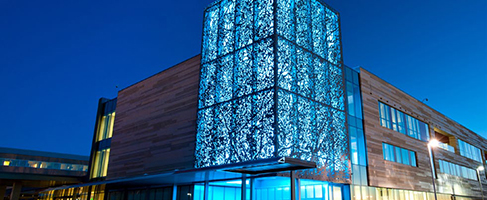
 In early 2009, a partnership was formed between Phoenix-based Banner Health[1], one of the largest nonprofit health care systems in the U.S., and The University of Texas MD Anderson Cancer Center[2], one of the world’s most respected cancer centers in Houston. The purpose for this union was to consolidate and expand metropolitan Phoenix’s inpatient and outpatient oncology services into a single comprehensive campus-facilitating a multidisciplinary approach to cancer diagnostics and treatment. This new center, the Banner MD Anderson Cancer Center[3], required the creation of a new architecture: one that respected the campus context and brand identity for Banner Health, but at the same time brought a new identity indicative of this unique partnership. Architectural metal in a variety of incarnations played a significant role in the creation of that original expression.
Context and Brand
Located on the Banner Gateway Medical Center campus in Gilbert, Ariz., the cancer center design needed to respond to the architectural context established by the existing hospital. Completed less than two years earlier, Banner Gateway Medical Center is a composition of concrete masonry, glass and Cor-Ten steel accents. More than that, Banner Gateway was the most recent in a series of community hospitals in the greater Phoenix area; and as a health care institution, Banner was on a path toward the creation of a mature architectural brand. This brand included key elements of architectural form, function and materials, such as strong planar geometries, exterior shading devices to control the desert sun, and a featured architectural metal-particularly at entry canopies, pergolas and courtyards. The cancer center took each of these defining elements into consideration, while reinterpreting them for this new service line.
Use of Zinc
In order to differentiate the cancer center from its neighboring hospital buildings, pre-weathered zinc was chosen as an accent metal. Zinc’s qualities as a durable, natural metal with a soft, warm appearance made it a good choice for the center’s east entrance canopy, setting the stage for a healing environment. Interlocking flat zinc panels were utilized on the underside of the main canopy, as well as the adjacent walkway canopies that would ultimately connect to future phase expansions. Zinc was also strategically employed on the building’s south elevation and in its roof overhang. In these instances, a flat-lock seam was used, further contributing to the building’s soft, inviting aesthetic.
Protecting from Desert Sun
Orientation of public circulation corridors and waiting areas is toward the exterior along the south-facing courtyard garden. These spaces inevitably wanted views out to the garden, but creating the most comfortable interior environment by providing protection from solar heat gain and glare was an imperative design goal. To this end, a fixed sunshading system was designed for this elevation, albeit one in which each louver blade’s position is calibrated to respond to an individual’s view out of the building without compromising shading performance. The result is a series of undulating ripples within the shading system, animating the building elevation. While many aluminum louver extrusion profiles were explored, ultimately the design team created its own custom profile that evolved from the shape of a leaf. Each louver had the structural capacity to span 18 feet between vertical supports and cantilever an additional 4 feet at each end, thus ensuring maximum openness for the most uninterrupted views possible of the courtyard.
The Lantern of Hope
Soaring over the north entry and visible from the adjacent Superstition Highway, the “Lantern of Hope” is the iconic architectural feature that defines the Cancer Center. At 64 feet tall, the structure rises to mark the desert as a tree of life and serves as a transition area from the harsh desert environment to a place of healing. The palo verde tree-known in arboreal terms as a nurse plant for its protective role in the life of other desert flora and fauna-is the reference point for this open-air entry pavilion. Fractal patterns of branches and leaves were translated through computer modeling for the digital fabrication of 32 1-inch-thick water-jet cut aluminum panels that make up the lantern’s outer shell.
The panels are comprised of over 10,000 unique openings. Each panel is bead-blasted with copper shot in order to soften the metal’s reflectivity in the desert sun. An inner scrim of fabric animates the lantern and the space it contains, welcoming patients and staff to the facility under a dappled canopy of sunlight filtered through the palo verde-esque pattern etched into the tower’s panels. By illuminating the fabric with color-changing LED lighting, the tower becomes a glowing lantern at night. The colors of the lantern can be coordinated to correspond to each of the different cancer disease awareness groups. This approach reinforces the concept of the structure’s expression as a lantern of hope to patients, their families and the staff working to eradicate cancer.
—
David M. Polzin, AIA, LEED AP, is a principal in the St. Louis office of CannonDesign. One of the firm’s most recognized design leaders, Polzin’s design process connects people with ideas, seeking the greatest architectural potentials through foresight and innovation. His diverse portfolio of significant health care, corporate, research and higher education projects spans the country and abroad. To learn more, visit www.cannondesign.com[4].
- Banner Health: http://www.bannerhealth.com/
- The University of Texas MD Anderson Cancer Center: http://www.mdanderson.org/
- Banner MD Anderson Cancer Center: http://www.bannerhealth.com/locations/arizona/banner+md+anderson+cancer+center/_banner+md+anderson+cancer+center+home.htm
- www.cannondesign.com: http://www.cannondesign.com
Source URL: https://www.metalarchitecture.com/articles/creating-new-architecture/