Curtain Wall Integration
by Stacy Rinella | October 21, 2024 7:35 am
 [1]
[1]Photos courtesy Airolite
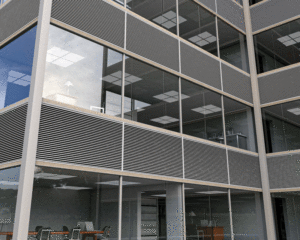
With advances in construction and fabrication techniques, there has been a growing trend in building designs that incorporate unitized louvers within curtain wall systems for both mechanical and aesthetic purposes. Specifying louvers to be installed into glazed applications can be challenging without knowing critical louver characteristics, or understanding how these products integrate. There are three main aspects to the successful integration of louvers into curtain wall systems: performance, building codes, and curtain wall integration.
Performance
Water protection, airflow requirements, and usage are the most important characteristics to consider when evaluating louver performance. While louvers can mitigate water penetration, no louver is 100 percent waterproof. All louvers will allow some water penetration under certain conditions.
Louvers come in several performance levels:
-
Standard non-drainable louvers are all-purpose louvers featuring simple Zee profile blades,
which offer very good airflow but the least amount of water rejection. - Drainable blade louvers feature blades that capture water and drain it to the jambs where it then flows down to the sill and exits the building. These louvers offer better water rejection and very good air performance but are not rated for wind-driven rain situations. These louvers are tested with static rainfall only.
- Wind-driven rain louvers, otherwise known as storm-class louvers, offer much better water performance at the expense of some airflow ability. These louvers are tested per the Air Movement and Control Association International or AMCA 500-L test protocol and are rated as to how much water penetrates at various velocities of incoming air at both 46.7 km per hour (29 miles per hour) and 80.5 km per hour (50 miles per hour) wind speed.
-
High-velocity wind-driven rain louvers, commonly known as AMCA 550 louvers, offer the highest level of water performance. As its name implies, this is also a wind-driven, rain-tested louver, but the velocity is increased to 177 km per hour (110 miles per hour) per the AMCA 550 test procedure. This is the highest level of performance offered and very few louver models on the market are AMCA 550 listed.
 [2]
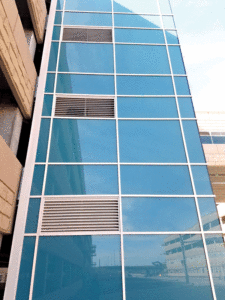
[2]Water protection, airflow requirements, and usage are the most important characteristics to consider when evaluating louver performance.
When placing louvers into a curtain wall system, it is advised to use AMCA-certified wind-driven rain louvers, or high-velocity wind-driven rain louvers at a minimum to reduce the risk of unwanted
water infiltration.
Building codes
While performance and appearance are important, the louver must also meet local, national, and international building codes. Mechanical codes must also be considered. For example, the IBC requires AMCA 550 level of performance for louvers within hurricane-prone regions. Code compliance can directly influence what louver model can and cannot be used, and is instrumental in defining the louver’s overall performance objectives.
Curtain wall integration
Finally, the curtain wall products and design itself must be considered. Is it a ground-floor storefront retail band, or an upper-level, high-wind load situation? Is the system factory unitization or will it be field installed? Many different types of glazing systems exist, and understanding which type of system is being proposed ensures the louver can be integrated. In general, there are two main categories:
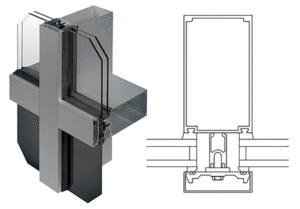
Curtain wall system—This can be a pressure wall-type system or a structurally glazed variety. The primary consideration is that the infill is set into place from one side, and then retained in some fashion (Figure 1).
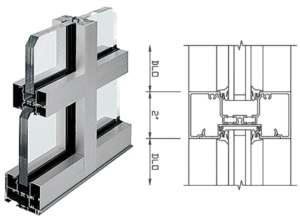
Storefront system—These are also referred to as flush-glazed systems. This is defined by captured glazing pockets, where the glass is set in place using slip or tuck glazing techniques (Figure 2).
 [3]
[3]Glazing adaptors are the most common method to integrate louvers into a curtain wall system. Adaptors are installed around the perimeter of the louver and provide an infill thickness, which can be captured by the glazing system. Most louver models can accept glazing adaptors, and they come in various thicknesses and widths that will work with most systems. Different systems may require other methods of integration. Work with your glazing contractor or louver manufacturer to meet your design goals.
In addition to the main components of performance, codes, and curtain wall integration, many other design features may be considered when specifying louvers for glazed-in applications. The following are just a few.
 [4]
[4]
Continuous blade appearance
Architects often desire a continuous blade appearance from louver to louver in a structurally glazed system. This design can present some challenges since the curtain wall mullion must pass in between the adjacent louvers. They occupy the same space the louver frame would normally occupy creating some interference. This can be accomplished by notching the louver blades and using a custom-shaped jamb extrusion, which wraps the louver around the mullion face. It is advisable to always review this detail with the louver manufacturer, as this is available on very few models. It should also be noted this option is not available for the AMCA 550-listed louver models previously discussed. AMCA 550 louvers are restricted from having any modifications to the frame profiles whatsoever.
Active/inactive louvers
Louvers typically are active or inactive. Active louvers remain open to airflow, therefore provisions for water infiltration should already be in place. Inactive louvers will often feature blank-off panels to close off the airflow. These usually are not sealed to the louver frame in a standard louver installation, but curtain wall installation can present new challenges. Inactive louvers become a decorative infill element and a part of the building’s weather envelope. They protect the building from the elements and limit water in the interior space. A factory-installed silicone seal around the perimeter of the blank-off panel can provide an added measure of water resistance. Eliminating the bird or insect screen at these locations can improve the effectiveness of this seal.
Glazed-in louvers have become more prevalent in today’s building designs, and knowing how louvers work within glazing systems can be key to your project’s success. Turn to your glazing contractor or louver manufacturer for preliminary design review, and application guidance to ensure design and performance requirements can be met.
Anthony Jackson, CSI, CDT, LEED Green Associate, is the product manager at Airolite. For more than 100 years, Airolite has been helping construction professionals around the world in the design, selection, and specification of architectural louvers, grilles, equipment screens, sun controls, and canopies. For more information visit airolite.com
- [Image]: https://www.metalarchitecture.com/wp-content/uploads/2024/10/Airolite-Glazed-In-Louver_HR.gif
- [Image]: https://www.metalarchitecture.com/wp-content/uploads/2024/10/Airolite-K6744-Drainable-Louver-.gif
- [Image]: https://www.metalarchitecture.com/wp-content/uploads/2024/10/Figure-1-Pressure-Plate-Curtain-Wall.gif
- [Image]: https://www.metalarchitecture.com/wp-content/uploads/2024/10/Figure-2-Flush-Glazed-Storefront.gif
Source URL: https://www.metalarchitecture.com/articles/curtain-wall-integration/