Designing the Full Building Envelope
by hanna_kowal | September 12, 2025 3:55 pm
 [1]
[1]Photo courtesy Brian’s Perspective
In this edition of The Firm, Metal Architecture sat down with BŌK Modern founder Russ Naylor to hear his story and the story of his company.
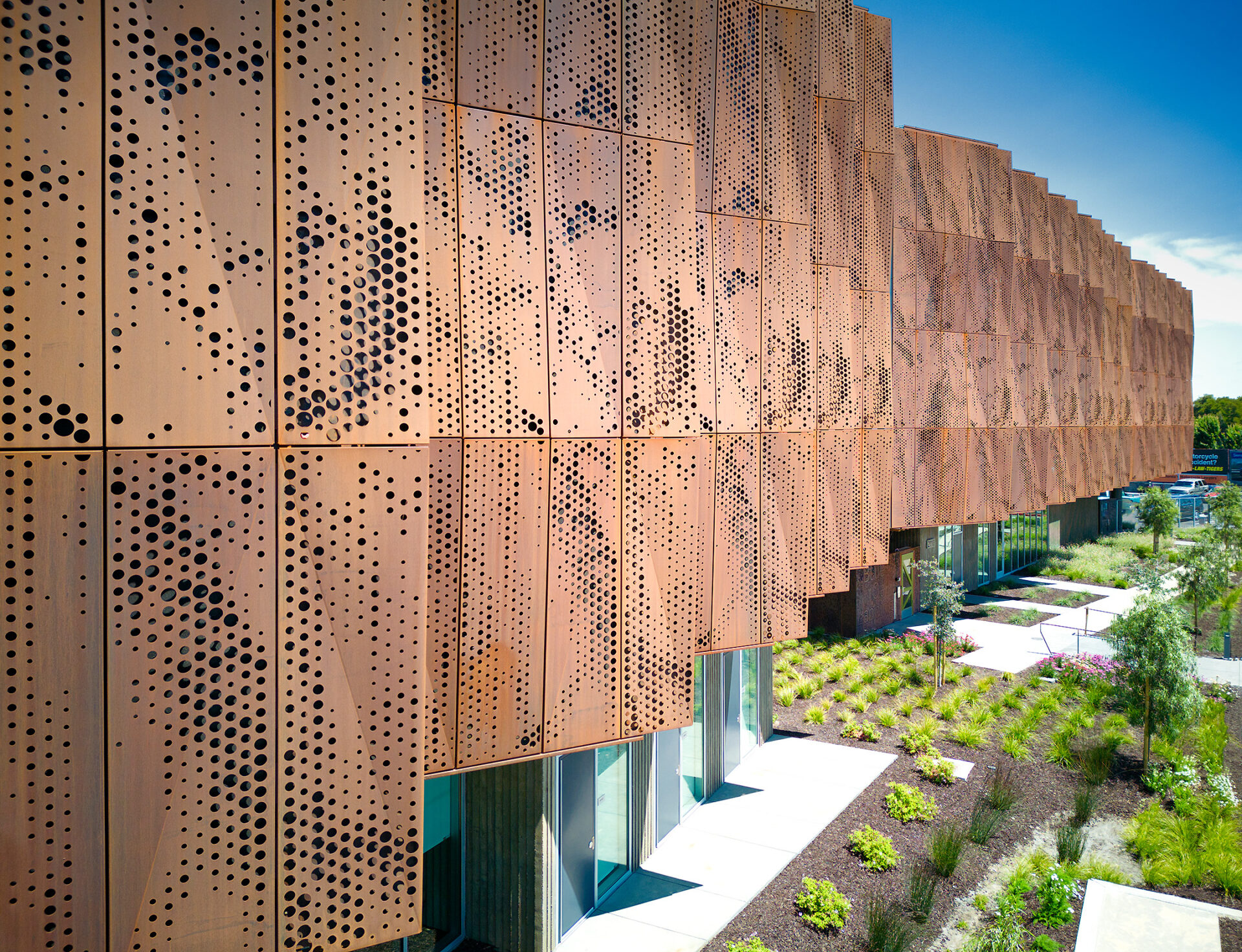
As the function of the building envelope expands from a simple barrier to an integrated environmental mediator, Naylor believes that the approach to material and system design must similarly evolve. He emphasizes that metal architectural systems present a powerful opportunity for architects and engineers seeking performance, cohesion, and constructability—allowing for holistic design across the entire building envelope and into the landscape through a single, scalable material language.
Founded more than a decade ago, BŌK Modern has focused on rethinking how metal systems can operate in architectural applications. Naylor explains that the company began with a pre-engineered guardrail system, “eliminating bulky welded frames by folding structure directly into perforated panels,” but has since developed a comprehensive suite of building envelope and landscape solutions. According to Naylor, the core philosophy has remained consistent: “We aim to minimize complexity, maximize performance, and preserve design intent.”
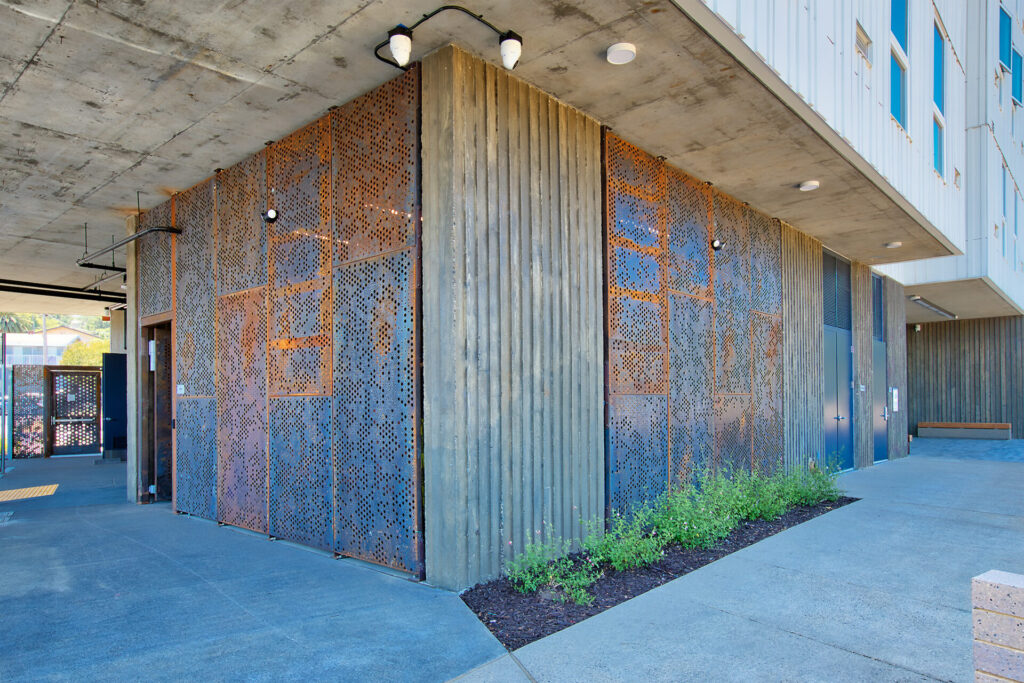
Rather than treating each exterior element as an isolated system with its own supplier and detail set, Naylor and his team advocate for a cohesive approach to the building envelope. Naylor describes how a facade pattern can continue uninterrupted from one element to another: “A single finish or perforation motif can tie together shading, privacy, and ventilation elements. And because the same structural principles and mounting strategies apply, installation is simplified, often with fewer penetrations, fewer trades, and lower overall cost.”
For the company, this strategy is about far more than aesthetics. Naylor points to projects like Albany Housing, which demonstrate how pattern, color, and material can extend a design vision from the building into the landscape, using trellises, planters, and fences. He argues that without these unified metal elements, the building would present merely as a stucco box; with them, it becomes a cohesive architectural composition.
 [2]
[2]Photo courtesy Brian’s Perspective
Engineering for performance and practicality
Naylor underscores the design flexibility provided by folded metal systems, which enable long spans with minimal secondary support and allow architects to maintain clean lines while reducing penetrations and minimizing waterproofing risks. He cites the company’s rainscreen panels, which employ integrated tabs and slots to eliminate the need for exposed fasteners. Similarly, he notes, the sunshades provided by the company can be mounted directly to the structure—no protruding brackets or field welding required. Naylor adds that “with high-performance finishes like powder coating or anodizing—both VOC [volatile organic compound]-free—our systems are engineered for longevity in even the most demanding exterior environments.”
Customization without starting from scratch
While BŌK Modern’s systems are modular in principle, the results are not necessarily repetitive. Naylor highlights the adaptability of pre-engineered systems, which are made possible through folding geometries, unique patterns, and digital fabrication. He references the 1500 Mission Street canopy in San Francisco: “We replaced a heavy steel truss design with a plate truss system—emulating the structural look through folded aluminum panels. These components cut structural weight and cost nearly in half, while preserving aesthetic goals and enabling a 9-m [29-ft] cantilever.”
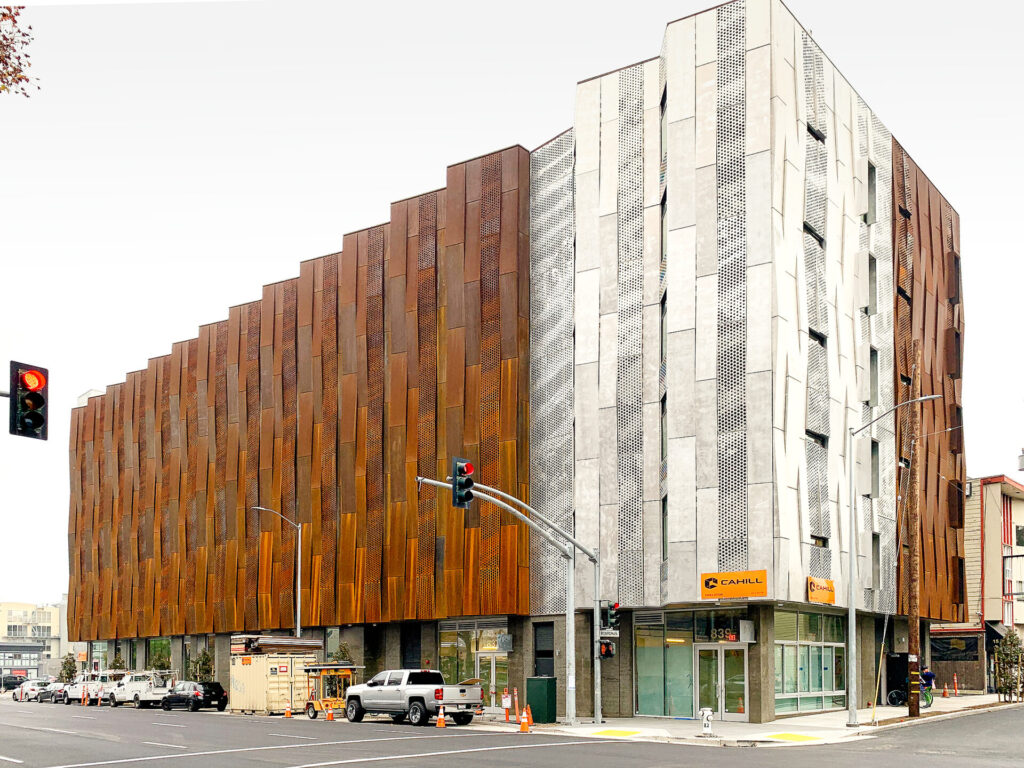
According to Naylor, other projects, such as Tahanan Supportive Housing and Blue Oak Landing, have used the same panel system to generate a variety of effects, from sculptural depth to visual lightness. He says this proves that a single metal system can produce vastly different spatial and tactile experiences.
 [3]
[3]Photo courtesy Brian’s Perspective
Enabling passive strategies
According to Naylor and his team, integrated metal systems also play a key role in supporting passive design strategies. Perforated screens and sunshades reduce solar heat gain and glare, while privacy panels can serve as ventilation screens and provide security for stairwells or parking garages. In their view, Trellis structures can extend the usability of outdoor space, tempering sun exposure and converting design features into climate-responsive infrastructure.
Naylor argues that these solutions often can be implemented at minimal cost compared to more complex mechanical strategies. “Since the systems are modular, architects can scale shading or screening elements based on orientation and need, dialing in performance zone by zone across the envelope,” he notes.
 [4]
[4]Photo courtesy Brian’s Perspective
Practical gains, project-wide
Naylor contends that the benefits of a unified metal system extend beyond design consistency for project teams. He observes that working with a single-source supplier can reduce coordination complexity, streamline detailing, and simplify the bidding process. Naylor points out that economies of scale become advantageous as more systems are specified for a project, noting that “the same installer can often handle all exterior metal elements, resulting in reduced labor time and fewer trades on site.”
A case for early integration
Naylor encourages early collaboration between architects, engineers, and metal systems suppliers.
“Our advice for architects and engineers interested in this approach is simple: bring your metal systems partner in early. The earlier we engage, the more we can help optimize structural strategies, eliminate redundant supports, and provide tested details that protect the design through value engineering,”
he says.
Naylor concludes that, in his view, metal is among the most versatile materials in the architect’s toolkit, and—“with thoughtful design and integration, it can also become a functional work of art.”
- [Image]: https://www.metalarchitecture.com/wp-content/uploads/2025/09/0021.jpg
- [Image]: https://www.metalarchitecture.com/wp-content/uploads/2025/09/9485.jpg
- [Image]: https://www.metalarchitecture.com/wp-content/uploads/2025/09/1198.jpg
- [Image]: https://www.metalarchitecture.com/wp-content/uploads/2025/09/0439.jpg
Source URL: https://www.metalarchitecture.com/articles/features/building-envelope-2/