Lessons in Sustainable Design
by Stacy Rinella | November 13, 2023 10:34 am
 [1]
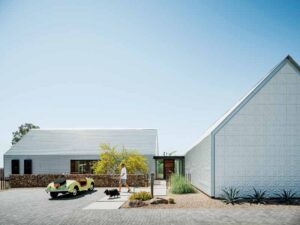
[1]Two Barns was a case study on creating a high-performance, net-zero home, on an attainable budget. With a design concept focused on integration, equitable communities, water, economy, and energy, mission accomplished. The project even took the local eco-system into consideration, providing a safe haven for a Mojave Desert tortoise to roam.
Located on a leftover infill flag lot just minutes from downtown Phoenix, Ariz., 2 Barns is walking distance from a light rail station and the 15th Ave. bike trail, making for a convenient commute to the owners’ offices. All aspects of the home’s performance and design were constantly refined to keep the elements straight forward.
Origin story
The origin of the building form and cladding came from the family’s ethnic background infused with the agrarian history of the area. The house is a high-performance home and is rated as a net-zero residence.
Simple forms and materials helped keep project costs in check, forcing the design to focus on aesthetic elements which were direct responses to climate, maintenance, and project performance. Building elements, materials, and finishes were carefully planned to be used on a limited basis but for high impact with a goal of having the performance elements of the home also act as the main form and design drivers of the project.
The project took almost two years to design and construct. From the start, the owners were open to any design strategy and material choices that helped them achieve their budget and sustainability goals. In fact, no dumpsters were used on the project and most left-over material and scrap was given away on Craigslist, often to volunteer organizations. Weekly curbside municipal recycling was used for all cardboard, paper, and packaging. Through 10 months of construction, the owners made six trips to the city landfill with a 1.83- x 3.6-m (6-ft- x 12- ft) trailer. These trailer loads equate to less than one 36.5-m (40-yard) dumpster typically used on a construction site and emptied monthly, if not more.
 [2]
[2]Metal works
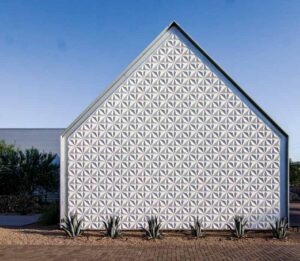
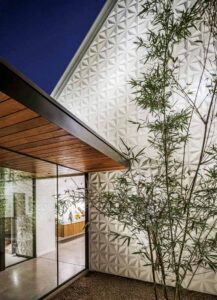
All the cladding on the home is designed as a rainscreen. Corrugated metal is used as a low-maintenance, long-lasting roofing material, seamlessly transitioning into the wall cladding. The 3D panels (a nod to the homeowner’s passion for quilting and sewing) and small amounts of wood accents are also designed as rainscreen elements to provide the desired building performance and give the project a variation in material and texture. The 3D panels accentuate each gable end while the wood siding creates a more tactile feel at openings into the home.
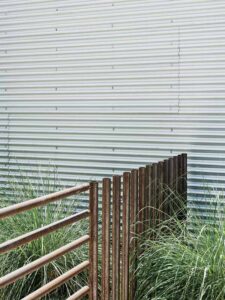
The front of the home features steel cage fences (“gabion” like custom steel baskets). Construction debris found during site excavation is hidden inside the cages in lieu of going to a landfill. Cantilevered steel pipe was used to make the remaining site fencing and gates, and all fencing was left to patina naturally to blend into the landscape.
The home’s skin and roofing are corrugated metal, giving the home a unifying design element, requiring little to no maintenance. This material has a long-life span and can be recycled when the time comes to replace it. Having the main exterior materials require little to no maintenance was extremely important to the owners.
The barn-like form of the two bars was based on the couple’s family background and the agricultural history of the area. The wife worked on her grandparent’s farm in her childhood and her husband’s father and uncles all shared an agricultural heritage in their upbringing. One side of the husband’s family were born and raised in Norway, where there is a rich history of steep-roofed residential and agricultural structures.
The rainscreen wall/roof system has a continuous vented chase from wall sill to roof peak. This chase allows for continuous air flow, exterior insulation, air/water barrier with no thermal bridges, all in one plane. The result, an extremely resilient roof and wall system that will last for years to come.
 [3]
[3]
High-performance education
The neighborhood was originally an agricultural region up until the late 40s and early 50s. A series of canals supplied farmers with the water needed for citrus fields along with cotton and alfalfa. Some of the canals still exist today, one of which, a below-grade piped canal, supplies this property with water through the Salt River Project, a reclaimed water system.
The remaining areas of the site are planted with native, low water use plants. No stormwater, including driveway water, goes to the street. All of it is retained on site providing water for plantings. A gutter system on the south side of the home is set up for future rainwater collection. The system will be designed to store water in rain barrels and be gravity fed for two landscape areas in the backyard.
 [4]
[4]Low flow plumbing fixtures are used including dual flush toilets and all showers are limited to a single fixture, no body sprays, or multiple fixtures. A wireless leak detection system was installed, and the irrigation system is equipped with a rain sensor with the intent of being unused once the landscape is established.
There is no natural gas to the home. The south facing solar panels support general energy use throughout the day and a west facing array helps to counter act afternoon peak demand. A high efficiency heat-pump water heater also helps cool the home. The post tensioned, exposed, concrete slab on grade floors provide for a long life span, limit the use of additional flooring materials/finishes, and were cost effective while providing the desired modern aesthetic.
Designed for discovery, the homeowners are happy to open their home to other architectural clients and has also been part of a local home tour to discuss the goals, successes, and failures along the way.
2 Barns, Phoenix, Ariz.
Owners: Erik and Shelly Koss
Architect: Koss Design LLC
Metal installer: Hahn Roofing
Metal roof/wall panels: Western States Metal Roofing, Phoenix, Ariz.
Project Size: 214.33 livable m2 (2,307 sf) plus 92.9 m2 (1,000 sf) garage
Main Metal: 22.23 mm (0.875 in.) corrugated metal panels in Galvalume
used for roof and siding
- [Image]: https://www.metalarchitecture.com/wp-content/uploads/2023/11/CM_02.jpg
- [Image]: https://www.metalarchitecture.com/wp-content/uploads/2023/11/CM_10.jpg
- [Image]: https://www.metalarchitecture.com/wp-content/uploads/2023/11/CM_21.jpg
- [Image]: https://www.metalarchitecture.com/wp-content/uploads/2023/11/CM_19.jpg
Source URL: https://www.metalarchitecture.com/articles/features/lessons-in-sustainable-design/