Top 5 Factors when Considering Insulated Metal Panels vs. Metal Building Insulation
by hanna_kowal | May 5, 2026 11:02 am
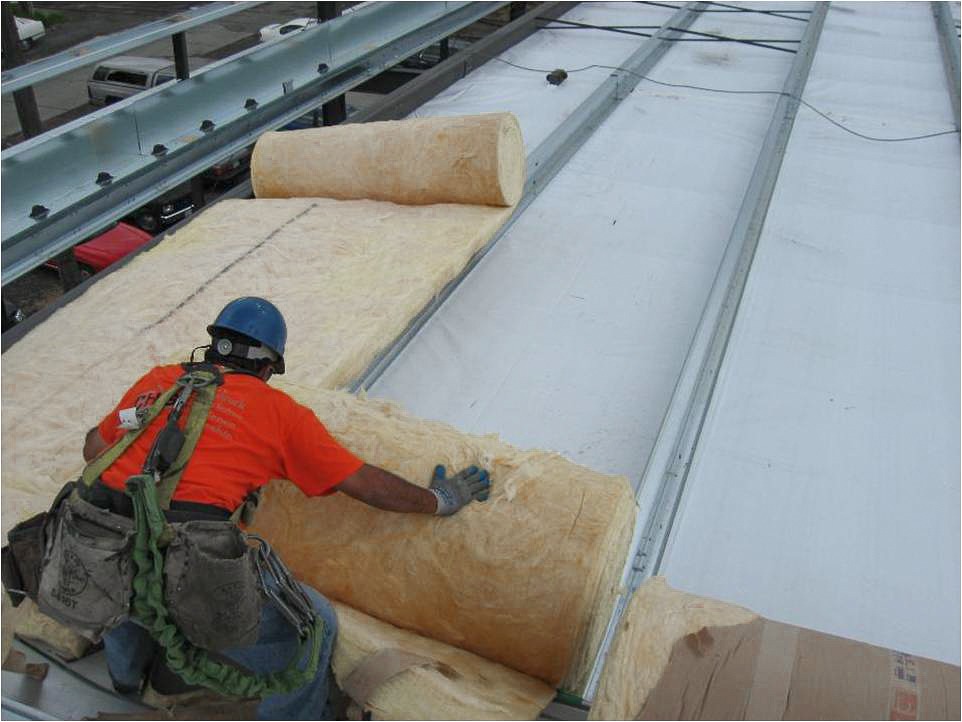 [1]
[1]Trade shows are great forums for getting insights into how the industry is responding to longstanding challenges. In the metal building sector, evolving energy codes are always on the minds of architecture, engineering, design, and construction (AEDC) professionals.
The challenge of how architects and contractors can meet stringent codes came up during a conversation on the 2025 METALCON show floor. As insulated metal panels (IMPs) are widely available, is it still a best practice to rely on a “legacy” insulating material like fiberglass-based metal building insulation?
Like many construction decisions, the choice of insulation is influenced by more than one factor. Taking a systems-level approach that considers energy codes, durability, economics, sustainability, and special requirements can help inform insulating decisions for metal buildings, ranging from agricultural buildings that require condensation control to facilities that prioritize aesthetics.
Here are five considerations for choosing an insulating material for metal construction:
1. The codes
Over the years, the requirements for metal building insulation have evolved from specifying inches of insulation, to prescriptive R-values for single- and double-layer systems, to U-factors providing the overall thermal performance of the installed metal building roof and wall assemblies.
One persistent misconception is that metal building insulation has not kept pace with modern energy codes. In practice, testing tells a different story. Metal building insulation systems meet the requirements of ASHRAE 90.1, including validation through testing. These systems also comply with the U.S. Army Corps of Engineers standards.
Fiberglass-based systems can provide U-factors as low as 0.026 in the roof and 0.039 in the walls. Options include faced systems, long tab banded systems, banded liner systems and hybrid configurations. Extensive hot box testing and modeling confirms that these systems deliver the stringent U-factors required in most current codes and standards.
2. The economics
IMPs are often described as “high performing” on the basis that they deliver a high R-value per inch. However, insulation is a system and fiberglass insulation can be installed at a designated thickness to achieve a specific R-value. In applications where wall thickness is limited or aesthetics are paramount, insulated wall panels may offer an advantage. IMPs require no facing and may make sense where architectural appearance is critical and a pristine, finished interior surface is desired.
The cost of insulation systems can vary widely. Comparing equivalent R-value products, IMPs can cost several times more per square foot than fiberglass insulation systems. The opportunity to meet codes more cost-effectively is a key consideration when selecting insulating materials.
3. The longevity
For building owners, long-term performance is a factor. Key questions to consider include how the insulation will perform after a few years of service, and whether it will retain its R-value. Fiberglass does not lose insulating performance over time, so there won’t be a loss in thermal performance over the life of the building or in cold temperatures, which may be a concern with other insulations.
4. The environment
Commercial and residential buildings consume about 40% of total U.S. energy demand.[2] The energy used to produce fiberglass insulation is saved within the first year of use. Select fiberglass materials carry the GREENGUARD[3] Gold certification for indoor air quality and a Material Health Certification from Cradle to Cradle.
5. The acoustics
As noted, insulation can do much more than deliver thermal performance. In environments near mechanical systems or other noise sources, fiberglass insulation can provide noise-mitigating benefits via its acoustic properties. Noise absorption may result in a pleasurable working environment, potentially improving employee satisfaction.
The takeaway from the METALCON discourse was clear: the question is not which product has the highest R-value per inch, but which insulating system delivers the required performance effectively and supports the economics of the application. Whether the priority is cost, longevity, sustainability, or acoustics, insulation decisions benefit from taking a holistic approach to material selection. In an era of evolving codes and expectations, the smart insulation choice may not be the one with the highest R-value per inch, but the one that checks the most boxes over the life of the building.
Todd Carlson is the Commercial Leader, Metal Building Insulation for Technical Insulation, Owens Corning.
- [Image]: https://www.metalarchitecture.com/wp-content/uploads/2026/05/1-BLS-Roof-Progress-Shot-Showing-FiberglasscourtesyOwensCorning.jpg
- 40% of total U.S. energy demand.: https://www.energycodes.gov/why-building-energy-codes
- GREENGUARD: https://www.ul.com/services/ul-greenguard-certification
Source URL: https://www.metalarchitecture.com/articles/features/metal-panels-vs/