Clearing the Air with Standard
and Acoustical Smoke Vents
by hanna_kowal | June 5, 2026 4:56 pm
 [1]
[1]All structures have unique requirements that depend on their function and environment. When designing for multiple considerations, including noise intrusion and smoke ventilation, metal building systems can support multi-function designs.
In most instances, architects for theater or performance venue construction projects specify acoustical smoke vents to help mitigate exterior noise. In a 2017 project in Sandy, Utah, architects selected 20 acoustical smoke vents for the construction of the Hale Center Theatre, a 12,356.1 m2 (133,000 sf) building with a seating capacity for 1,368 guests.
The Ruth and Nathan Hale Theatre at dōTERRA, a new venue that opened in 2025 in Pleasant Grove, Utah, features two theaters spanning 7,241.8 m2 (77,950 sf). Pleasant Grove, however, does not have the same exterior noise mitigation needs as Sandy. Architects specified three smoke vents, but they were not concerned with the potential for disruptive noise.
“We have utilized acoustical vents on other projects to mitigate noise from flight paths, light rail and transit, and adjacent sound sources, but the site conditions for this project allowed us to select non-acoustical smoke vents comfortably,’’ says Todd Kelsey of Method Studios, the architectural firm for The Ruth. “This afforded some cost savings to the project with some of the other upgraded features that were a priority for the selection of smoke vents.”
Smoke vents are an important component of any commercial space. They assist firefighting efforts by removing heat, smoke, and gases from a burning building. They also promote safe and fast evacuation. While standard and acoustic smoke vents are similar, it is beneficial to understand their differences, the important life- and property-saving properties they offer, and how they have come to play a crucial role in commercial construction.
Tragedy drives code changes
A fire tragedy in Michigan in 1953 led to significant changes in the construction of commercial buildings and the adoption of smoke vents.
The blaze at the General Motors (GM) facility in Livonia, Mich., is considered the worst industrial fire in the United States, resulting in the death of six people. The fire caused $80 million in damage to the building, which spanned more than 139,354.6 m2 (1.5 million sf) across 14 ha (34.5 acres). The nearly new building represented state-of-the-art construction in post-World War II plant design, and more than 4,000 workers were employed across all three shifts at the facility, which manufactured transmissions.
A welder’s torch started the fire, which raced through the structure in minutes. “It was literally raining fire all over the building,’’ says John Stinson, a construction superintendent for GM.
The roof, which lacked smoke vents, partially collapsed before firefighters arrived, rendering the building too hazardous to enter. Workers used fire extinguishers in an attempt to stop the fire, but they were emptied before the blaze was under control.
As a result, new commercial building codes pertaining to fire safety were adopted. “The major change,’’ Stinson says, “was the demand for smoke and heat vents.”
Following the fire, it became a common practice to install automatic smoke vents in large commercial buildings. They are designed to open automatically when excessive heat is detected, releasing smoke and heat from the building. Metal provides several key elements: durability, fire resistance, and sound absorption. The metal frame holds insulation to create an insulated, sound-dampening barrier.
Nixing noise
Architects at Beecher Walker in Holladay, Utah, faced roofing challenges in the construction of the $80 million Hale Center. Besides being positioned directly in the flight path of a nearby airport, the theater is situated adjacent to Interstate 15, where 260,000 vehicles pass by daily.
“The sound issues were pretty intense,” says architect Lyle Beecher. “We knew it was going to be an issue.”
Noise from aircraft, vehicular traffic, and trains can disrupt any theatrical performance. Designing with this key consideration in mind, and specifying accordingly, can support and enhance the overall enjoyment of the structure’s intended use. Acoustical smoke vents are frequently specified for concert halls, school auditoriums, and other performance venues where exterior noise can cause disturbances. The metal material ensures optimal durability, fire resistance, and sound absorption. Further, mineral wool insulation, 101.6 mm (4 in.) thick, inhibits sound transmission. Heavy-gauge steel ensures the vent maintains its shape and functions reliably in the event of a blaze.
“There are also helicopters that fly directly overhead,’’ says Beecher. “The air traffic was one of the primary concerns that we had when we discussed what roofing components we would use. Those acoustic smoke vents are the only thing stopping noise from the outside at the loading level. We could not have any noise infiltrating the building.”
In a project at The Venue at Thunder Valley in California, Gary Martinez, senior principal at OTJ Architects, remembers attending a comedy performance at an amphitheater that had been used prior to the construction of The Venue. “There’s a major train line about 400 or 500 yards [365 or 457 m] away,” says Martinez. “We could hear it coming as it was crossing a street. Horns were blowing, and the comic just went wild. I turned to my colleague and said, ‘We’re going to have to do something about that.’ It wasn’t a huge piece of land, so we had to be conscious of how we addressed that.”
The OTJ Architects team specified six acoustical smoke vents to help mitigate exterior noise. The motorized smoke vents feature an industry-high Outdoor/Indoor Transmission Class (OITC) rating of 46 and a Sound Transmission Class (STC) rating of 50. The OITC figure is the preferred rating when addressing sound insulation from exterior noise, as it rates the transmission of sound between outdoor and indoor spaces.
Ratings for acoustical smoke vents are divided into two categories: STC and OITC. The difference in the ratings is essential for architects, designers, and construction teams to understand.
OITC rates the transmission of sound between outdoor spaces and indoor spaces in a structure. The OITC rating was developed in 1990 and is typically used to measure sound transmission loss (TL) over a frequency range from 80 to 4000 Hz. It is most applicable for measuring the prevention of low-frequency exterior sounds such as automotive traffic, construction, and low-flying airplanes through exterior building surfaces.
“OITC is the preferred rating when addressing sound insulation from exterior noise—especially when transportation noise sources are impacting a building facade with significant low-frequency (bass) sound,” says Harold Merck, principal and acoustician for Merck & Hill Consultants of Atlanta. “While STC ratings may be fine for typical interior noise sources such as voices, STC doesn’t adequately address the extended low-frequency noise contribution of aircraft, traffic, or even large rooftop equipment. This also applies to large rooftop equipment noise sources. The OITC better addresses low-frequency noise impacts and is the more applicable sound rating for roof-mounted automatic smoke vents.”
STC measures the extent to which sound is prevented from being transferred from one area to another. The higher the STC value, the less sound can be transferred through a building product. STC is typically used to measure sound transmission loss over a frequency range of 125 to 4,000 Hz and is most applicable for interior areas that experience mid-to-high frequency noises, such as conversations, television, telephones, and office equipment.
 [2]
[2]Enhanced safety
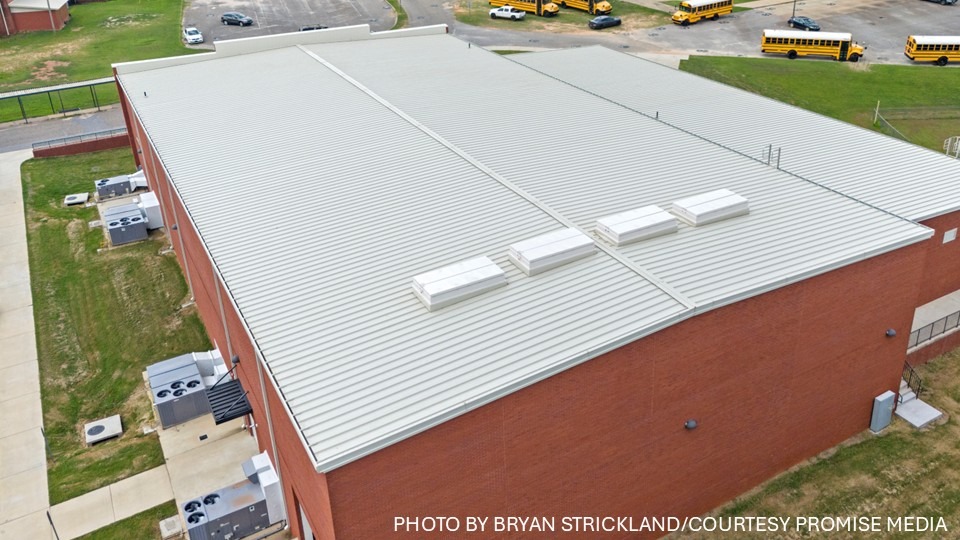
While acoustical smoke vents are often specified for theater projects, The Ruth in Pleasant Grove is largely isolated from unwelcome exterior noise.
Smoke vents are particularly important in large industrial warehouses, which have become increasingly common with the shift toward online shopping. In Texas, McKinney National Business Park encompasses more than 92,903 m2 (1 million sf) of industrial space. The project includes 16 smoke vents. Metal is ideal for smoke vents, as it is
non-combustible, preventing it from catching fire and dripping hot plastic into the building. It also resists cracking, warping, and deterioration from weather and offers better structural rigidity.
Smoke vents are activated upon the melting of a fusible link and are the most economical way to add fire venting in large areas. In a project in North Carolina, plans for a new building for NoDa Brewing included sprinkler activation. Fire protection officials mandated that the design include smoke vents.
In Ohio, Dick Cold Storage was forced to rebuild its facility after a fire destroyed the site. The company built a new structure that included 18 smoke vents. The metal vents were a critical component of the rebuild, as the structure destroyed by fire did not include smoke vents. More than 400 firefighters tackled the blaze, which began on Friday night and was not extinguished until the following day.
“Two of the biggest challenges we face in fighting any fire are heat and smoke,’’ says Steve Martin, Battalion Chief for the Columbus Fire Department. “The heat of the fire radiates on everything surrounding it, causing the flames to spread and causing rapid degradation of structural elements.”
“Buildings that do not lend themselves to ventilation, such as cold storage buildings, are especially dangerous to firefighters,’’ says Martin. “If there is no known life-safety issue, firefighters will retreat to a defensive position and fight the fire from outside the building instead of going inside.”
The previous facility did not have smoke vents, and, similar to the Livonia fire, it was destroyed quickly.
Martin says vents “permit firefighters to see and enter the building, to possibly extinguish the fire early, preventing the entire building from becoming a loss.”
Thermally broken smoke vents are also a material option, an energy-efficient alternative that features an innovative frame and cover design to minimize heat transfer and the effects of condensation.
Thomas Renner writes on building, construction, and other trade industry topics for publications throughout the United States.
This feature originally appeared in the March/April 2026 edition of Metal Architecture, which you can find in our Digital Edition Archives.
- [Image]: https://www.metalarchitecture.com/wp-content/uploads/2026/06/NODA.jpg
- [Image]: https://www.metalarchitecture.com/wp-content/uploads/2026/06/School.jpg
Source URL: https://www.metalarchitecture.com/articles/features/smoke-vents/