Kinetic Facades Rise on University Campuses
by hanna_kowal | March 2, 2026 1:26 pm
 [1]
[1]Photo by Whistler Studios
In the evolving landscape of architecture, designers are increasingly seeking dynamic facades that combine aesthetics with performance. Among the most compelling of these innovations are kinetic metal facades—architectural skins that move with the wind. Unlike conventional cladding, these systems rely on natural forces to animate buildings, providing design functionality, reducing environmental impact, and producing striking visual effects.
Two recent university projects, the Hawkeye Parking Ramp at the University of Iowa and the Wellness + Helfaer Recreation Facility at Marquette University, highlight how kinetic facades are transforming traditionally utilitarian structures into architectural landmarks and inspiring spaces for communities.
The science and art of kinetic facades
Kinetic facades are designed with arrays of small, lightweight metal panels, sometimes referred to as “flappers” or “kinetic elements,” that are mounted to respond to wind currents. As air flows across the surface, the elements rotate back and forth, creating shimmering patterns of movement.
The design intent goes far beyond the visual aesthetic they create. By catching and reflecting light differently throughout the day, kinetic facades elegantly diffuse daylight. They also enable natural ventilation, an essential factor for structures such as parking ramps that require adequate airflow. Since they require no sensors or motorized mechanisms, these facades function as sustainable, low-maintenance systems that harness nature.
Function meets beauty at the University of Iowa
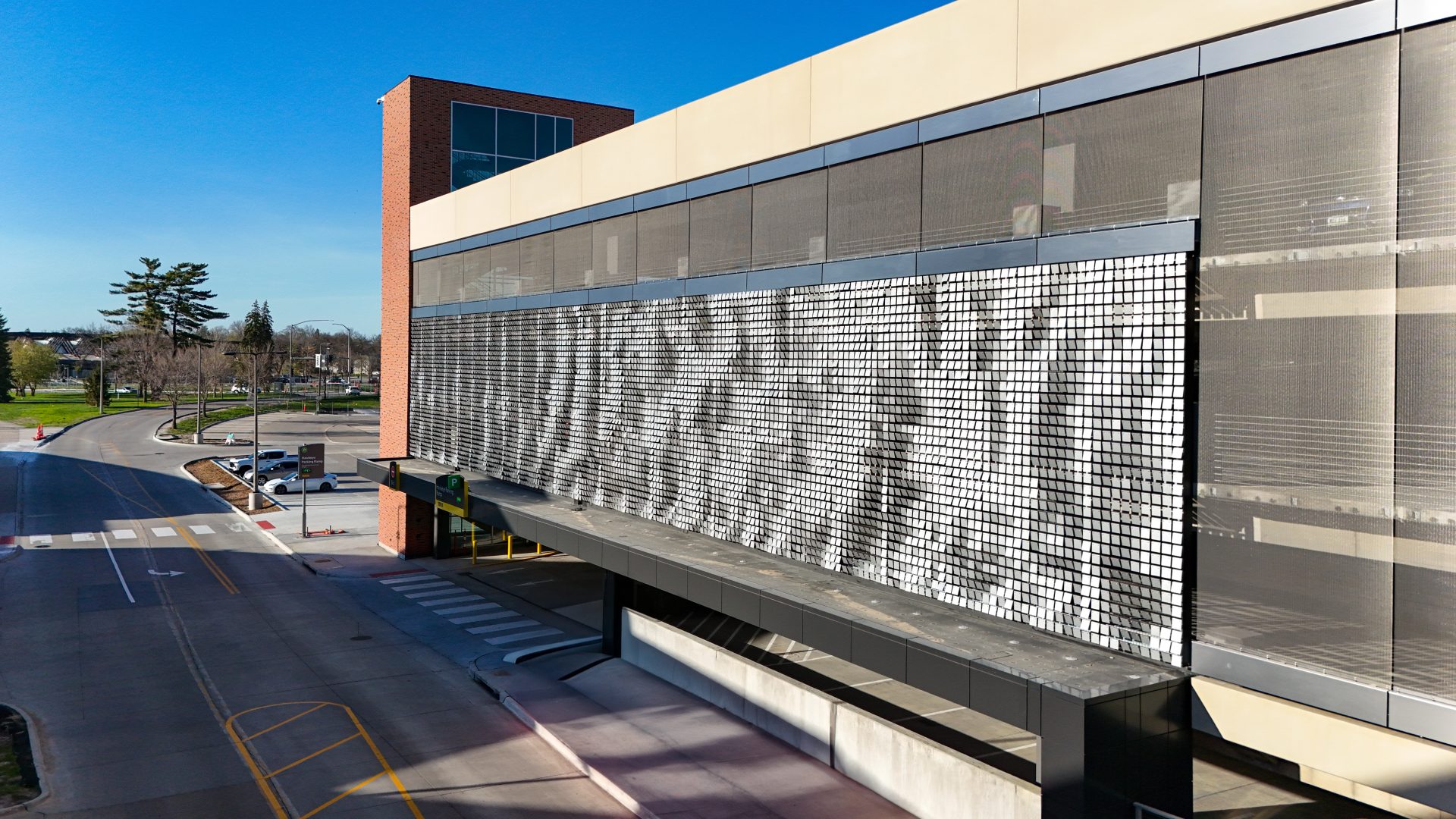
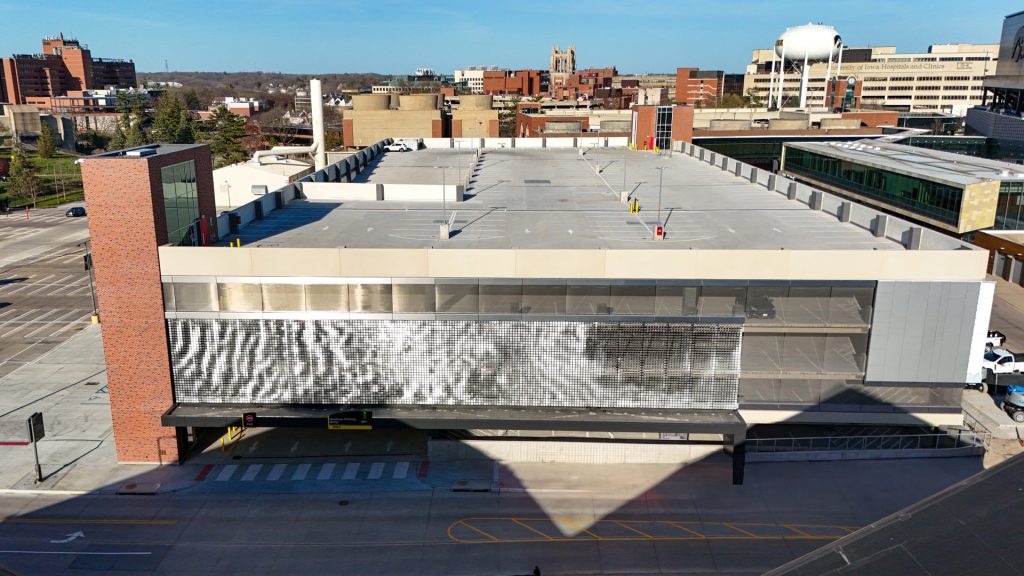
At the University of Iowa, the new Hawkeye Parking Ramp is situated at the heart of the west campus, serving thousands of students, staff, and visitors daily. At first glance, it may appear to be another multilevel garage; however, the building sets itself apart with a kinetic facade that brings movement and life to its exterior.
 [2]
[2]Photo by Whistler Studios
Spanning nearly 278.7 m2 (3,000 sf), the facade incorporates thousands of aluminum elements mounted across prefabricated panels. As wind currents sweep across the building, the surface transforms into silver ripples that both capture the eye and respond to the environment.
Beyond its aesthetic impact, the facade delivers practical benefits. Parking structures require extensive mechanical ventilation, which consumes significant energy. By integrating a semi-transparent, wind-permeable skin, the design team created a natural ventilation solution that reduces reliance on mechanical systems. The reflective properties of the metal elements, combined with a 25.4 mm (1 in.) spacing between flappers, also help bring daylight into the structure, enhancing visibility and safety.
“Achieving natural ventilation is a major challenge in parking design,” says Kevin Smith, president of EXTECH. “The kinetic system meets airflow requirements passively while managing sunlight by reflecting and diffusing natural light, supporting energy efficiency and occupant comfort.”
The result is a garage that operates more sustainably while also contributing to the campus identity. “The semi-transparent, wind-moving facade provided ventilation benefits while also contributing to the visual appeal of the structure,” notes Victor Ritter, architect at Shive-Hattery, who designed the project. The kinetic system underscores how thoughtful design can elevate even the most utilitarian campus facilities into architectural landmarks.
A healing instrument at Marquette University
 [3]
[3]Photo by Ned Kahn
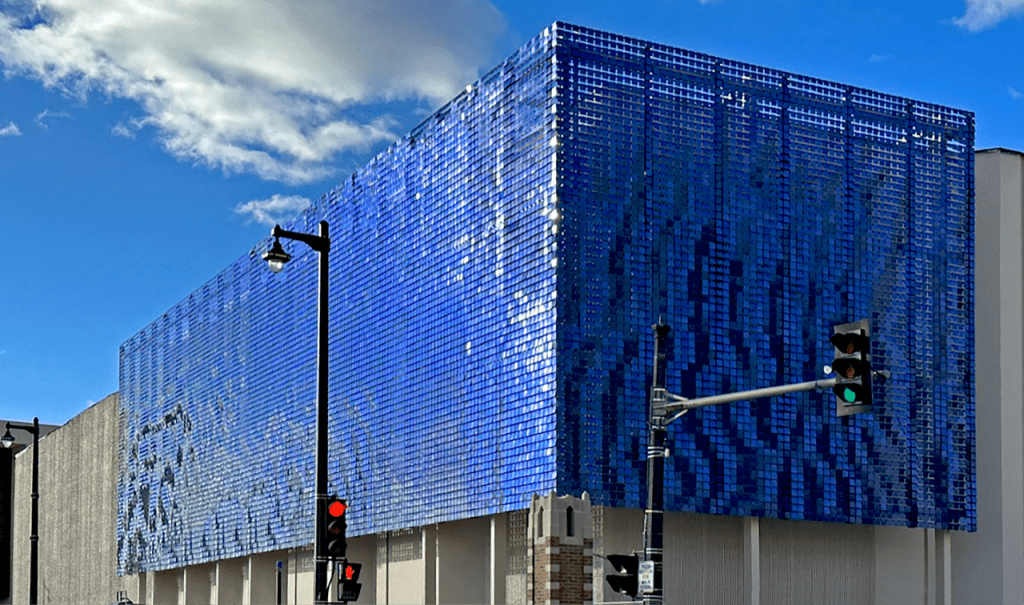
While Iowa’s project demonstrates the functional strengths of kinetic facades, the new Wellness + Helfaer Recreation Facility at Marquette University reveals their potential as a form of environmental art. There, the facade is not just an enclosure but a therapeutic experience.
The design was developed in collaboration with environmental artist Ned Kahn, whose work often explores natural phenomena through interactive installations. For Marquette, Kahn envisioned the entire building as a “healing instrument”: a surface that could reconnect people with the invisible but vital forces of light, air, and motion.
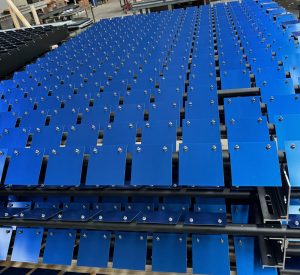
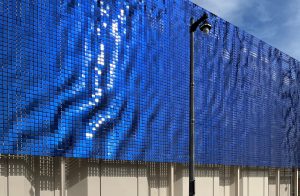
The kinetic facade, covering an area of more than 511 m2 (5,500 sf), consists of thousands of aluminum elements finished in calming shades of blue to evoke the surface of nearby Lake Michigan. As wind moves across the building, the wall ripples like water, mirroring nature’s rhythms and transforming the structure into a constantly changing artwork.
Inside, smaller arrays of kinetic panels echo the same theme, extending the sensory experience into the building’s interior. The movement of light and air, both inside and outside, supports the facility’s mission to foster physical wellness and mental and emotional well-being.
 [4]
[4]Photo courtesy EXTECH/ Exterior Technologies
Kahn described the effect as “visually connecting people to the mysterious and beautiful air that we breathe.” For students, staff, and community members, the facade creates a calming backdrop for recreation, reflection, and healing.
Sustainability in motion
The projects at Iowa and Marquette both demonstrate how wind-activated design strategies can advance sustainability goals in higher education and other project applications. Key benefits include:
- Daylight control: Reflecting and diffusing natural light reduces glare and supports interior illumination.
- Ventilation: Semi-transparent surfaces allow air exchange, particularly important in parking structures.
- Energy efficiency: The design allows natural light during the day, and mechanical ventilation lowers operational energy use.
- Durability: Metal elements are resistant to weathering and require minimal maintenance.
- Wellness: The movement and interplay of light create calming effects that benefit occupants through biophilic design.
Collaboration and craft
Behind these kinetic facades lies a highly coordinated process among architects, engineers, fabricators, and contractors. Precision is essential: each panel must be designed to withstand wind loads, thermal expansion, and long-term wear, while maintaining free movement of the individual flappers.
 [5]
[5]Photo by Ned Kahn
At the University of Iowa, the facade design was realized through close collaboration between Shive-Hattery, Conlon Construction, and glazing contractor Forman Ford Glass & Glazing. At Marquette University, Kahn worked with Workshop Architects and Findorff contractors to ensure the artful vision translated into an exterior that would perform for decades. Both design teams collaborated closely with the manufacturer to create custom facade systems tailored to each project, illustrating the increasingly interdisciplinary nature of design and construction, where artistry, engineering, and sustainability align to deliver transformative results.
A glimpse of the future
As more owners and designers embrace environmentally conscious design, kinetic facades are poised to play a larger role. Their adaptability makes them suitable for a variety of applications, including parking structures, recreation facilities, libraries, student centers, civic buildings, and commercial facilities.
In a design culture increasingly focused on energy efficiency and placemaking, wind-activated facades offer a unique synthesis: they turn ordinary walls into canvases, passive design strategies into public art, and functional enclosures into community landmarks.
The projects at the University of Iowa and Marquette University demonstrate that metal buildings need not be static. They can breathe, shimmer, and respond—inviting viewers to see metal architecture not as a backdrop, but as a living part of the built environment.
Victoria Scanlon is the marketing manager at EXTECH/Exterior Technologies. She leads the company’s communications and began her career at EXTECH in May 2021. Headquartered in Pittsburgh, Pa., EXTECH manufactures and designs wall, window, skylight, canopy, and custom facade systems. Her experience spans over 11 years in the manufacturing industry, encompassing various creative and marketing roles. She graduated from PennWest University with a bachelor’s degree in journalism and business.
- [Image]: https://www.metalarchitecture.com/wp-content/uploads/2026/02/EXTECHUniversity-of-Iowa-HawkeyeParkingRamp2.jpg
- [Image]: https://www.metalarchitecture.com/wp-content/uploads/2026/02/EXTECH-University-of-Iowa-HawkeyeParkingRamp1.jpg
- [Image]: https://www.metalarchitecture.com/wp-content/uploads/2026/02/EXTECH-Marquette-Wellness-and-Helfaer-Recreation-Facility.png
- [Image]: https://www.metalarchitecture.com/wp-content/uploads/2026/02/Marquette-Kinetic-Flapper-Production.jpg
- [Image]: https://www.metalarchitecture.com/wp-content/uploads/2026/02/EXTECH-Marquette-Breathing-Lake.jpg
Source URL: https://www.metalarchitecture.com/articles/kinetic-facades-school/