Metal Ceiling Considerations
by hanna_kowal | September 30, 2025 9:01 am
 [1]
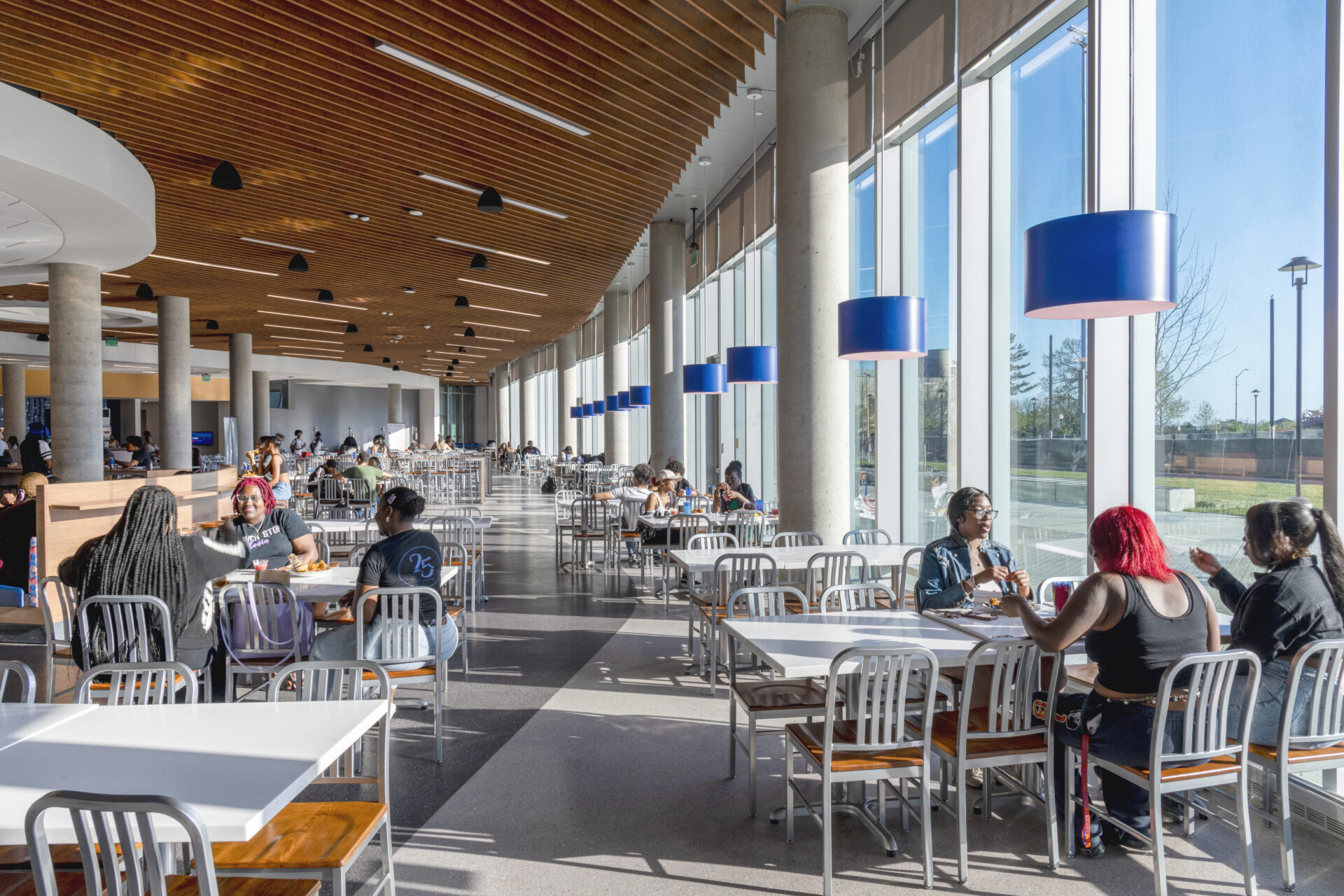
[1]Metal ceilings in educational spaces serve more than a utilitarian, concealing function; they enhance facilities’ appearance with dramatic, decorative, and distinctive designs. They also meet rigorous performance requirements for acoustics, safety, and sustainability. These ceilings contribute to students’ and faculty’s comfort and well-being, support operational efficiency and low-maintenance reliability, and bolster long-term value for public and private universities, college campuses,
and schools.
Metal panel and plank ceiling systems
Learning facilities often showcase metal ceiling designs with a square or rectangular panel composition in a metal suspension grid system. A variety of panel systems exist depending on desired final aesthetics and functional needs of the maintenance teams.
Concealed systems, such as torsion spring metal panels, hide the suspension grid system, creating a monolithic look. Torsion spring panels are ideal for frequently accessed plenum areas, allowing maintenance staff access without taking the panel completely out. Due to the strong connection to the grid, this system can be effective in areas concerned with seismic activity and exterior areas.
With exposed metal panel systems, the suspension grid is visible and accentuated as part of the overall ceiling design. These panels install much like traditional acoustical ceilings, utilizing the same type of ceiling grid. These panels may have square edge details, which sit on top of the suspension grid or reveal edge details, which allow the panel to sit recessed below the grid, creating a shadow effect on the grid profile itself. Grid is available in a wide array of aesthetics, including traditional 24 mm (0.94 in.) exposed face; a sleek, narrow 14 mm (0.56 in.) exposed face, bolt-slot visuals, or double reveal designer grids. These lay-in panels may be produced as three-dimensional with deep straight, sloped, or diagonal profiles.
Solid or perforated panels can be an aesthetic decision, but acoustic performance usually is the key factor. Solid panels with no perforations offer no acoustical absorption and reflect sound. A perforated panel with an encapsulated fiberglass pad can provide high sound absorption with a noise reduction coefficient of up to 0.90 NRC.
In addition to traditional 610 x 610 mm and 610 x 1,219 mm (2 x 2 ft and 2 x 4 ft) sizes, metal panels are available in plank sizes and large formats. Ideal for large common areas, corridors, and connecting spaces, and as design features in faculty and staff offices, planks can be formed into custom shapes and can be manufactured as solid or with perforations.
Linear metal ceiling systems
 [2]
[2]Photo courtesy GPD Group and Rockfon
Defined by their long, flat appearance, linear metal ceiling systems are found in cafeterias, libraries, hallways, and other connecting and communal spaces. The width is a subjective choice, and the length is the focal point. The spacing between the linear panels may be determined by numerous factors, balancing both form and function. If the space between the panels is closed, consider whether the “filler” should be integral to the panel or installed as an applied accessory.
As with metal panel ceiling systems, linear metal systems can include perforations and insulation for acoustical absorption, and are available in myriad sizes, materials, and finishes. They may be used inside or outside and can extend from the interior through to the exterior soffits. Many designers like the continuity this provides, particularly in transparent buildings with large glass openings and lobbies.
Open plenum ceiling systems
 [3]
[3]Photo ©Anne Chan, Hord Coplan Macht; courtesy Rockfon
Linear metal ceiling systems can be used to create open-plenum systems. As the name suggests, an open plenum refers to an application where the occupied space is not separated from the space above by a continuous ceiling.
Other open plenum systems include beam assemblies, which use deep sections to create large, open modules. These systems allow air circulation and flexible placement of light fixtures and other features. They are effective in defining a ceiling plane without a solid ceiling, and letting equipment and furniture define the space.
A subset of beam systems, open-cell systems offer an effective way to add a design element to open areas. These systems are standard grid, painted 360 degrees. This system can be used as standalone ceilings or with heavily perforated panels and wire/mesh panels. Steel- or aluminum-cell ceilings and metal panels can be mixed for visual interest, and a wide range of finishes can be specified.
Ceiling baffle systems are used to mask the plenum with a linear design element. Metal baffles offer a dynamic focal point, presenting a different look when viewed from different angles.
Curves and trim
 [4]
[4]Photo ©Seamus Payne Commercial Photography, courtesy Rockfon
Metal ceiling panels typically are flat but can be curved and accommodated with specialized suspension systems. Curved systems are categorized as one- or two-directional and concealed curved systems. A two-directional system refers to a ceiling system that uses exposed curved main tees and cross-tees. A one-directional system uses exposed curved main tees, and concealed systems hide the suspension from view. Each curved system forms undulating “ribbons.”
Custom-designed systems can be used as ornamentation to create a change of elevation in ceilings or to add drama. Trim systems can incorporate metal panel ceilings, acoustical ceilings, drywall, and open-plenum designs, even those with beam systems.
Color and finish
 [5]
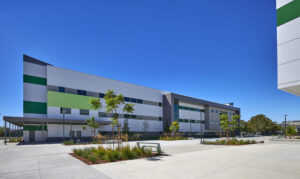
[5]Enhancing the ceiling’s aesthetic qualities, metal ceilings are available in a nearly endless color palette. This includes the manufacturer’s standard color range, RAL colors, or matching the color to an existing carpet, flooring, or wall. Metal ceilings are frequently used to match branded colors, creating a ceiling that showcases school pride.
Metallic, anodized, and wood-look finishes are available to further elevate the finished ceiling. Wood-look finishes on metal provide the aesthetic of natural wood in a durable, low-maintenance material. Matching the finished panels with trims, suspension grids, and accessory items complete the desired effect.
Successful metal ceiling designs take close coordination between the architect, manufacturer, and installing contractor. Blending multiple systems and finishes, the team can create one-of-a-kind spaces fitting the school colors, brand standards, and style, while working within the timeframe and budget. The earlier the manufacturer is involved in the design discussion, the more easily it can help bring the vision to reality within the project’s scope.
Michael Thill is the senior product manager of metal ceilings at Rockfon North America, Chicago. For more information, visit www.rockfon.com.
- [Image]: https://www.metalarchitecture.com/wp-content/uploads/2025/09/Rockfon_MD-MorganStateU-MarshallHall_©AnneChan-HordCoplanMacht_48.jpg
- [Image]: https://www.metalarchitecture.com/wp-content/uploads/2025/09/Rockfon_TX-GWHarbyJrHigh_GPDGroup2.jpeg
- [Image]: https://www.metalarchitecture.com/wp-content/uploads/2025/09/Rockfon_MD-MorganStateU-MarshallHall_©AnneChan-HordCoplanMacht_47.jpg
- [Image]: https://www.metalarchitecture.com/wp-content/uploads/2025/09/Rockfon_FL-SPHSchool_SeamusPayne3.jpg
- [Image]: https://www.metalarchitecture.com/wp-content/uploads/2025/09/3CA-EmeraldHS_NWArchitecturalPhotography-DaleLang.jpg
Source URL: https://www.metalarchitecture.com/articles/metal-ceiling-considerations/