Reducing Emissions Through Material Selection
by Stacy Rinella | January 18, 2024 7:00 am
 [1]
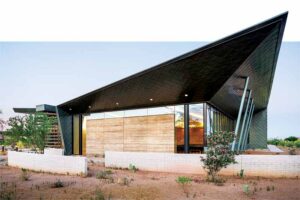
[1]the structure.
Photos courtesy Kyle Zirkus
In the heart of the Sonoran Desert, where the TSG Foundation’s Center for Spiritual Development now stands as a testament to thoughtful design and construction, the choice of materials go beyond aesthetics. The team behind this Scottsdale, Ariz. project included the architectural firm Orcutt | Winslow and design-build firm 180 Degrees Design + Build.
A commitment to sustainability extends to every facet of the structure. Central to this commitment is the use of zinc cladding, specifically tailored to not only withstand the desert’s harsh conditions but also to contribute significantly to the reduction of carbon emissions.
A sustainable design choice
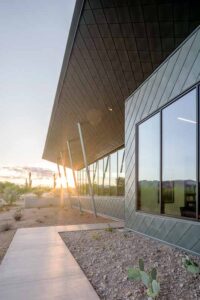
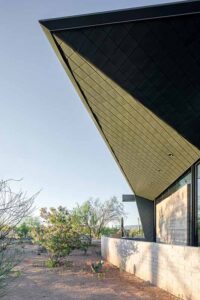
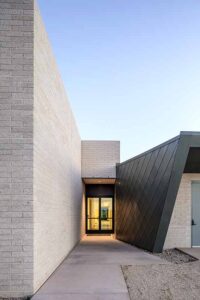
The exterior of the TSG building uses RHEINZINK diamond-shaped zinc tiles, drawing inspiration from the region’s native rattlesnake, blending seamlessly with the desert landscape. However, the decision to use zinc extends beyond its visual appeal. As Charles “Chip” McGowan, president of RHEINZINK America, Inc., emphasizes, “Today, architectural zinc can be manufactured with energy-efficient, low-carbon processes, validated with product-specific documentation. Installed as roofing, wall cladding, and other building products, architectural zinc supports climate-resilient, low-maintenance performance, and occupants’ safety and health.
Infinitely recyclable, zinc continues to add value beyond the life of the building.”
These material aspects were echoed by the Ashley Mulhall, AIA, LEED AP BD+C, WELL AP, EDAC, LFA, the lead architect of the project, who stated, “The matte zinc panels at TSG were selected because they take on the character of the ever-changing desert light and color throughout the day, giving the building true character of place. They are low to no maintenance, and will become more beautiful as they age. At the building’s end of life, the zinc panels can be disassembled, reinstalled, and given a new life, contributing to a circular architectural economy.”
 [2]
[2]Understanding the carbon footprint
As global attention increasingly focuses on reducing carbon emissions, the construction industry plays a pivotal role in addressing climate change. According to a statement by the American Institute of Architects (AIA), “Since the built environment creates a staggering 40 percent of the world’s emissions, architects, engineers, and owners play a key role.”
The term “carbon footprint” encompasses the total amount of greenhouse gases emitted directly or indirectly by a person, organization, event, or product. In construction, the carbon footprint is categorized into three scopes:
Scope 1: Direct emissions from fuel consumption, including transportation, equipment operation, and facility operation.
Scope 2: Indirect emissions from purchased energy for electricity, heating, and cooling.
Scope 3: Indirect emissions from activities not covered in Scope 1 or 2, such as waste generation and end-of-life treatment of products.
Industry professionals are now tasked with evaluating and selecting materials that contribute to lowering carbon emissions across all three scopes. For roofing and wall cladding, architectural zinc emerges as a powerful ally in this effort.
 [3]
[3]and minimizing maintenance needs.
The role of zinc in carbon reduction
Low-carbon architectural zinc can be part of the solution to achieving carbon neutrality and to supporting building projects’ sustainability goals such as achieving net-zero energy, Living Building Challenge, LEED, and other green building programs’ criteria.
Architectural zinc is a natural and abundant metal manufactured into exceptionally resilient, sustainable, and aesthetically appealing building materials. According to the International Zinc Association (IZA), zinc is the 24th most abundant element in the Earth’s crust and the fourth most used metal in the world.
The carbon footprint of zinc production is notably lower than many other metals due to its relatively low melting point. A recent study indicates 65 percent of zinc production’s carbon footprint is attributed to smelting. Selecting zinc manufacturers committed to minimizing their carbon footprint becomes crucial in achieving overall greenhouse gas reduction goals.
Carbon-reduced, high-quality
zinc production
Architectural zinc, used in projects like the TSG building, undergoes a meticulous production process. Special high-grade (SHG) zinc, composed of 99.995 percent pure zinc alloyed with minute quantities of copper, titanium, and aluminum, is used to create sheets with the necessary strength while maintaining ease of shaping.
Installation and longevity
of architectural zinc
Architectural zinc, offers versatility in applications ranging from wall cladding to various roofing structures. Its lightweight nature reduces structural loads, contributing to the overall sustainability of a building.
The unique self-healing properties of zinc, as it forms a patina over time, add to its appeal. The patina not only provides a dynamic aesthetic but also protects the material, ensuring longevity and minimal maintenance requirements. In regions facing diverse climate challenges, such as marine environments susceptible to wildfires, zinc offers a non-combustible, non-corrosive solution. As a waterproof building material, zinc’s runoff is minimal, non-staining and non-toxic. Further, when installed properly, zinc cladding systems will resist air and water infiltration. For regions with high winds and hurricane conditions, zinc systems have been tested to withstand high winds as required by codes and local jurisdictions.
“The zinc installation team worked tirelessly on layout in advance of starting the installation. Since the zinc was installed on vertical and horizontal wall planes as well as the underside of the cantilevered soffits, the geometry was very complex in tying non-coplanar surfaces together. Extensive digital and physical mock-ups allowed the design and construction team to refine the “intersections” before the actual installation took place,” explains James Trahan, AIA principal of 180 Degrees Design + Build.
 [4]
[4]Zinc’s sustainable life cycle:
A cradle-to-cradle approach
Zinc’s sustainability extends beyond the construction phase. Unlike asphalt shingles, which contribute significantly to construction and demolition debris, zinc is 100 percent recyclable. The recycling process retains the material’s original quality, adhering to the cradle-to-cradle (C2C) principle. This approach emphasizes upcycling, converting materials and their residual materials back into new products without any loss of quality.
Asphalt shingles, with a lifespan of approximately 20 years, end up in landfills, with more than 90 percent contributing to environmental harm. In contrast, zinc, with a lifespan of 100 years or more, not only minimizes the need for replacements but also offers a sustainable solution for rainwater collection and harvesting systems.
Today’s projects shape the future building lifecycles
The global conversation on climate change has led to international agreements and national commitments. For example, AIA has established a “2030 Commitment” that asks architectural firms throughout the United States to create and commit to a sustainability action plan that will support the goal of reaching zero net emissions in the build environment by 2030. Currently, more than 1,100 architectural firms in the United States have made this commitment.
As the urgency for climate action intensifies, industry professionals find themselves at the forefront of sustainable design. The projects they design and specify today will shape the operational lifecycles of buildings well into the future. The call to action is clear—select materials that align with sustainability goals, and architectural zinc is an example of a versatile building material that can assist with the goals of moving toward a more sustainable future.
In the pursuit of a sustainable tomorrow, architectural zinc emerges not just as a material choice but as a commitment to a circular economy, where resources are continually reused and recycled without compromising quality. The TSG building stands as a testament to the power of thoughtful material selection in achieving a harmonious blend of aesthetics, functionality, and environmental responsibility.
Justin Stephenson is the marketing director of 180 Degrees Design + Build, an award-winning architectural and construction firm based in Phoenix, Ariz. He specializes in elevating the firm’s projects through strategic marketing initiatives.
- [Image]: https://www.metalarchitecture.com/wp-content/uploads/2024/01/TSG-Foundation-19-1.jpg
- [Image]: https://www.metalarchitecture.com/wp-content/uploads/2024/01/TSG-Foundation-2.jpg
- [Image]: https://www.metalarchitecture.com/wp-content/uploads/2024/01/TSG-Foundation-21.jpg
- [Image]: https://www.metalarchitecture.com/wp-content/uploads/2024/01/TSG-Foundation-15.jpg
Source URL: https://www.metalarchitecture.com/articles/reducing-emissions-through-material-selection/