Best Practices for Coatings in Resilient Metal Architecture
by hanna_kowal | December 1, 2025 4:29 pm
 [1]
[1]Photo by Alan Karchmer
Metal is a cornerstone of modern architecture. Few buildings are as durable, versatile, and aesthetically pleasing as expertly designed metal buildings. However, metal’s creative and architectural potential is often diminished by a persistent challenge: short-term, cost-driven decision-making.
Developers and their customers are understandably focused on upfront construction costs. As one architectural design firm shares[2], the most common question they hear from clients is “How much longer will it take, and how much more will it cost?” Consequently, developers are incentivized to control costs and mitigate expenses as much as possible.
Blowing the budget is not the goal, but developers often focus solely on upfront costs, neglecting long-term expenses. According to one analysis, these expenses can equal 1.5 to 2 times[3] the initial construction price tag over the building’s lifespan. Practically, this means that metal specifications are commonly value-engineered to save a fraction of the cost upfront, leading to significant hidden expenses in future maintenance, energy loss, and premature replacements. Simply put, developers are trading short-term gain for long-term financial pain.
As engineers, architects, and building owners make plans for future designs, resilient design, a design philosophy that protects the architect’s vision and the owner’s investment, offers a more sustainable and profitable approach to building design.
The following best practices for stakeholders ensure that metal designs are built as intended and endure as envisioned.
Prioritize lifecycle value over first cost
The first step is a paradigm shift in how we evaluate cost. Instead of asking only “How much does it cost?”, the more critical question is “What is the lifecycle cost of this component?” For metal architecture, this often means making strategic decisions about the coating, which is the first line of defense against the elements and the primary expression of the design’s aesthetic.
Low-performance coatings save money initially, but these savings are quickly erased by costs associated with fading, chalking, staining, and other degradations on a metal facade, such as corrosion. It may save money on day one, but there are significant costs associated with repainting or replacement costs. Meanwhile, high-performance coatings, such as polyvinylidene fluoride (PVDF)-based coatings, add upfront expense but reduce or even eliminate costly recoats/replacement later in the building’s life.
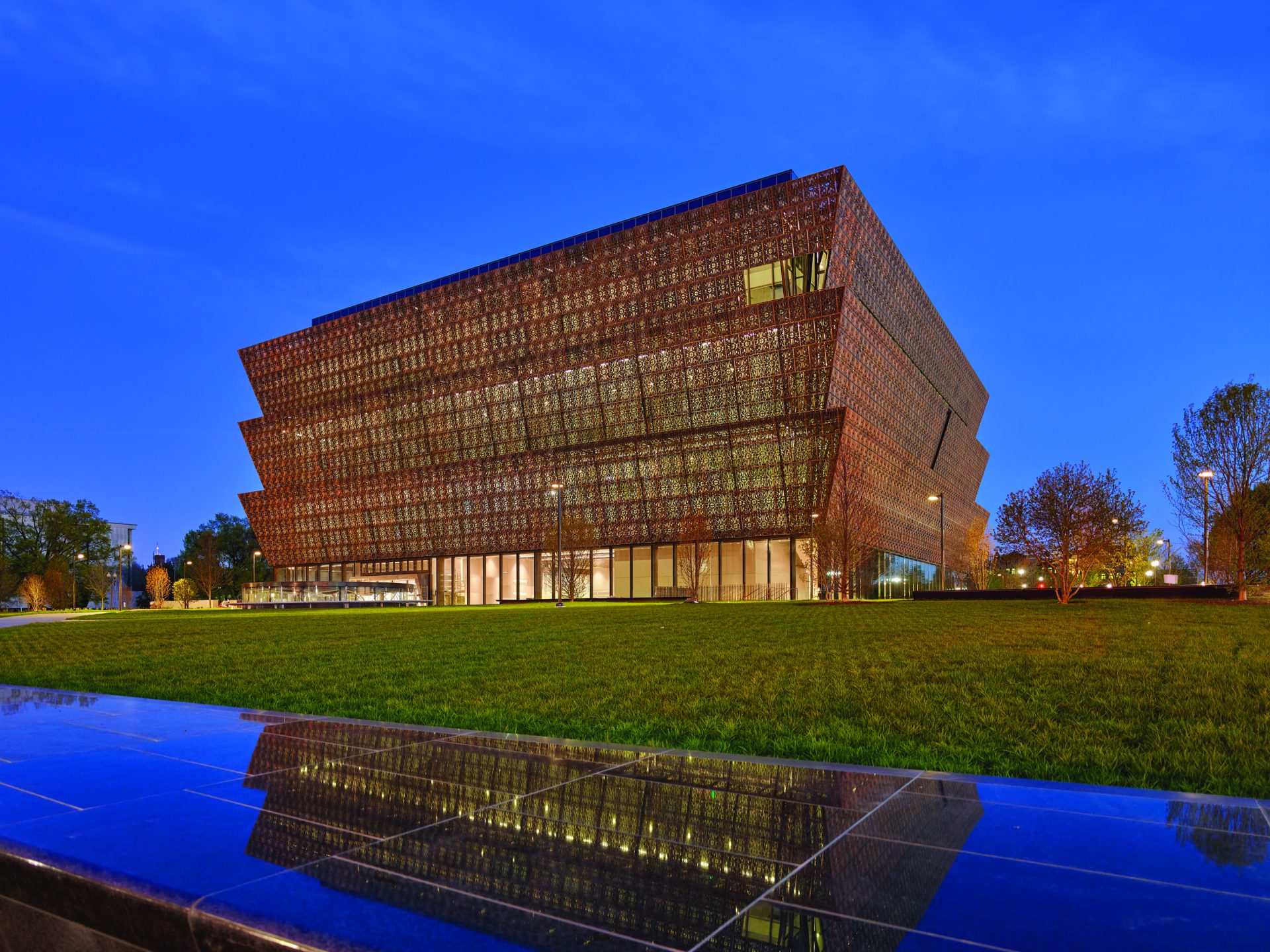
High-performance coatings are an investment similar to saving for retirement: they require more capital upfront but pay significant dividends over the long term in color stability, durability, and brand reputation. For instance, when the Smithsonian National Museum of African American History and Culture (NMAAHC) designed its building in Washington, D.C, adjacent to the Washington Monument, the team had to account for the building’s signature architectural feature: the “corona,” a three-tiered bronze-colored filigree envelope that wraps the structure.
Rather than just paint the metal facade, the design team used a high-performance 70 percent PVDF coating with a resin to ensure durability and color retention, which will continue to showcase the vivid color for many years.
Scrutinize performance to preserve design intent
Aesthetics and performance are not distinct in metal architecture. They are intertwined and interconnected.
The color and gloss specified in design software must withstand the real-world conditions, including constant UV radiation, humidity, salt spray, and pollutants. Resilient design demands that materials be selected based on their proven ability to withstand these factors over time.
Architects can ask three critical questions to scrutinize performance and preserve design intent:
- What is the coating’s real-world track record in a similar climate?
- What are the 20- or 30-year or even 40-year warranty terms for color fade and chalk resistance?
- How does the material’s performance contribute to the building’s long-term efficiency and value?
Ultimately, achieving long-term value is predicated on materials’ proven ability to perform as intended over time.
Connect durability to sustainability and legacy
 [4]
[4]Photo by Alan Karchmer
Making the most of a metal design means selling a vision to the client, which helps convey its long-term value. In 2026 and beyond, sustainability is no longer an altruistic add-on. It is a central component of value creation.
The equation is simple: the most cost-effective metal design is the one that does not need to be replaced.
Resilient design ensures building projects continue to perform, protect, and inspire long after the construction crews have gone home. It is a commitment to building long-term value for the client, the community, and the individual firm’s reputation.
Building for today and tomorrow
Metal is a high-quality and aesthetically pleasing material with tremendous merit and value. A short-sighted focus can also compromise it on first costs that prioritize short-term savings, which often leads to a future burdened by unforeseen expenses, compromised aesthetics, and premature failures. Resilient design promises a better path forward.
To preserve build quality, maximize aesthetic appeal, and control long-term costs, it is essential to prioritize a component’s entire lifecycle value over its initial price tag, rigorously scrutinize material performance to ensure it can withstand the tests of time and environment, and connect the concept of durability directly to the growing demands for sustainability.
Paul Lavallee serves as the Global Market Manager of Kynar PVDF Coatings, with responsibility for the Kynar 500[5] and Kynar Aquatec[6] PVDF [7]product lines globally. Paul has worked for Arkema[8] for 27 years in various engineering, manufacturing, research, supply chain, and business roles. He holds a B.S. in Chemical Engineering from Rensselaer Polytechnic Institute and an Executive Certificate in Business Administration from the University of Notre Dame. He is based in Radnor, Pa.
- [Image]: https://www.metalarchitecture.com/wp-content/uploads/2025/12/Case-Study-Photos-to-use2016AK11_222.jpg
- architectural design firm shares: https://sheadesign.com/costs-of-building-today-the-strategies-to-manage-it-upfront/
- expenses can equal 1.5 to 2 times: https://www.spmassets.com/news/what-are-the-building-lifecycle-costs-of-a-new-building
- [Image]: https://www.metalarchitecture.com/wp-content/uploads/2025/12/Case-Study-Photos-to-use2016AK11_110.jpg
- Kynar 500: https://kynar500.arkema.com/en/
- Kynar Aquatec: https://kynaraquatec.arkema.com/en/
- PVDF : https://kynaraquatec.arkema.com/en/
- Arkema: https://www.arkema.com/
Source URL: https://www.metalarchitecture.com/main-slider/resilient-metal-architecture/