The Sound of Metal Ceilings
by Stacy Rinella | August 26, 2024 7:10 am
 [1]
[1]In a world demanding distinct ceilings that command immediate attention in a space, metal solutions rise to the top among architects, designers, and contractors. This same world also seeks improved indoor environmental quality (IEQ), which is driving demand for ceilings that can reduce noise, improve speech intelligibility, and offer confidential speech privacy. More than just a trend, the modern look and creative versatility of metal ceilings and premium acoustic performance will continue to dominate new construction and renovation decision-making. Often, those in charge of creating these spaces ask if they can achieve the desired acoustical performance with metal ceilings. The answer is a definite yes. Moreover, the available options present exciting opportunities for new design considerations and delivering advantages that clients may not realize exist.
Why metal ceilings?
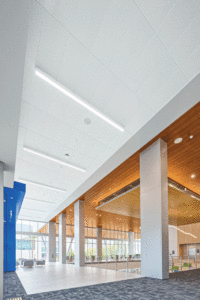
There is more to metal ceilings than meets the eye. However, the “eye” is where many people—from architects and designers to building owners and facility managers—start when choosing metal ceilings over alternatives such as mineral fiber and wood. Sleek, modern, and offering a considerable amount of design flexibility, metal ceiling panels can meet the needs of the space and deliver on highly creative designs. They have also come a long way from the standard square or rectangular metal panels of the past, and today’s various color and finish options—even allowing a natural wood look—are impressive. In addition to traditional panels, metal ceiling products include blades, mesh, and open cells that offer a more open look; 3D options and cloud configurations that add dimension; unique shapes for visual interest, and more.
Beyond aesthetics, metal ceilings offer other important qualities including:
- High durability and resilience
- Ability to be scrubbed and disinfected, supporting today’s rigorous standards for cleaner, healthier spaces
- Large-format capabilities that help create a monolithic look
- Light weight for easier installation
- Configuration possibilities that offer easy access to the plenum
 [2]
[2]Turning non-acoustical metal into an acoustical superstar
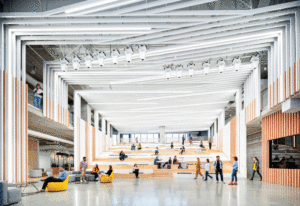
Typically associated with echoes and significant reverberation, metal is rarely thought of as being conducive for quiet spaces. However, this perception is slowly changing, as more buildings are demonstrating they can have amazing metal ceiling aesthetics and achieve the same great acoustics offered by mineral-fiber ceiling panels. A case study of Adobe’s new 18-story North Tower office building illustrates this. The acoustical and design requirements of the building’s “All Hands” room—an open, two-story-high amphitheater space—were successfully met with metal ceiling blades fitted with several sound-absorption solutions.1
At the basic level, measuring ceiling panel acoustics comes down to noise reduction coefficient (NRC) and ceiling attenuation class (CAC). NRC measures how well a ceiling panel absorbs sound. In general, one wants ceiling panels that offer an NRC of 0.70 or higher. CAC measures a ceiling system’s ability to block sound between two enclosed rooms. A minimum CAC of 35 is recommended to reach the level of confidential speech privacy.
Step by step
The first step in creating an acoustical metal ceiling panel is to perforate it by drilling holes. These perforations allow sound to travel through what would otherwise be a metal barrier. Typically, perforations in metal ceiling panels are uniform and evenly spaced, but, if desired, they can be customized and used as an added design element. Their size, shape, and even backlighting can create anything from subtle visual interest to attention-commanding imagery such as skyline depictions.
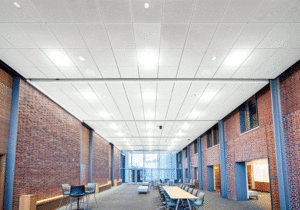
After they are perforated, the panels are backloaded with a sound-absorbent liner, usually in the form of thin, black acoustical fleece, mineral-fiber ceiling panels, and/or a fiberglass infill. In general, when the open percentage of the metal (achieved through perforations) is at least 25 percent, the acoustical absorption of the liner material is preserved. For example, if you meet this 25 percent open area requirement and use acoustical mineral-fiber panels with an NRC of 0.85 and a CAC of 35, you can expect 85 percent of the sound hitting the ceiling to be absorbed, with sound blocking at a level recommended for confidential speech privacy.
 [3]
[3]
These are the three basic categories of perforation levels, with sample applications for each:
- Highly perforated; open area of 25 percent or greater—used in spaces where noise reduction and speech intelligibility are critical, including boutique environments, restaurants and other hospitality spaces, and gymnasiums
- Moderately perforated; open area between two percent and 25 percent—commonly used in office, educational, and healthcare settings
- Minimally perforated; open area less than two percent—used where reflection and diffusion are desired to liven a space (e.g. an auditorium).
While perforations play the largest role in making metal ceiling panels acoustically transparent, other factors determine how much sound gets through to the liner. These include the metal’s thickness and the number, size, shape, and spacing of the perforations.
Getting started
Solutions for acoustical metal ceilings should be part of a comprehensive plan for a space. One should consider how the ceiling may contribute to WELL Building Standard™ goals and LEED® credits. Also analyze the space’s acoustical requirements. How will the space be used? Is speech privacy a priority? What about speech intelligibility? Lastly, partner with a manufacturer that offers personalized customer service in addition to ample metal acoustical ceiling options.
Conclusion
Acoustical metal ceiling solutions support indoor environmental quality (IEQ) for most situations—from mammoth spaces in airport terminals and transportation centers, which need large-format ceilings and intense reverberation control, to corporate offices wanting to convey a modern vision while protecting speech privacy. As demand for such applications increases, embrace both traditional and new options, remembering that metal ceiling panels can deliver on the boldest design intent, without acoustical compromise.
Notes
1 For more information, visit armstrongceilings.com/commercial/en/case-study/office/adobe-north-tower-office-ceiling-design.html
Sean Browne is the senior manager of the research and development group at Armstrong. He is responsible for the company’s codes and standards program and is an active member of the Acoustical Society of America and ASTM International. He has engineering degrees from Florida State University and the University of Miami.
- [Image]: https://www.metalarchitecture.com/wp-content/uploads/2024/08/Adobe_C_RS_MwBlCstm_AdobeNorth_A.gif
- [Image]: https://www.metalarchitecture.com/wp-content/uploads/2024/08/SMSU_C_RS_MwTg_CA-State_FF.gif
- [Image]: https://www.metalarchitecture.com/wp-content/uploads/2024/08/Wesleyan_C_RS_MwAtTs_Wesleyan_D.gif
Source URL: https://www.metalarchitecture.com/articles/the-sound-of-metal-ceilings/