3 new builds, 5 restorations shine
in the 19th annual North American
Copper in Architecture Awards
by hanna_kowal | June 16, 2026 9:15 am
The eight winning entries in the 2026 North American Copper in Architecture Awards (NACIA)[1] uphold the tradition of celebrating copper design and craftsmanship, featuring architectural copper and copper alloy material used in roof, facade, and wall systems, as well as in custom-fabricated elements.
“Overall, the historical restoration portion of the 2026 field was larger, thanks to submissions of many quality government and institutional buildings,” explains Larry Peters, project manager of building construction with the Copper Development Association[2]. “The two corporate headquarters winners represent companies with long and distinguished histories.”
New construction honorees
The Arlington Conservatory[3] in Birmingham, Mich.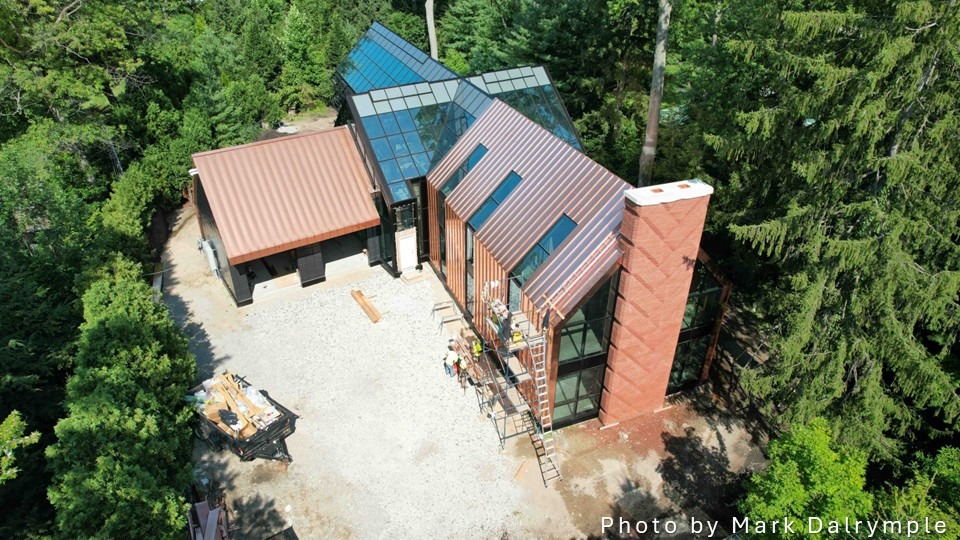 [4]
[4]
Sitting adjacent to the main residence, this project functions as a conservatory, indoor pool house, and compact guest house.
The architectural vision called for a fully copper-clad exterior on the guest house portion and an all-glass envelope for the conservatory portion. Given that the main house features a cedar roof with extensive copper flashing, along with multiple copper standing-seam and flat-lock roof elements, the design team sought to harmonize the new addition by incorporating matching copper characteristics throughout the visible roofing and select wall areas.
Quincy Public Safety Headquarters in Quincy, Mass.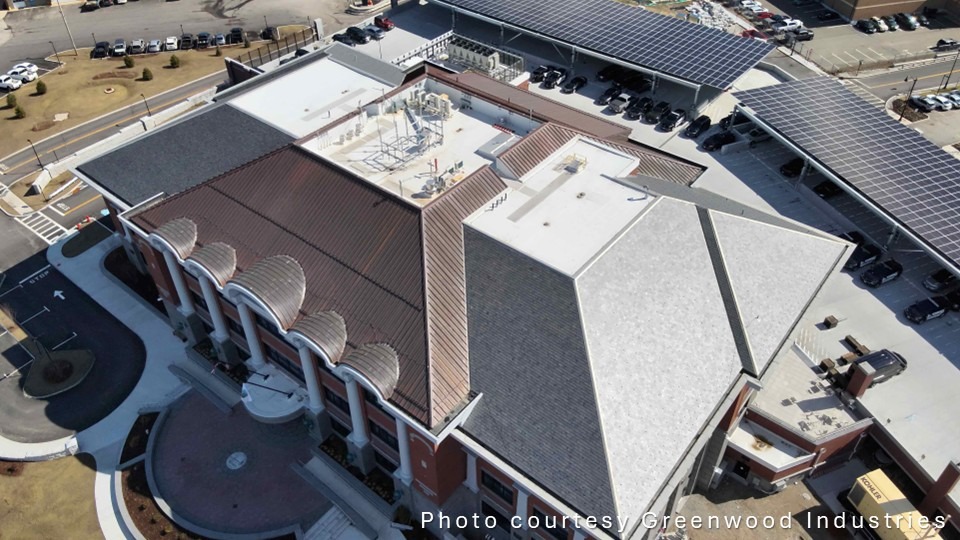 [5]
[5]
This new building houses Quincy’s police, fire, emergency response, and IT departments. Capping off the building envelope is its exterior crown jewel, a 11,196 sf (1,040.1 m²) copper roof.
The roof is divided into front and back sections, each hiding the complex’s mechanical roof from street view. Arched windows provide stunning views over the cemetery across from the building.
In addition to the copper roof system, the building is adorned with copper trim, including a magnificent crest surrounding the roof-mounted mechanical systems and snow guards that protect the areas below from snow and ice buildup.
University of Minnesota Fraser Hall Chemistry Undergraduate Teaching Lab[6] in Minneapolis, Minn.
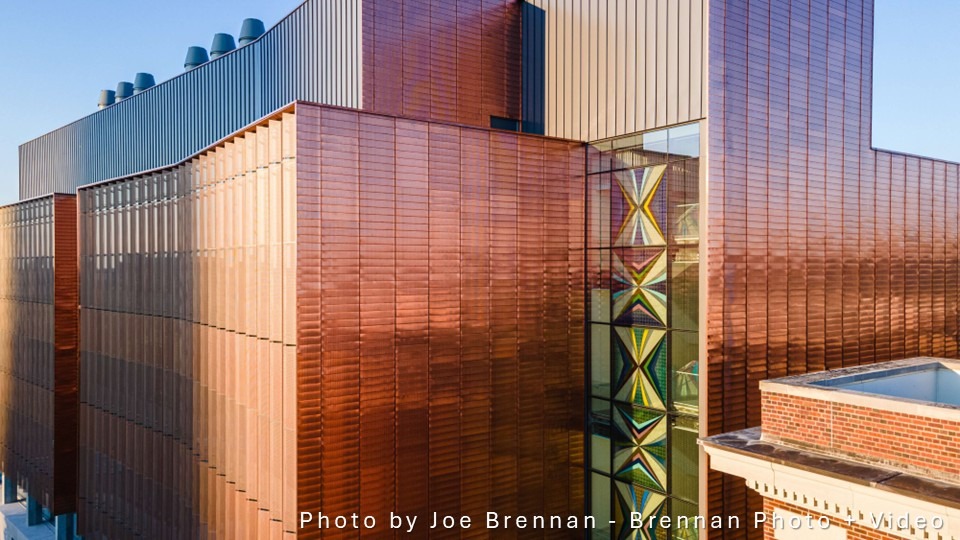 [7]The University of Minnesota Twin Cities recently completed upgrades to its nearly 100-year-old Fraser Hall. This $132-million project consolidated several chemistry disciplines across multiple halls into a single central chemistry building for undergraduate-level courses.
The structure stands out with sweeping views of floor-to-ceiling glass and a shiny new facade, comprising 15,607 sf (1,449.9 m²) of custom-fabricated copper panels with personalized embossing.
Restoration Honorees
Groupe Desgagnés Headquarters[8] in Quebec City, Que.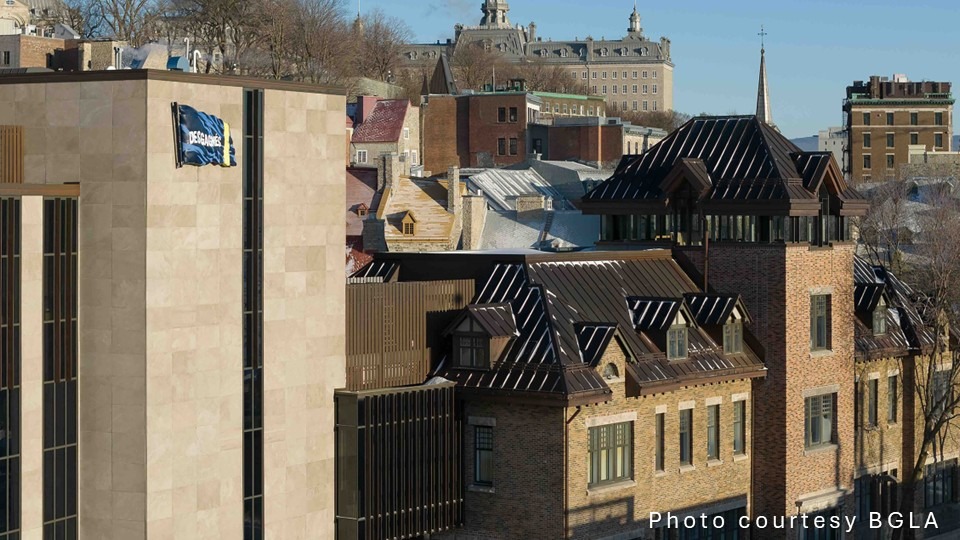 [9]
[9]
Anchored in Quebec City’s Old Port, this project sought to restore clarity and coherence to an ensemble composed of two buildings—one dating from 1911, the other from 1960—linked by a connecting walkway that establishes an architectural dialogue between them.
The 1911 building was given a new copper roof, while its original turret, truncated in the 1970s, was boldly reinstated at the client’s request and reconstructed as part of the project. Clad in copper, the turret once again asserts its distinctive silhouette, enhancing the building’s architectural dignity and re-establishing its presence within the historic urban landscape.
The connected 1960 building’s curtain wall now incorporates refined copper accents, including new fascias and rooftop mechanical screening.
Jacob Riis Park Fieldhouse[10] in Chicago, Ill.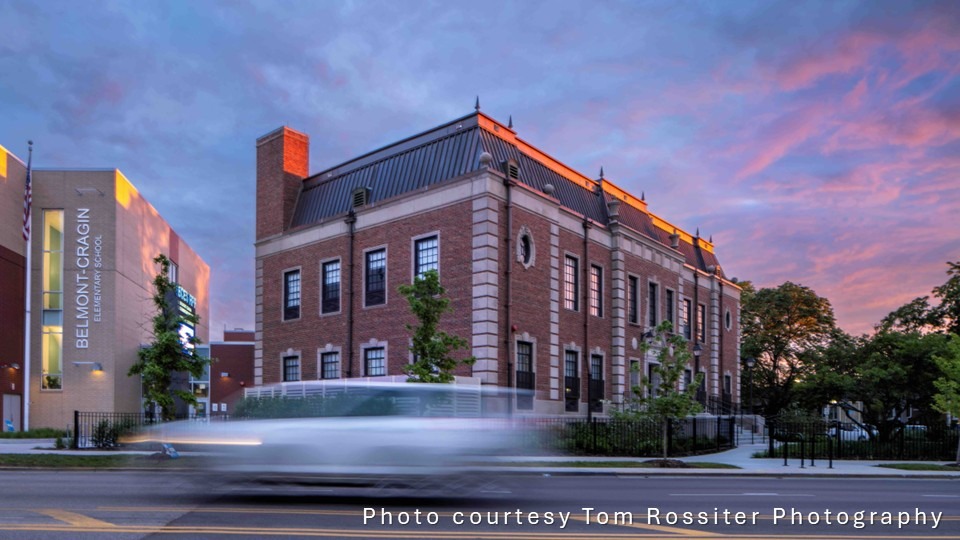 [11]
[11]
Built in the late 1920s, this venue for events, park programming, and recreational activities boasts a distinctive batten seam copper mansard roof. It contributes to the park’s certification on the National Register of Historic Places.
The building was fully renovated from 2023 to 2025, a process that included a complete roof replacement, additional insulation, replacement sheathing as needed, and installation of new copper cladding.
This building’s unique, angled copper mansard roof features an integrated copper drainage and trim system, including gutters, scupper boxes, cleats, coping, and downspouts, all functioning cohesively to shed water downward past the facade and below grade on the tight, corner site.
The Philadelphia Contributionship[12] in Philadelphia, Pa.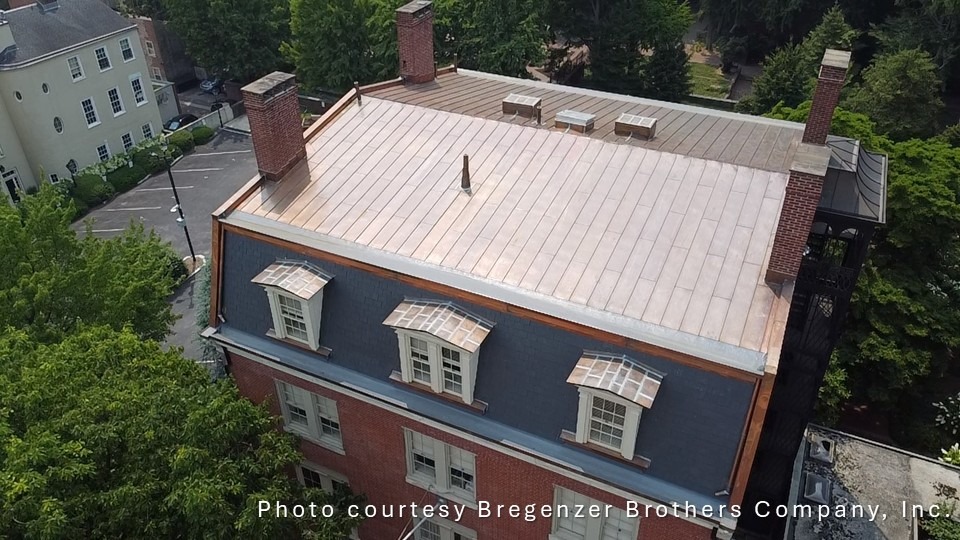 [13]
[13]
Completed in April 2023, this project restored and upgraded the historic facility’s roofing and sheet metal systems. Founded in 1752 by Benjamin Franklin, the Contributionship is the nation’s oldest property insurance company, with its legacy closely tied to advancing fire-resistant construction and preserving the architectural character of Philadelphia.
The project involved installing a new slate and sheet metal, removing existing materials from the main upper roof, and installing new copper standing seam panels, flashing, and a roof vent.
The copper downspouts were replaced and new copper flashings were installed on the slate mansard roofs. At the west mansard, deteriorated fascia and crown molding were replaced with new copper components to restore architectural definition and ensure long-term durability. This thoughtful restoration balances historical integrity with modern performance, extending the life of the building envelope while maintaining its original character.
Smith College Seelye Hall Cupola[14] Restoration in Northampton, Mass.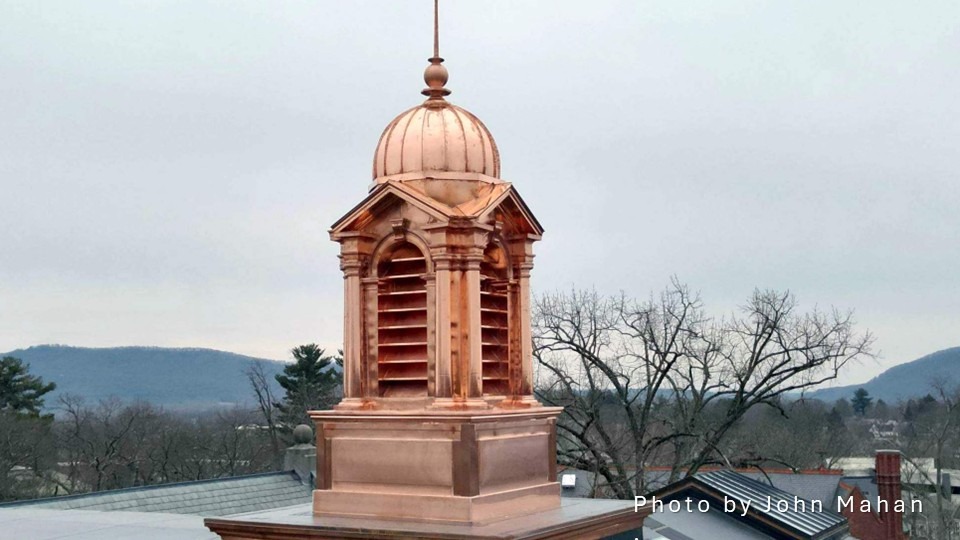 [15]
[15]
For this project, the significant deterioration of the underlying wood substrate made in-place restoration impractical. To properly restore the structure, the entire cupola was carefully removed by crane and transported for restoration. The cupola was strategically redesigned to be reinstalled in three sections—the pedestal, main body, and cap—while maintaining its historic appearance.
Professionals restored the copper cladding over a two-and-a-half-month period, replicating the original detailing through traditional fabrication techniques, ensuring both historical accuracy and long-term durability.
West Memorial Building[16] Rehabilitation in Ottawa, Ont.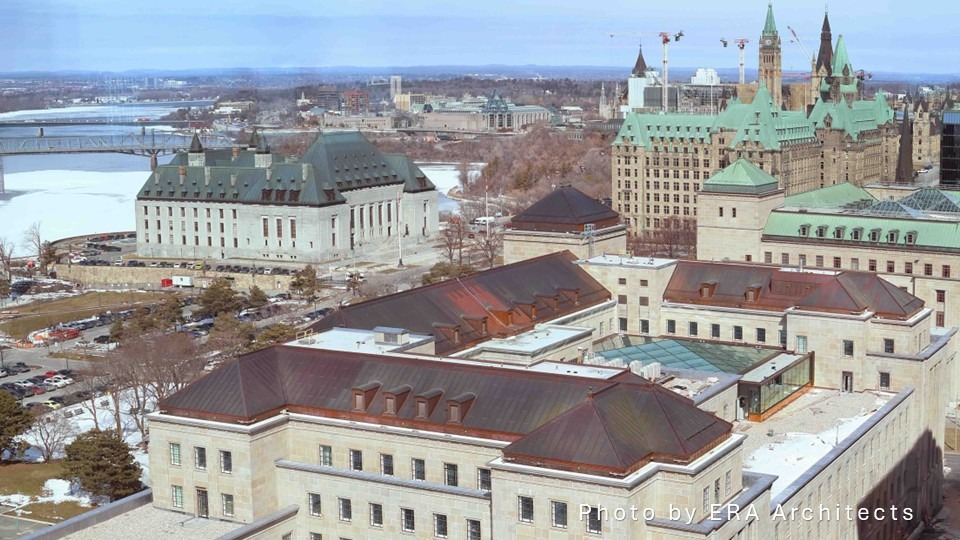 [17]
[17]
As part of a comprehensive rehabilitation and modernization program for this prominent federal heritage landmark, the project prioritized the conservation and renewal of the building envelope while preserving defining heritage elements. Central to this work was the renewal of the building’s copper roofing and associated assemblies, with new sheet copper fabricated and installed using traditional batten seam detailing.
Custom copper flashings, parapet caps, and coping details were crafted to resolve complex roof geometries and transitions, with lead-coated copper used at stone interfaces to ensure long-term material compatibility. Copper finials were carefully replicated from original details, while discreet custom bronze snow guards were incorporated to address snow-retention requirements without detracting from the roof’s historic character.
The dormers were fitted with custom louvers designed to meet ventilation requirements and integrate seamlessly within the building’s architectural language.
“By featuring copper in their structures, these businesses and institutions demonstrate the value of copper, a high-performance, natural building material that bridges the past with the future; maintaining a lasting connection to their communities,” Peters added.
The Copper Development Association[2] is a U.S.-based, not-for-profit association of the global copper industry, bringing together the North American copper and copper alloy semis fabricators and the global copper mining and production industries.
- 2026 North American Copper in Architecture Awards (NACIA): https://copper.org/applications/architecture/awards/
- Copper Development Association: https://copper.org/
- The Arlington Conservatory: https://www.arlingtonhouse.org/Visit/Virtual-Tour/conservatory
- [Image]: https://www.metalarchitecture.com/wp-content/uploads/2026/06/Arlington.jpg
- [Image]: https://www.metalarchitecture.com/wp-content/uploads/2026/06/Quincy.jpg
- University of Minnesota Fraser Hall Chemistry Undergraduate Teaching Lab: https://cse.umn.edu/chem/undergraduate-teaching-laboratory-facility
- [Image]: https://www.metalarchitecture.com/wp-content/uploads/2026/06/fraser.jpg
- Groupe Desgagnés Headquarters: https://desgagnes.com/
- [Image]: https://www.metalarchitecture.com/wp-content/uploads/2026/06/Photo-Resizing-for-WEB-01AC-2.jpg
- Jacob Riis Park Fieldhouse: https://www.chicagoparkdistrict.com/parks-facilities/riis-jacob-park
- [Image]: https://www.metalarchitecture.com/wp-content/uploads/2026/06/riig.jpg
- The Philadelphia Contributionship: https://1752.com/
- [Image]: https://www.metalarchitecture.com/wp-content/uploads/2026/06/Philly.jpg
- Smith College Seelye Hall Cupola: https://www.smith.edu/about-smith/classrooms
- [Image]: https://www.metalarchitecture.com/wp-content/uploads/2026/06/Coupla.jpg
- West Memorial Building: https://www.pc.gc.ca/apps/dfhd/page_fhbro_eng.aspx?id=5596
- [Image]: https://www.metalarchitecture.com/wp-content/uploads/2026/06/WarMemorial.jpg
Source URL: https://www.metalarchitecture.com/news/daily-news/copper-north-america-2026/