Steel Windows Seal Historic Home
by hanna_kowal | December 16, 2025 1:06 pm
 [1]
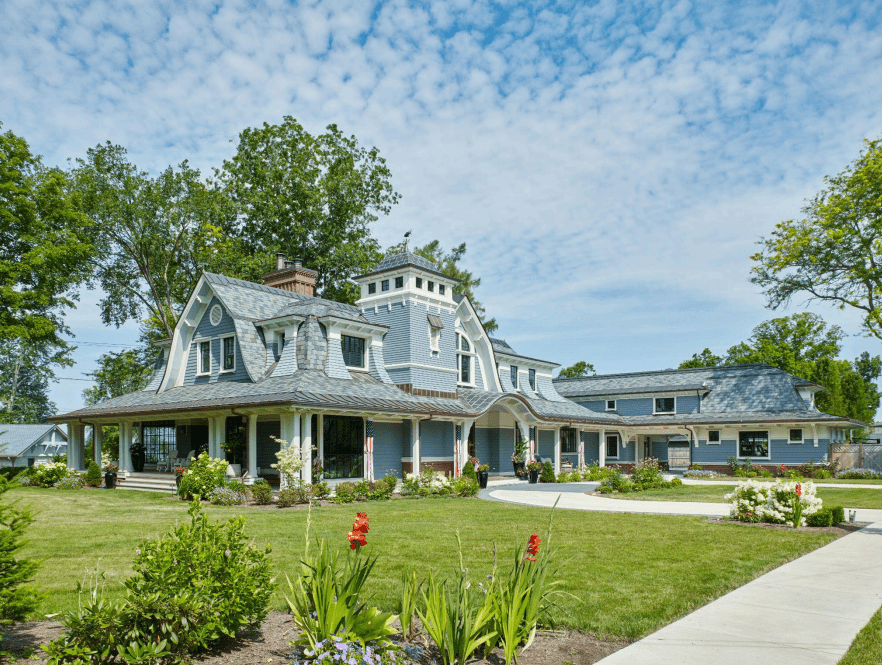
[1]In Lakewood, N.Y., the renovation of a historic home brought together steel windows and doors with a meticulously coordinated HVAC strategy.
Early collaboration between the window design and HVAC teams ensured the residence achieved its owners’ vision of timeless style, expansive lake views, and year-round comfort and energy efficiency through thoughtful system integration.
The project was designed by Meyer and Meyer Architects, a firm renowned for its work in both historic and contemporary architecture. John Meyer, principal architect and co-founder, says, “There’s nothing more timeless and classically premium than steel windows.”
The homeowners wanted to maximize their views of the lake without compromising the traditional look and feel of the building. To fit this requirement, windows with their thin steel dividers and crafted profiles offer a refined, non-minimalist appearance that complements the home’s composition and preserves its historic charm.
Meyer saw the arrow‑shaped steel frame profiles of the windows as integral to aligning the product with the home’s historic character. This distinctive shape provided a subtle depth and craftsmanship consistent with his design philosophy, ensuring the steel windows felt like a natural extension of the building’s composition. Functionally, the arrow‑shaped profiles also enhanced rigidity, supporting the hardware systems and ensuring long‑term structural stability. By uniting aesthetic precision with engineering strength, the profiles contributed to both the visual harmony of the renovation and the enduring reliability of the installation.
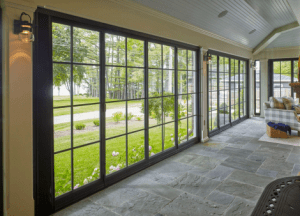
One of the project’s standout features is the three-season room overlooking the lake. Outfitted with folding metal doors, this space can be opened completely to the outdoors and has quickly become the most popular room in the house.
 [2]
[2]While the team did not have quantitative data on energy savings, Meyer emphasized the combination of Hope’s windows and the integrated HVAC design resulted in a home with “the strongest aesthetic for a very well built, reliable window with consistent thermal properties that made our design calculations and coordination practical.”
Close collaboration between the window design team and HVAC specialists was fundamental to the project’s success. The teams worked together to align ductwork and precisely position air distribution near the windows, guaranteeing that each unit was thermally washed, meaning it was kept free from cold‑surface condensation by directed warm airflow, and that interior comfort was never compromised.
The steel windows proved especially well-suited for this integrated approach. Its weather-tight, structurally robust frames made flashing and envelope integration straightforward, minimizing the risk of air or moisture infiltration. The suite’s compatibility with advanced HVAC systems allowed for seamless load calculations using the window manufacturer’s thermal evolution technology, giving the design team confidence that the windows and doors would deliver consistent energy performance and simplify coordination throughout the build.
Given the home’s location in a cold climate, energy efficiency and envelope performance were paramount. The supplied steel window and door products are tested and certified under the National Fenestration Rating Council (NFRC) program, providing verified performance metrics for U‑Factor, Solar Heat Gain Coefficient (SHGC), and Air Leakage (AL). These independent ratings allowed the design team to make informed choices to balance thermal comfort, energy consumption, and expansive views.
This steel frames’ high level of airtightness also supports better HVAC efficiency, as the mechanical system can maintain desired conditions without compensating for uncontrolled outdoor air infiltration. These low AL ratings worked hand‑in‑hand with the project’s HVAC design, reducing the need for excess heating capacity and ensuring consistent comfort.
By combining NFRC‑certified performance with precise installation and HVAC integration, the project team ensured that the windows and doors would deliver long-term comfort, energy efficiency, and compliance with high-performance building standards.
- [Image]: https://www.metalarchitecture.com/wp-content/uploads/2025/12/Screenshot-2025-12-16-102619.png
- [Image]: https://www.metalarchitecture.com/wp-content/uploads/2025/12/Screenshot-2025-12-16-102653.png
Source URL: https://www.metalarchitecture.com/news/daily-news/steel-windows-seal-historic-home/