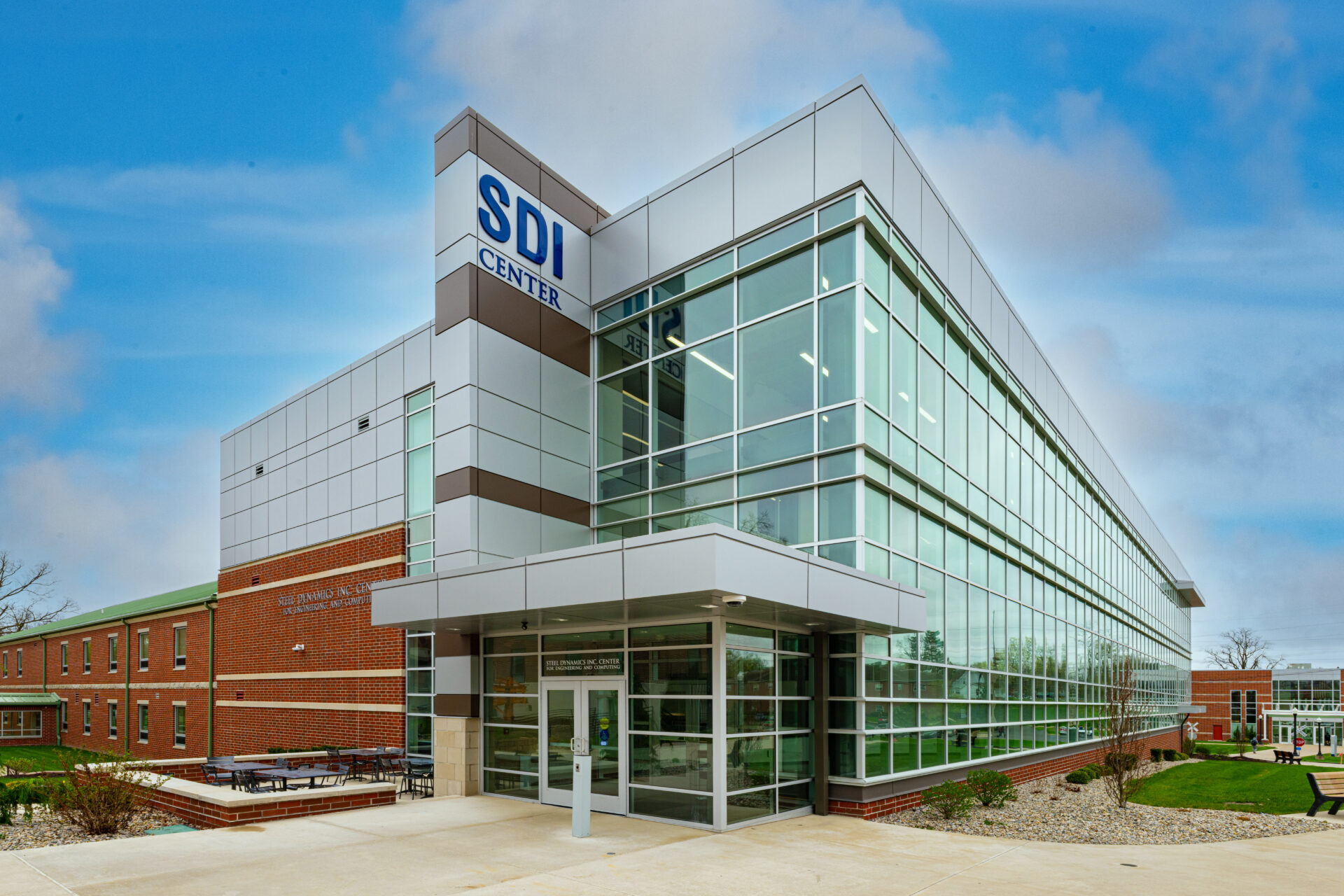
At Trine University in Angola, Ind., the Steel Dynamics Inc. Center for Engineering and Computing (SDI Center) exemplifies how thoughtfully integrated aluminum framing systems can advance both performance and design in a higher education setting. Housing the university’s biomedical engineering and computer science programs, the three-story, 6,040-m2 (65,000-sf) facility blends renovated and new construction with a strong emphasis on visibility, flexibility, and collaborative learning.
The architectural team at Design Collaborative developed the SDI Center as part of a long-term campus master plan. Their vision called for a building that could express technological innovation while maintaining continuity with Trine’s brick-and-metal campus vernacular. The result is a structure defined by transparency and daylighting, achieved through the use of aluminum curtain wall, storefront, entrance, and interior framing systems.
To deliver on these design goals, the project employed multiple systems from Tubelite, including the 400 Series curtain wall, T24650 and T14000 Series storefronts, Wide Stile entrances, and interior aluminum framing. Each was finished in clear anodize by Linetec, providing a unified aesthetic and high-performance durability. The anodized aluminum meets AAMA 611 standards for weatherability and wear resistance—important for a high-traffic facility expected to serve a growing student population for decades.
The SDI Center’s massing is organized to maximize daylight exposure. Classrooms and laboratories are arranged along the building’s perimeter, where the Tubelite systems frame expansive views of the landscaped 263-ha (450-acre) campus. A two-story curtain wall anchors the central atrium, allowing light to penetrate into public and communal areas. Interior corridors and staircases also employ glass and aluminum framing to visually connect departments and invite collaboration between disciplines.
For installer Architectural Glass and Aluminum (AGA), Tubelite’s uniform 7-1/2-inch-deep framing modules simplified fabrication and field installation, supporting clean transitions and system integration. This modularity was key in maintaining alignment between aesthetics and constructability.
In addition to exterior framing systems, Tubelite’s Wide Stile entrance doors—also finished in clear anodize—were selected for their robust construction and ease of maintenance. Designed for high-cycle use, their tie-rod assembly allows for straightforward repairs and part replacement over time.
Since opening in 2022, the SDI Center has contributed to a 40 percent increase in enrollment in engineering and computing programs, supporting Trine’s decade-long expansion that has included more than $150 million in campus investments. The building reflects a broader trend in academic design: merging material performance with transparency to create environments that foster innovation, engagement, and community.
In this context, the use of aluminum framing systems is not just a material decision—it’s a design strategy that advances both sustainability and student success.