Performance-Driven Perforation at the Desert Botanical Garden
by hanna_kowal | June 2, 2026 8:59 am
 [1]
[1]In architecture, perforated metal tends to be treated as a finish. It is a way to add visual texture to a facade, to break up an otherwise flat surface, to signal design intent without necessarily doing much else.
A ten-year collaboration with the Desert Botanical Garden[2] (DBG) in Phoenix, Ariz., and architect Matt Salenger, AIA of coLAB Studio[3], presented the opportunity to push perforation well past that default. Across three distinct buildings on the DBG campus, perforated metal is treated as the primary building system. The engineering of the hole pattern, the opacity percentage, and the material behavior itself to solves some very specific, very difficult problems.
The results have been instructive. When you stop treating perforation as decoration and start treating it as a calculation, it opens up a different set of possibilities.
 [4]
[4]The campus and the challenge
The $20 million Hazel Hare Center for Plant Science[5] is the operational heart of the Desert Botanical Garden. It is an institution that houses one of the most significant collections of arid plants on earth, including rare and endangered agave and cactus species from around the world.
The 7,896.8 m² (85,000 sf) campus, a decade in the making, replaced facilities that DBG staff had been making do with for more than thirty years. Matt Salenger led the master planning process starting in 2014, and 180 Degrees Design + Build[6] came aboard as co-architect and builder, responsible for translating an ambitious regenerative design vision into built reality under the constraints of a Phoenix climate and City of Phoenix life safety codes.
Phoenix is not a forgiving environment for buildings. Summer temperatures regularly exceed 46.1 C (115 F). UV radiation is intense. The plants housed in these facilities are sometimes irreplaceable. Every material and system decision carries real consequences for the collections, the energy budget, and regulatory compliance. Perforated metal ended up playing a central role in navigating all three.
Greenhouse West: engineering the 50 percent
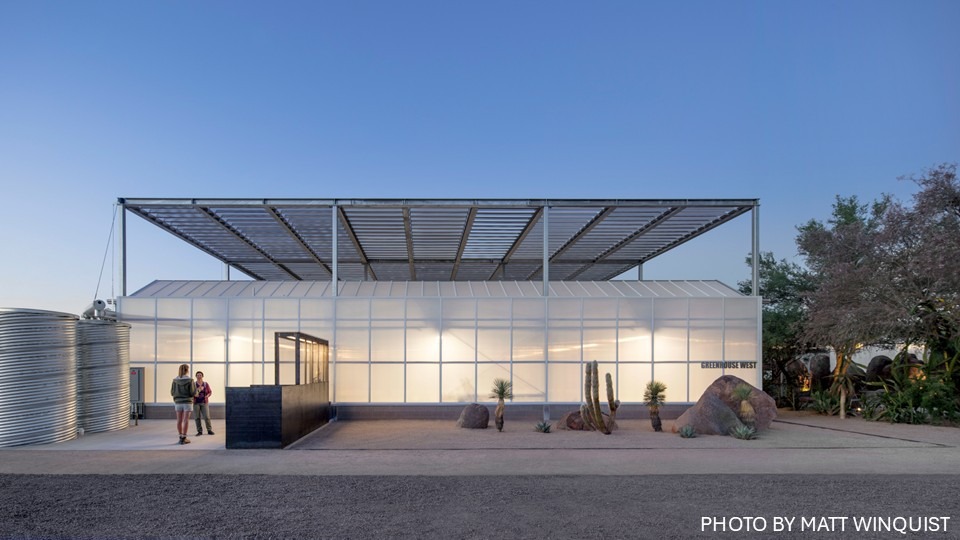
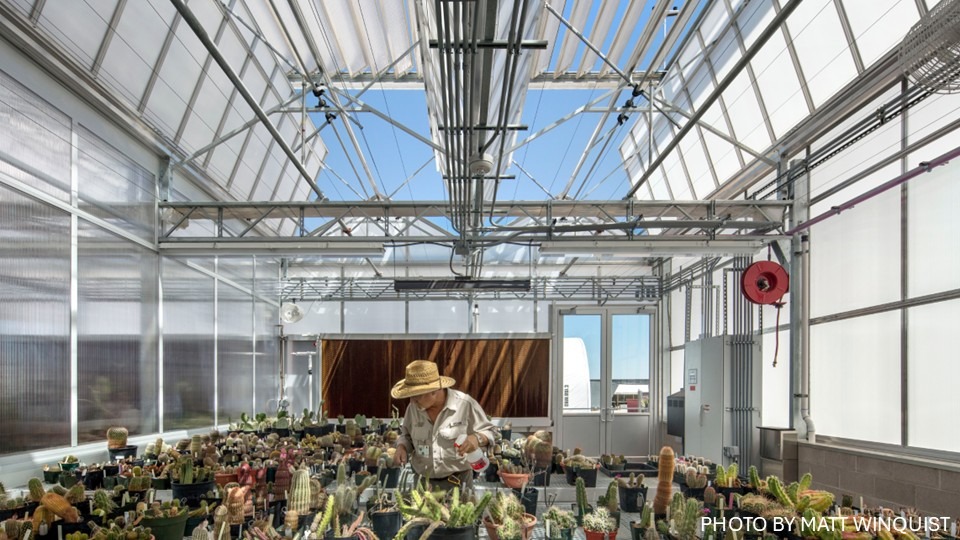
The West Greenhouse was the first structure completed under the master plan, and it presented the most technically demanding perforation problem encountered on the project. The building needed multiple layers of solar and UV control to protect sensitive plant collections, including some of the largest and rarest agave specimens in the world. Working with a greenhouse consultant, the team determined early on that a fixed shading system would not perform as required. The collections required different light levels at different times of day and different points in the growing season.
The solution was a motorized louver array: a broad metal canopy above the polycarbonate greenhouse roof. Its panels are adjustable to any angle, programmed to track the sun, and independently controlled by bay to create different shade zones across the growing space.
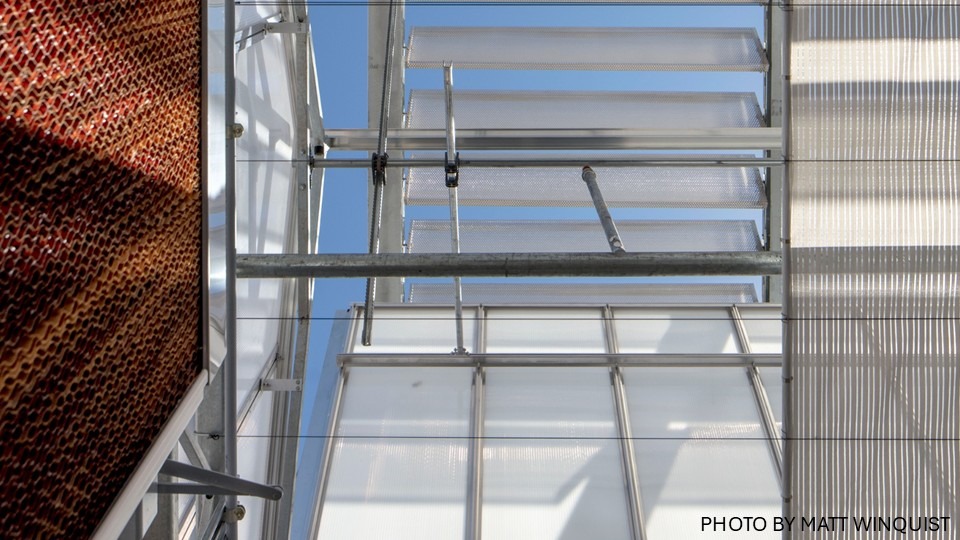
Mechanically, the system connected custom bent perforated aluminum panels to a strut system driven by 27 motors, all integrated with a greenhouse automation and climate control platform. Temperature, humidity, wind conditions, time of day and day of year all feed into the system’s logic. The louvers track the sun like a sunflower. They can alco be pivoted in synchronicity like a gigantic Venetian blind, or each bay can be set independently to create distinct micro-environments within the single structure.
The design detail that made the whole thing work was not the automation. It was the specific perforation percentage.
 [7]
[7]To avoid installing fire sprinklers at the upper operable louver level, the City of Phoenix required that the panels demonstrate sufficient natural smoke and heat venting capacity. After testing multiple configurations, the team landed on 50 percent open area, meaning half the panel surface is open. That specific ratio satisfied the City’s life safety calculations for natural venting, eliminating the need for a sprinkler system in that zone entirely. The panels were custom milled with that tolerance held precisely, because the variance actually mattered to the code compliance. It was not a design preference. It was an engineered answer to a regulatory question.
In practice, the 50 percent opacity also does something visually striking. The diffused light that passes through the moving louvers and then through the polycarbonate roof below. This creates a constantly shifting, layered quality of light inside the greenhouse that is soft enough for the plants and dynamic enough to remind occupants that the building is alive and responding. The polycarbonate cladding itself, unlike glass, diffuses direct light further to improve plant health. Combined with operable roof panels that allow staff to “flush” the interior with cooler night air, the system creates an environment that, by all accounts from DBG’s horticulture team, the plants love.
Ahearn Desert Conservation Laboratory: biomimetic rainscreen
The Ahearn Desert Conservation Laboratory came later, as part of Phase II of the master plan. At 167.2 m² (1,800 sf), the building houses three laboratories (herbarium, soil, and seed) and serves as a repository for over 4,000 seed accessions representing some of the rarest plants in the world. It was built to Passive House[8] standards, with double wall framing packed with cellulose insulation and 457.2 mm (18 in.) of roof insulation, both well above code minimums. The thermal performance of the envelope was a primary concern from the start.
 [9]
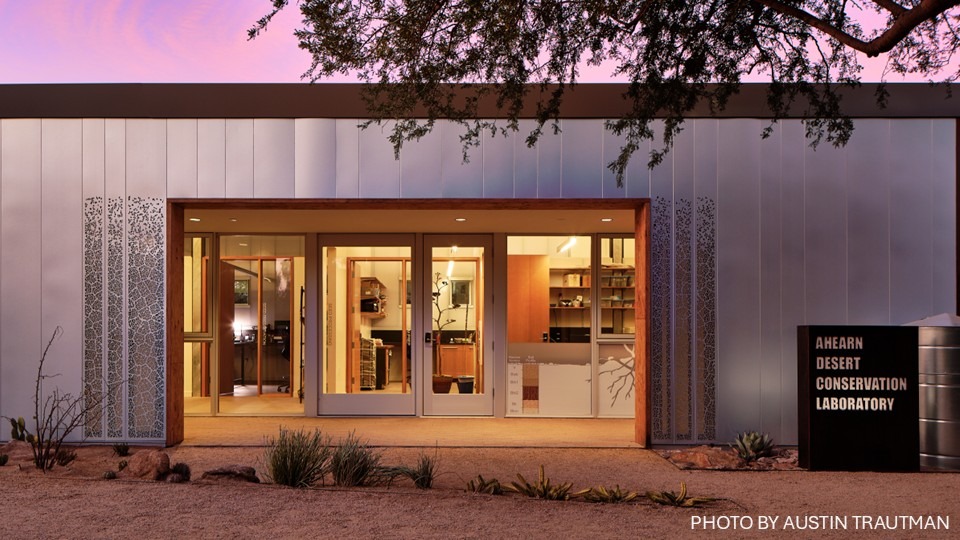
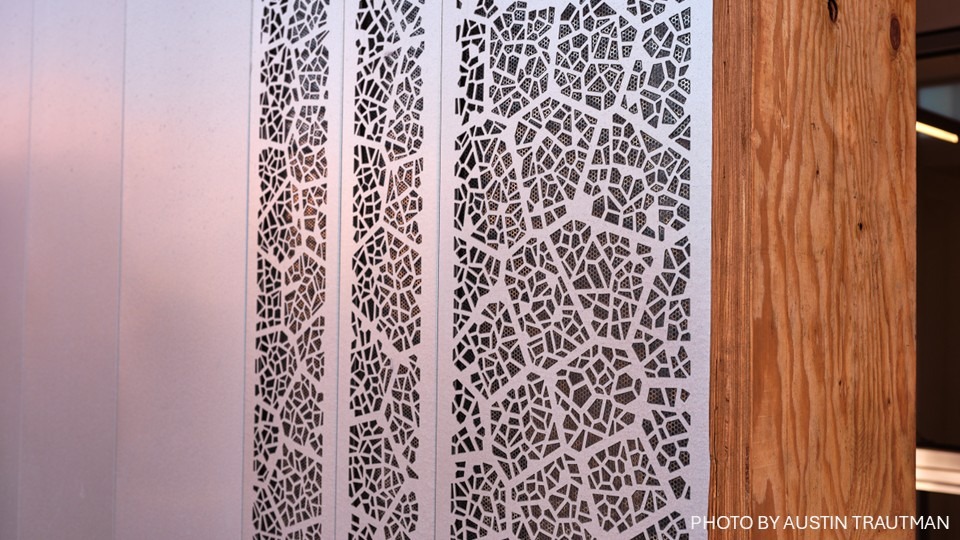
[9]The exterior cladding needed to do reduce radiant heat gain into the wall assembly in a way that made sense in the context of the Garden. The solution was a vented rainscreen system using custom laser cut perforated metal panels, but the perforation pattern itself was drawn from the desert.
The pattern was inspired by the skeletal remains of a dried prickly pear cactus pad. When a prickly pear dies and desiccates in the Sonoran Desert, what’s left behind is a delicate, lacy mesh of fibrous material, structural without being solid, open without being insubstantial.
That geometry became the template for the laser cut pattern on the metal cladding. It is both a reference to the Garden’s mission and a genuinely functional response to the climate: the panels shade the wall surface while the air gap behind them allows heat to convect away from the building rather than transferring into the interior.
 [10]
[10]The building also incorporated wood salvaged from elsewhere on the DBG campus for window details, a material reuse decision consistent with the Living Building Challenge[11] principles that guided the broader master plan. Nothing about the Ahearn lab was gratuitous. Every detail was earned.
RAF Exhibit Gallery: light as environment
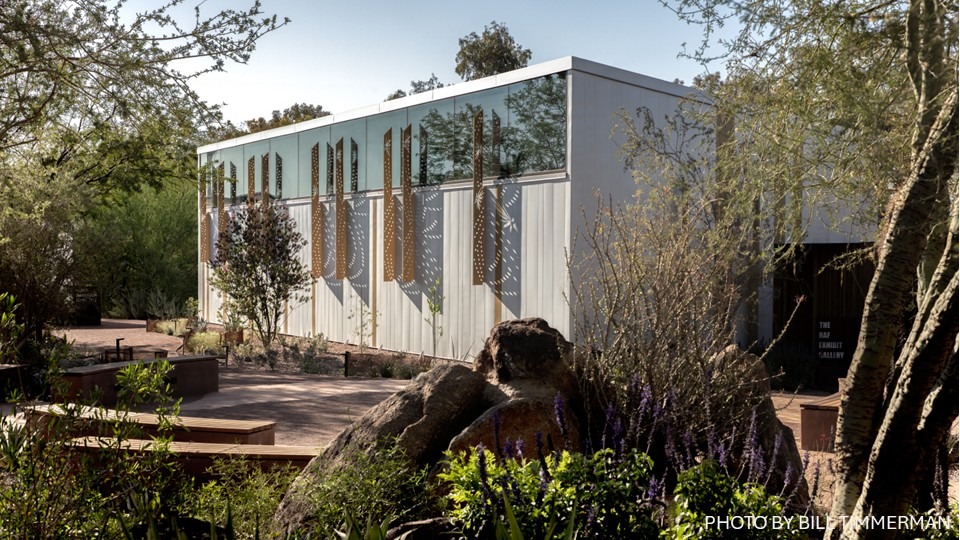
The Ruth Alter Finke (RAF) Exhibit Gallery[12] is the most visible building in the Phase II program, a dedicated gallery space for plant and art exhibitions that opened to visitors in late 2024. Salenger led the design; 180 Degrees Design + Build built it.
 [13]
[13]The building’s exterior presented a different kind of problem than the greenhouse or the laboratory. Here, the challenge was not thermal regulation or code compliance. It was the experience of moving from the Sonoran Desert’s aggressive exterior brightness into the controlled, contemplative interior of a gallery.
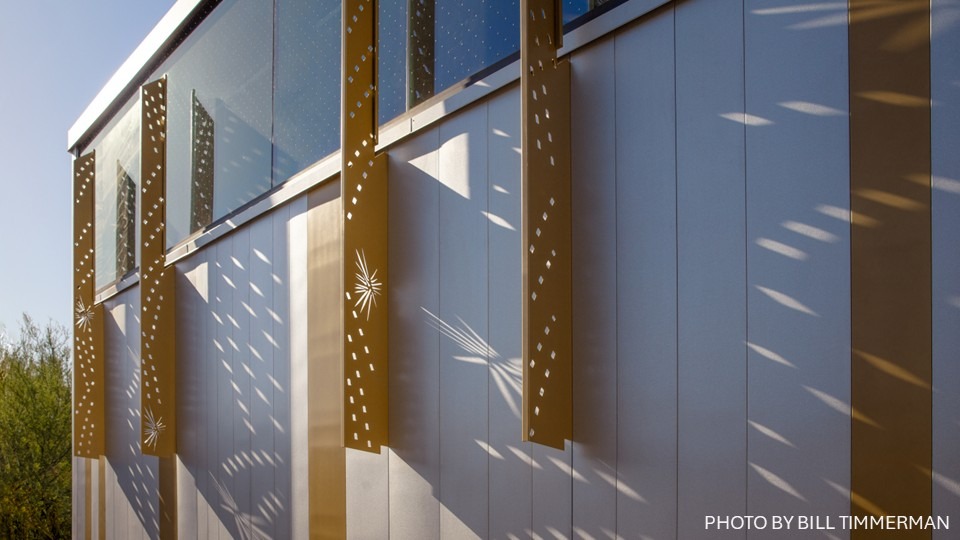
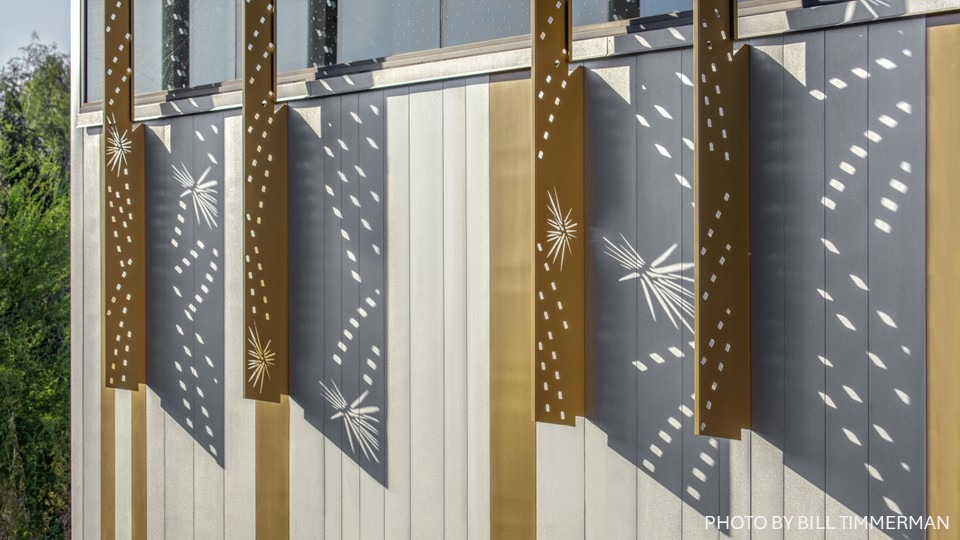
The approach was a series of vertical perforated metal fins applied to the building’s cool grey facade, accented in a warm golden tone that reads almost amber in direct sun. The fins are not passive decoration. They actively break up direct desert sunlight into shifting patterns of dappled shadow across the wall surface, patterns that change hour by hour as the sun moves.
 [14]
[14]Functioning as a transitional threshold, the fins soften the visual intensity before a visitor steps inside. The warm finish color plays against the grey panels differently throughout the day, charged in the afternoon light and quietly luminous at dusk.
Thermally, the fins also do real work. By casting shadow across the facade, they reduce the surface temperature of the exterior cladding and lower the radiant heat load on the building skin. Thermal sensor data gathered by our team confirms measurable differences in surface and near-surface air temperatures between the finned and unfinned elevations.
 [15]
[15]The numbers put quantitative support behind what was already observable: the fins create a microclimate at the building’s perimeter, and that microclimate matters for visitor comfort and building energy performance alike.
Lessons from the three buildings
There is a connective thread across all three of these projects that goes beyond material consistency. In each case, the perforated metal was not selected for how it looked. It was selected for what it could do. The open area was calculated, not estimated. The pattern was derived from a problem, not from a mood board. The system was integrated with automation, or with passive air movement, or with structural shadow casting, depending on what the building needed.
Moving from perforation as finish to perforation as system is the design methodology that the Desert Botanical Garden campus helped develop. The Sonoran Desert is a demanding client. It punishes soft decisions while rewarding the kind of close, specific attention to natural performance that these projects demanded. In that sense, the desert itself was the best design collaborator.
Justin Stephenson is the Marketing Director of 180 Degrees Design + Build, an award-winning design-build firm based in Phoenix, Arizona, recognized by Forbes as one of America’s Best-in-State Architects 2025. The firm has served as architectural partner and builder for the Desert Botanical Garden’s Hazel Hare Center for Plant Science campus since 2014.
- [Image]: https://www.metalarchitecture.com/wp-content/uploads/2026/05/Greenouse-1.jpg
- Desert Botanical Garden: https://dbg.org/research-conservation/hazelhare/
- coLAB Studio: https://www.colabstudio.com/
- [Image]: https://www.metalarchitecture.com/wp-content/uploads/2026/05/Greenhouse2.jpg
- Hazel Hare Center for Plant Science: https://dbg.org/research-conservation/hazelhare/
- 180 Degrees Design + Build: https://www.180degreesinc.com/
- [Image]: https://www.metalarchitecture.com/wp-content/uploads/2026/05/Greenhouse3.jpg
- Passive House: https://www.phius.org/standards
- [Image]: https://www.metalarchitecture.com/wp-content/uploads/2026/05/Lab1.jpg
- [Image]: https://www.metalarchitecture.com/wp-content/uploads/2026/05/Lab2.jpg
- Living Building Challenge: https://living-future.org/lbc/
- Ruth Alter Finke (RAF) Exhibit Gallery: https://dbg.org/seeing-the-desert-differently/
- [Image]: https://www.metalarchitecture.com/wp-content/uploads/2026/05/RAF1.jpg
- [Image]: https://www.metalarchitecture.com/wp-content/uploads/2026/05/RAF2.jpg
- [Image]: https://www.metalarchitecture.com/wp-content/uploads/2026/05/RAF3.jpg
Source URL: https://www.metalarchitecture.com/news/desert-botanical-garden/