A Legacy in Copper: Expanding
New England Biolabs’ Facility
by hanna_kowal | April 13, 2026 3:02 pm
 [1]
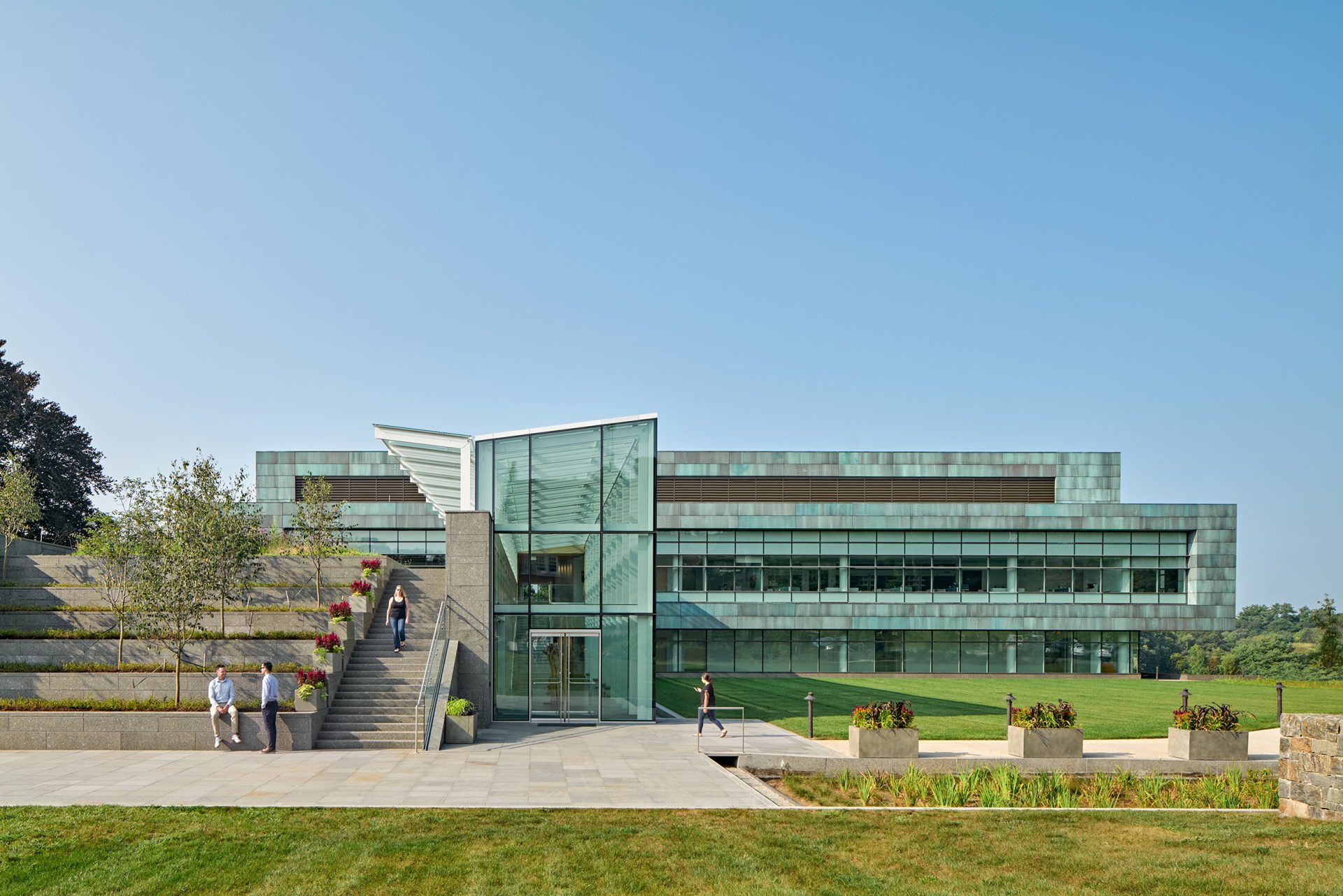
[1]Tucked within the coastal woodlands of Ipswich, Mass., biotechnology company New England Biolabs (NEB)[2] recently continued its decades-long architectural dialogue between science and nature with a 15,329 m² (165,000 sf) expansion. Designed by Architectural Resources Cambridge (ARC), the addition deepens NEB’s commitment to sustainable science while preserving the aesthetic tradition of its iconic copper-clad campus.
“The new addition needed to connect both to the campus’s history and the client’s values,” says architect Christopher Angelakis, who is an associate principal at ARC. “It was important that the facade for the new addition integrate seamlessly with both the existing facility as well as the natural environment.”
 [3]
[3]Establishing a site with history and purpose
The original campus was established on the site of a late 19th-century estate owned by the Proctor family of Boston, with a well-appointed summer mansion still in use. NEB acquired the estate in 1999, and its first lab building was built in 2003, where the original copper panels were installed. The first copper-clad laboratory building reflected the company’s eco-conscious philosophy and its desire to harmonize with the estate’s historic structures.
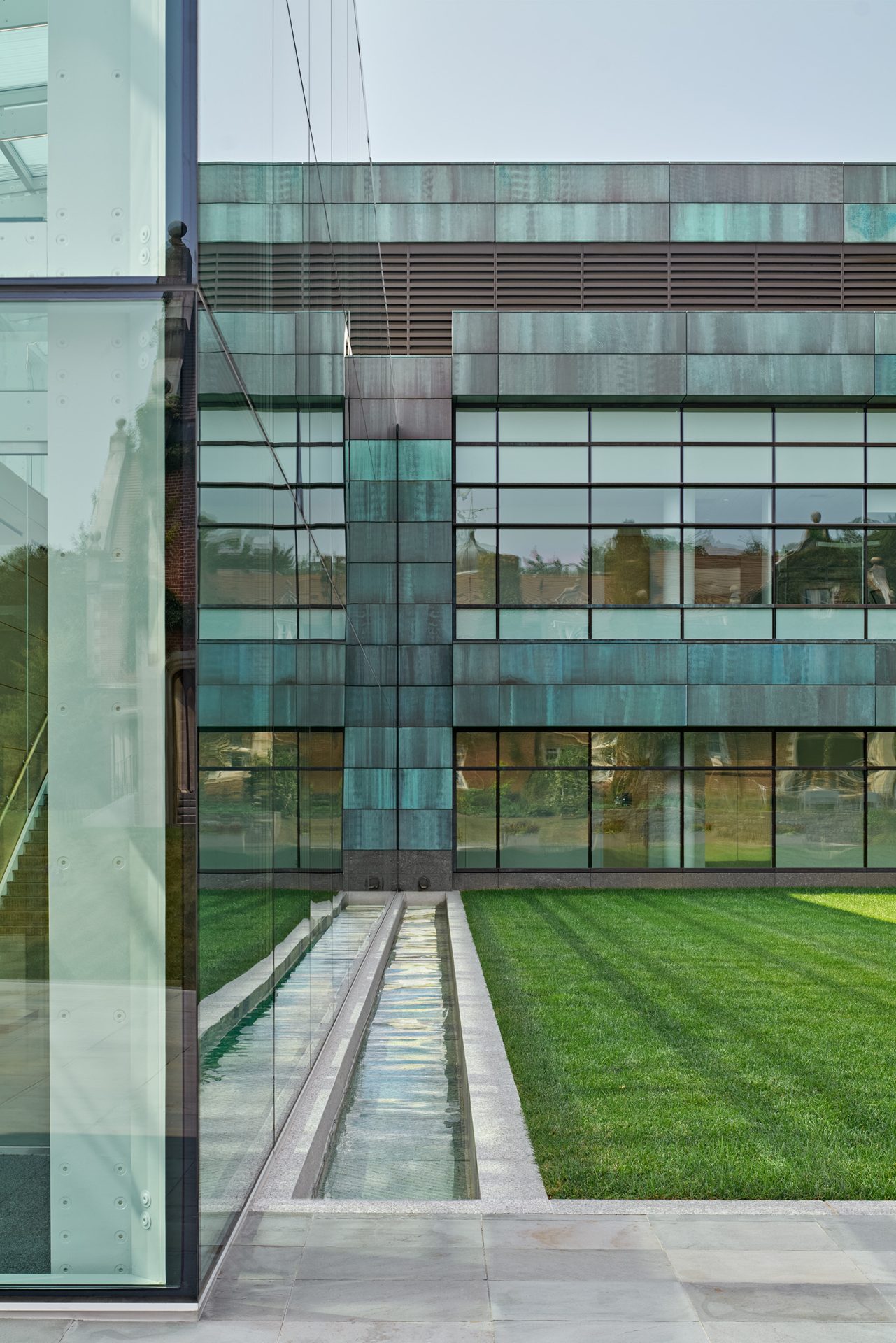
The structure’s characteristic green tones—developed through the process of applying acidic compounds to copper—inspire an elegant, aged appearance that coexists well with the site’s other structures. When the company approached the firm about a new addition to its campus, copper was a top request.
“When the client decided to do copper again, I don’t think anyone really understood what the real challenges were going to be in reproducing something that was so organically created,” says Angelakis. “Recreating that original texture and color took us the entire length of the project—and maybe even a little bit more—to get it right.”
 [4]
[4]Restoring a signature look through dedication and detail
Over the past several decades, facade design and construction methods have evolved. The exact process used to chemically weather wall panels for the facade was nearly inconceivable to reproduce: it was very unique, done by hand.
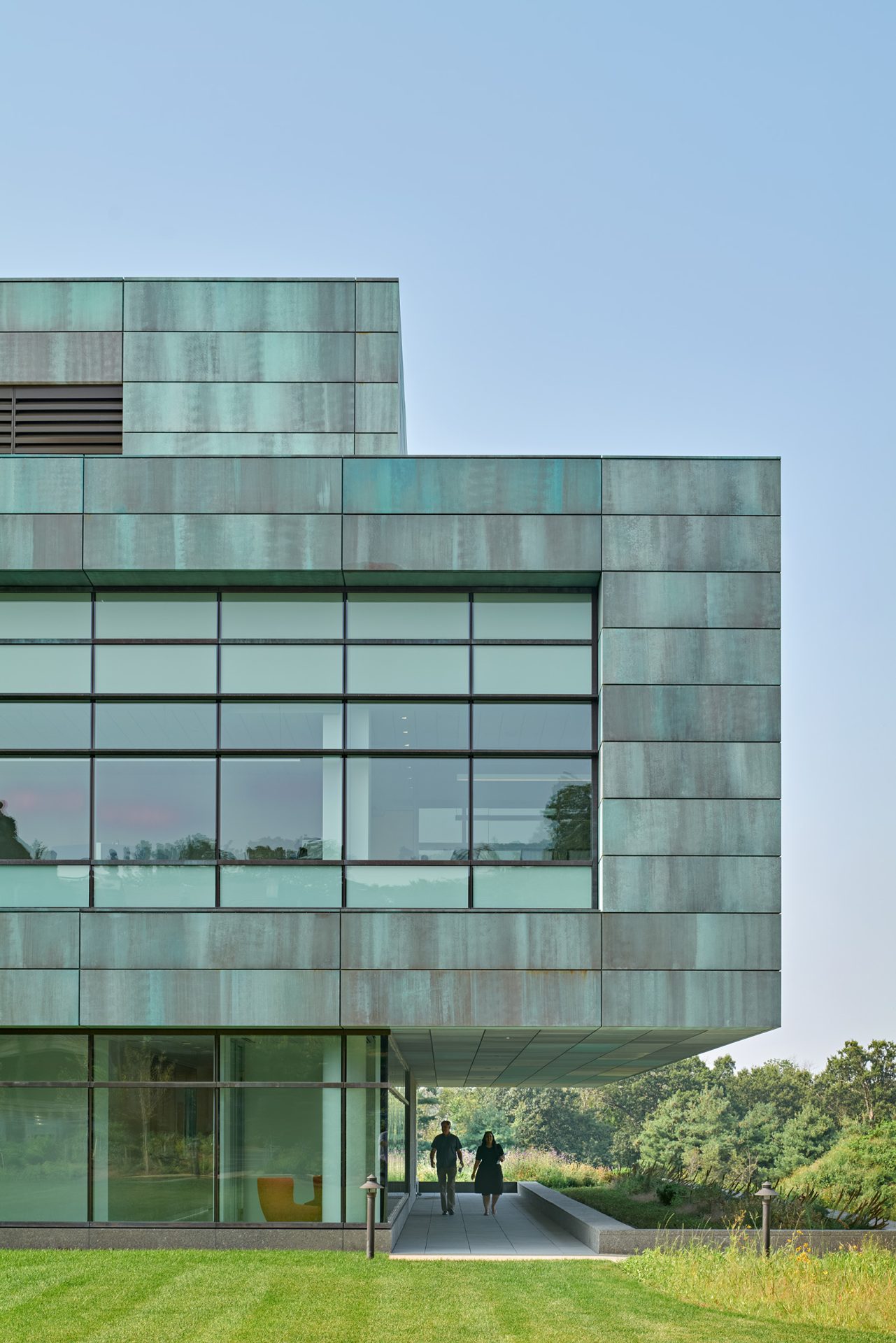
“If you see pictures of the original building, the texture is extremely varied all over the place—even to the point where you can literally see handprints on it,” remarks Angelakis. “We used to joke that any individual panel looks like it should be rejected. Each panel’s texture felt haphazard, but as a composition, it’s actually quite incredible.”
Working closely with the architectural metal company A. Zahner, the team collaborated with the client to obtain the ideal base finish sample. Since the new building would connect to the existing one, several of the original panels were removed. In many ways, these panels helped provide a quality-control guide to achieve the right kind of texture and color.
Although helpful, the existing panels also confused the process, as every panel differed because of its orientation to the sun and the elements, resulting in different finish variations. Even though they were pre-patinated, the panels each had their own darkening and lightening cycles, creating more texture and character.
Despite the challenges, the client was committed to getting as close as possible to the original, as that appearance felt integral to their corporate identity and the overall look and feel of the campus. The new architecture needed to blend into the campus while standing apart in its own way.
“The goal was to replicate a patina that had naturally evolved over two decades since its original installation,” explains Tony Crockett, operations manager at A. Zahner. “This required us to maintain consistent grain direction, color, and tonal blending from one panel to the next. It took roughly three months to develop a finish that aligned with the aged reference.”
Several potential variables were considered. Even local environmental conditions can change the way the patina develops. Various methods of applying the chemical patina solutions—from a broom to hand wiping—were all explored. Upwards of 30 iterations were examined before a base sample was finalized.
“It’s one of those things that designers love but hate because the amount of effort and work that went into making it look like it’s been there forever. And the ultimate result looks like it was just always that way,” says ARC’s Angelakis, noting that 2,750.9 m² (29,610 sf) of custom copper was installed. “It was almost like we had to back-engineer how it was done.”
 [5]
[5]Blending architecture and ecology through thoughtful design
With the right copper panel finish established, the firm worked to design a contemporary building that also echoed the company’s values.
“Their corporate culture is this perfect combination of scientific rigor and artful exploration,” says Angelakis. “We could have done some wild facade, but we knew the right thing was to do something quiet, calm, and extremely contextual with what was already there.”
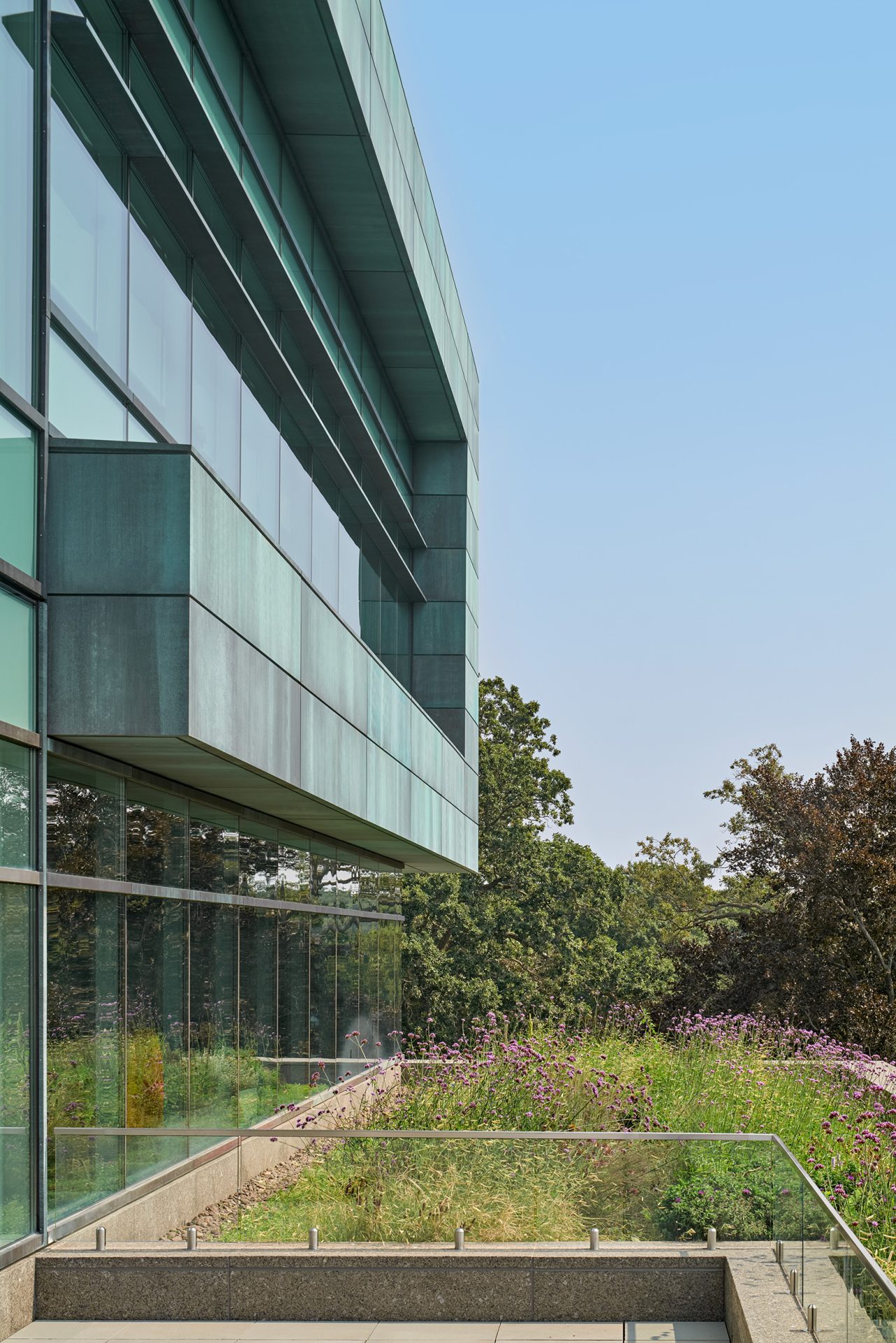
This more contemporary building features a flat facade; the glass windows are placed further back in the architectural frame to provide solar shading. The copper cladding on the curtain wall gives the appearance of architectural depth and, through its projecting sunshades, contributes to solar heat management.
Behind the shimmering facade, triple-glazed curtain walls and high-performance insulation deliver significant energy efficiency. Inside, open-plan laboratories and offices are flooded with natural light, while mechanical systems are designed for flexibility and future growth.
The project’s most significant sustainable feature isn’t its energy systems but its (2,787.1 m²) 30,000 sf of green roof. Born from the desire not to overwhelm the adjacent buildings, much of the new building is situated underground. The surrounding lawns and gardens are planted to let the landscape flow naturally around the building, so it never feels like a conventional roof. This limits the amount of copper actually on the structure and helps ensure the new structure does not visually overpower the adjacent historic mansion.
“We were using a lot of architectural strategies to get the mass of the building perceptibly lower or smaller and moved away from the mansion, and this is where the copper itself comes into play,” says Angelakis. “We needed to have a texture that felt very human scale, so it doesn’t overwhelm this Victorian mansion, which has its own highly detailed, architectural style.”
A seamless synthesis of craft, science, and beauty
The final structure seems to glow softly against the surrounding green landscape as a living testament to the dialogue between craft, science, and sustainability. It is more than a research facility; it is a showcase of how nature, craft, and innovation can coexist in enduring beauty.
“In our experience, we often fight to make all of the pieces and parts look like they belong together,” says Angelakis. “In this case, they look like they absolutely work as one whole.”
“It was a remarkable effort and yet a dream to be able to do that.”
- [Image]: https://www.metalarchitecture.com/wp-content/uploads/2026/04/5-NEB-Garden-ExpansionPhoto-courtesy-New-England-Biolabs.jpg
- New England Biolabs (NEB): https://www.neb.com/en-ca/
- [Image]: https://www.metalarchitecture.com/wp-content/uploads/2026/04/3-NEB-Garden-ExpansionRobert-Benson.jpg
- [Image]: https://www.metalarchitecture.com/wp-content/uploads/2026/04/2-NEB-Garden-ExpansionRobert-Benson.jpg
- [Image]: https://www.metalarchitecture.com/wp-content/uploads/2026/04/4-NEB-Garden-ExpansionPhoto-courtesy-Robert-Benson.jpg
Source URL: https://www.metalarchitecture.com/news/expanding-new-england-biolabs/