Unique Cloud-like Aluminum and Steel Design
Emulates Denver Landscape
by hanna_kowal | April 8, 2026 1:41 pm
 [1]
[1]Photo by Jess Blackwell Photography
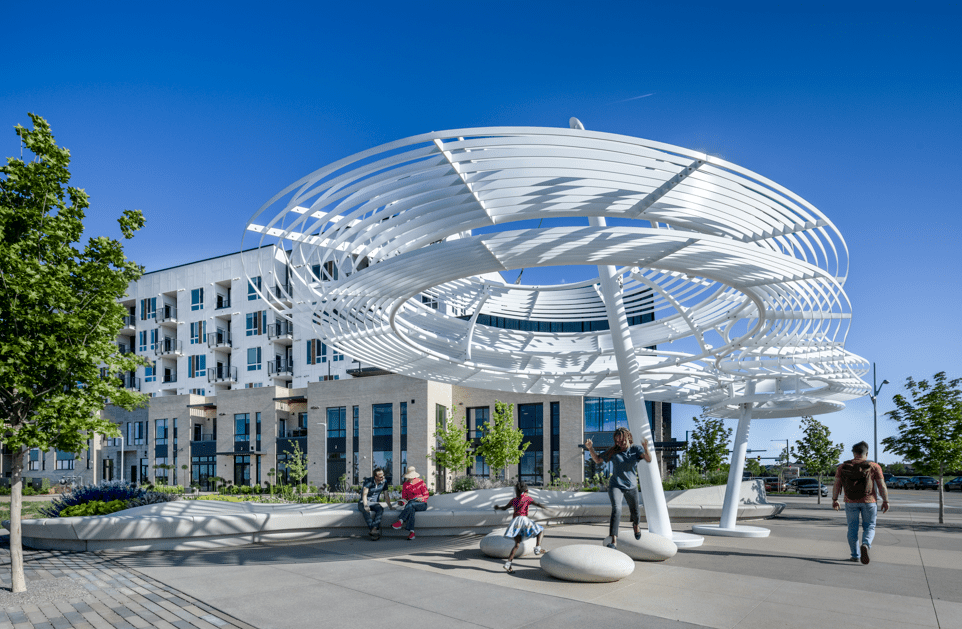
A cloud-like aluminum and steel sculptural element draws on the local landscape in Central Park Station Plaza in Denver, Colo. Located along the RTD A-Line connecting Downtown Denver to Denver International Airport, the plaza anchors one of the final phases of the Stapleton redevelopment. The 19.4 ha (48 acre) transit-oriented district is designed to serve as a new civic and commercial hub in Northeast Denver.
From the beginning, the plaza was conceived not simply as a place, but as a composition. Dig Studio shaped this vision over many years, first with Stapleton Development and later with Brookfield, as part of the broader strategy for the Central Park Station transit-oriented development (TOD).
At the center of the district, Dig Studio envisioned a public space that is both memorable and rooted in its Colorado context. The plaza brings together transit, neighborhood life, and destination experiences in a cohesive environment. While it responds to many practical needs, its core is grounded in artistic expression.
 [2]
[2]Design vision: a cloud-like aluminum and steel success
The design draws deeply from the Colorado high plains, where the land stretches wide beneath an expansive sky. Inspired by lenticular clouds[3], a natural phenomenon often seen hovering above Colorado’s plains, these clouds are layered, elongated, and appear suspended in motion. It is this meeting of earth and atmosphere, horizon and cloud, that guided the concept.
Imagined from above, the plains become a canvas, with clouds drifting slowly and their shadows gliding across the terrain below. This idea is expressed in the plaza’s bold striping, an echo of the region’s agricultural legacy. The pattern extends across the street, dissolving boundaries and allowing the space to read as one continuous ground plane for gathering, celebration, and everyday life.
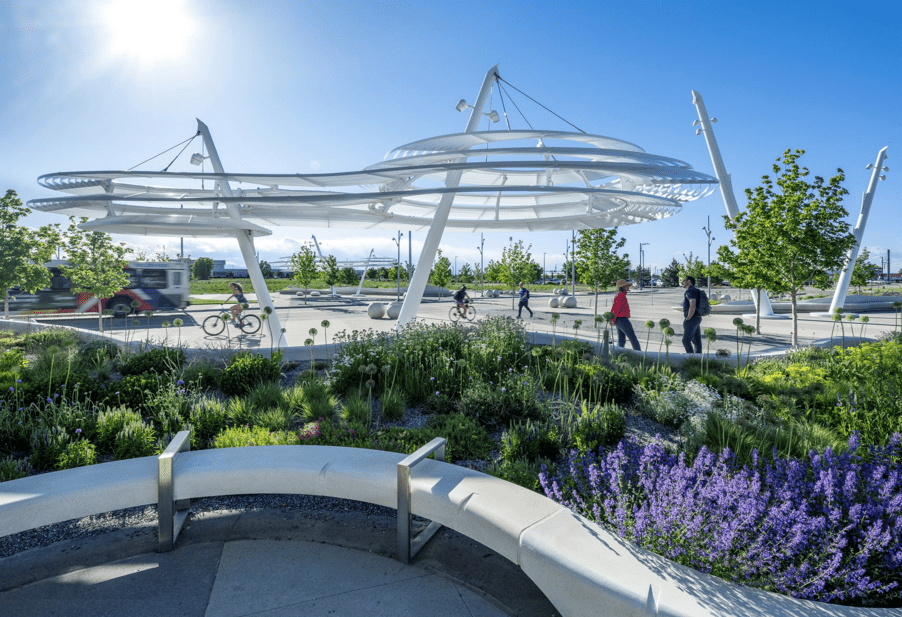
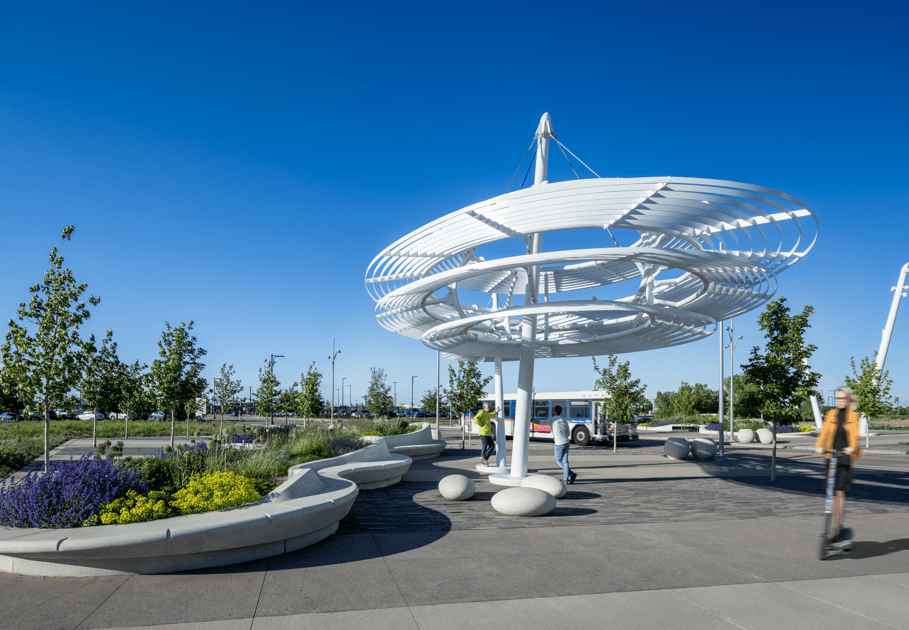
Suspended above are three lenticular cloud shade structures, inspired by a natural phenomenon both rare and distinctly Coloradan. These layered forms are elongated, soft, and seemingly in motion, creating the impression of clouds floating just above the plaza.
At ground level, this concept continues through curvilinear concrete planter walls that mirror the forms above. These soft, white elements read as shadows made solid, reinforcing the visual language while creating spaces to sit, linger and observe the rhythms of the plaza.
 [4]
[4]Floating from fabrication
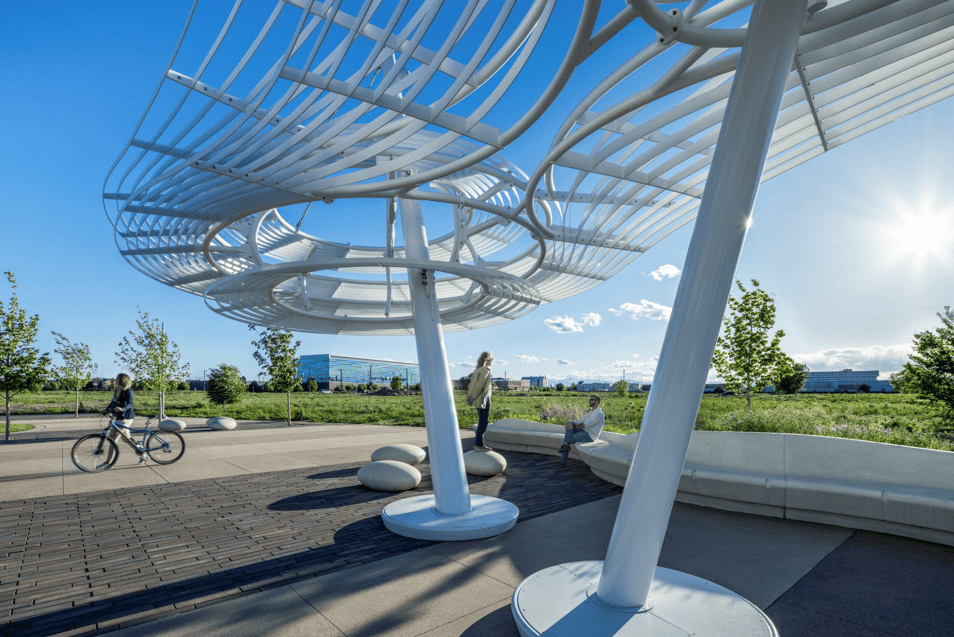
Each cloud structure is composed of layered aluminum elements engineered to appear lightweight while spanning large distances. Circular tubular rings form the structural core, from which radiating aluminum pipes and flat bars extend outward to create a rippling canopy. The structures are supported by tall, tapered steel poles, enhancing the sense that they are suspended rather than anchored, further strengthening the illusion of floating.
Dig Studio partnered with multifaceted art fabrication studio Demiurge to bring the cloud structures to life. Their craft and ingenuity were essential in translating complex digital models into precise, buildable components that remain both structurally sound and artistically expressive.
Light, shadow, and experience
The cloud structures shape the experience of the plaza through light and shadow. The layered aluminum elements filter sunlight to cast intricate, shifting patterns across the linear paving below. These patterns change throughout the day, creating a dynamic environment that evolves with time and movement.
At night, integrated lighting within the support structures illuminates the forms from above, transforming the clouds into luminous elements and extending the life of the plaza into the evening.
The result is a space that balances functional shade with a strong visual presence, where light, material, and form create moments of discovery throughout the day.
 [5]
[5]Public realm impact
As a central gathering space within a transit-oriented development, the plaza supports a wide range of uses, serving commuters, residents, and visitors while accommodating events and informal gatherings.
The relationship between the cloud structures, planted areas, and open circulation zones creates a flexible, human-scaled environment. Native and drought-tolerant plantings introduce texture, color, and seasonal change over time.
From above, the composition reads as clouds drifting across a patterned ground plane, reinforcing the concept at both the pedestrian and district scale. The plaza operates as both a functional transit space and a layered public experience.
Central Park Station Plaza demonstrates how infrastructure-focused sites can become recognizable public destinations through design and fabrication. By drawing from a regional phenomenon and translating it into form and material, the project creates a strong sense of place that feels both familiar and distinctive.
The lenticular cloud structures act as a visual anchor for the district, establishing identity while elevating the everyday experience of a transit-oriented environment. Through the integration of art, infrastructure, and landscape, the plaza transforms a transit node into a place of connection and community.
- [Image]: https://www.metalarchitecture.com/wp-content/uploads/2026/04/Screenshot-2026-04-07-103835.png
- [Image]: https://www.metalarchitecture.com/wp-content/uploads/2026/04/Screenshot-2026-04-07-103852.png
- lenticular clouds: https://www.weather.gov/abq/features_acsl
- [Image]: https://www.metalarchitecture.com/wp-content/uploads/2026/04/Screenshot-2026-04-07-103939.png
- [Image]: https://www.metalarchitecture.com/wp-content/uploads/2026/04/Screenshot-2026-04-07-103919.png
Source URL: https://www.metalarchitecture.com/projects/cloud-like-aluminum-and-steel/