

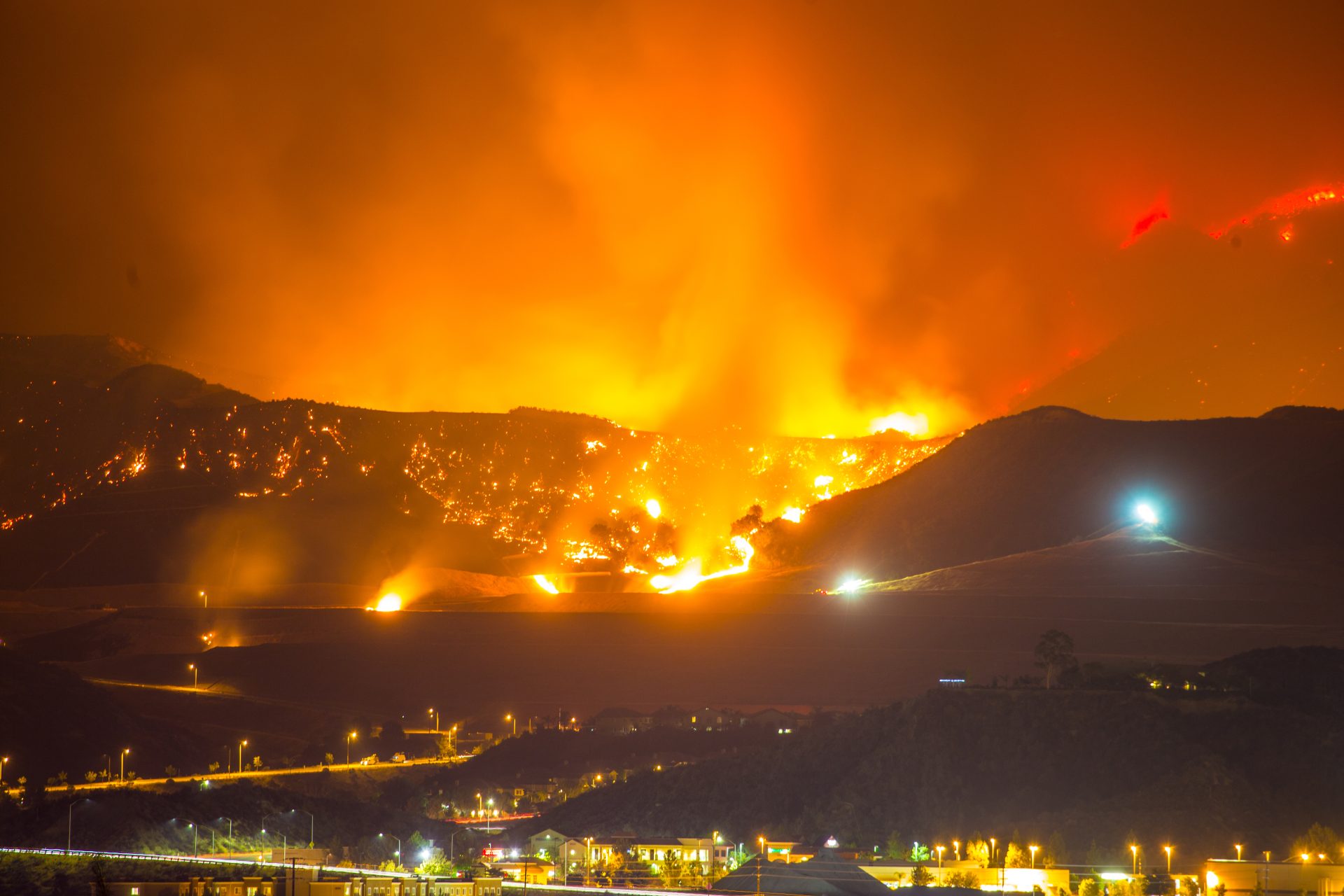
The expanding reach of urban development, coupled with a changing climate, is fueling a dangerous convergence: wildfires escalating into urban conflagrations. Much of the discussion around wildfire resilience has focused on single-family homes in the wildland-urban interface (WUI). However, as recent disasters show, commercial and multifamily buildings face their own unique, and often greater, risks.
The scale, shared surfaces, and mechanical complexity of these structures make them especially vulnerable to radiant heat, ember exposure, and smoke infiltration. In California, the Eaton and Palisades fires of early 2025 destroyed nearly 1,000 multifamily and commercial buildings combined, underscoring the urgency of extending resilience strategies beyond detached housing to larger building types.
Unique vulnerabilities of larger buildings
- Large, flat roofs—These surfaces can accumulate combustible debris, collect wind-blown embers, and contain multiple points of vulnerability such as skylights, HVAC units, solar panels, and other penetrations.
- Rainscreen systems—While effective for moisture management, vented rainscreens can act as chimneys if unprotected, drawing flames and embers into wall cavities.
- Shared systems—Interconnected HVAC and mechanical systems can provide potential entry pathways for embers and smoke.
- Mixed uses—Buildings that combine residential, commercial, and public functions increase the stakes for occupant safety and continuity of operations.
Even modern construction can fail under these conditions. The 2023 Lahaina Fire in Hawaii revealed how ember penetration undermined otherwise code-compliant structures. Two contrasting examples illustrate the importance of design: a reinforced concrete house with a heavy-gauge metal roof and minimal landscaping survived, while adjacent blocks burned; and in the same community, the Lahaina Roads apartments, a concrete multifamily complex on Front Street, remained structurally intact, while neighboring wood-framed buildings were reduced to ash. Noncombustible construction, defensible space, and careful detailing were decisive.
The role of metal systems in fire resilience
Metal cladding and roofing are inherently noncombustible, providing significant advantages over combustible siding and roofing. Properly detailed, they resist ignition from direct flame contact and embers. Designers must account for one important caveat: metal conducts heat. If the insulation or substrates beneath are combustible, heat transfer can ignite hidden layers even when the outer metal skin remains intact.
Key considerations for architects include:
- Pairing metal roofing and cladding with non-combustible insulation such as mineral wool rather than foam-based products.
- Ensure assemblies are tested as a complete system, not just individual components, for fire performance.
- Use heavier-gauge or fire-rated metal panels where feasible to extend protection.
- Pay close attention to penetrations and transitions, where embers and heat transfer are most likely to exploit weaknesses.
Protecting wall assemblies
Rainscreen wall assemblies are particularly at risk if cavities are left unprotected. Strategies include:
- Non-combustible insect screens—Use metal mesh with openings less than or equal to 3.18 mm (0.13 in.) at the top and bottom of cavities, per California Building Code (CBC) Ch. 7A and Insurance Institute for Building and Home Safety (IBHS) guidelines.
- Cavity fire blocking—Install horizontal mineral wool barriers at intervals to stop vertical flame spread.
- Non-combustible insulation—Mineral wool resists ignition and retains structural integrity at high temperatures, whereas foam plastics may degrade, melt, or emit toxic smoke under fire exposure.
- Cladding and gaps—Specify fiber cement or metal panels and minimize air gaps to limit convective heat transfer.
- Base and head detailing—Incorporate flashings or intumescent materials to protect transitions.
Windows, doors, and openings
Openings remain one of the weakest points in fire resilience. Recommended measures include:
- dual-pane glazing with at least one tempered pane
- non-combustible frames such as aluminum or steel
- fire-rated exterior doors, especially at balconies and adjacent decks
- 3.18 mm (0.13 in.) metal mesh screens at windows and vents
- intumescent perimeter seals to block ember intrusion
Codes like the International Wildland-Urban Interface Code (IWUIC) and the National Fire Protection Association’s (NFPA) 1140 already include these provisions; however, architects must ensure consistent application in larger projects, where higher occupancy and complex egress routes raise the stakes.
Roofing and rooftop equipment
Large commercial and multifamily roofs present critical wildfire challenges. Possible mitigations include:
- Class A fire-rated roofing assemblies should be the default.
- Maintain drains, gutters, and areas behind equipment regularly to prevent debris buildup.
- Use non-combustible curbs and flashing around all penetrations.
- Provide protective housings for rooftop HVAC and electrical systems.
- Establish defensible perimeters at parapets and edges to keep combustible materials away.
Connected fuels, such as wooden fences, decks, and outbuildings, can accelerate fire spread. Replacing them with masonry walls, gravel mulch, or metal enclosures interrupts ignition pathways.
Smoke resilience: beyond the flames
Even when flames never reach a building, wildfire smoke is a building emergency. In 2023’s widespread smoke episodes, asthma emergency-department visits rose 17 percent above normal on smoke days across the U.S. Longer-term exposure to wildfire-origin fine particulate matter (PM₂.₅) is associated with higher mortality, adverse birth outcomes, and worsened respiratory illness in children. Research also indicates wildfire smoke may be more harmful than other pollution sources because it often contains volatile organic compounds (VOCs) and heavy metals in addition to PM₂.₅.
For larger facilities, smoke impacts can be devastating. During the 2021 Marshall Fire in Colorado, Avista Adventist Hospital, though spared from flames, had to evacuate due to smoke infiltration that contaminated air-handling systems and interior spaces. The hospital only reopened after months of remediation.
To protect commercial and multifamily occupants, architects should incorporate the following:
- HVAC systems should include a dedicated “wildfire smoke mode,” as outlined in the American Society of Heating, Refrigerating, and Air-Conditioning Engineers (ASHRAE) Guideline 44-2024, allowing for temporary shutoff of outside air intakes, internal air recirculation, and activation of enhanced filtration in response to wildfire smoke events.
- Specify minimum efficiency reporting value (MERV)-13 or high-efficiency particulate air (HEPA) filtration with sealed ductwork.
- Provide outside-air shutoff and pressurization for refuge areas.
- Detail penetrations to ensure air-tight seals and minimize infiltration.
The forgotten hazard: flooding after fire
Wildfire damage does not end when flames are extinguished. Burn scars often create hydrophobic soils that shed rain rather than absorb it, significantly increasing the risk of floods and debris flows. Even modest precipitation can produce devastating secondary hazards.
Following the January 2025 Palisades Fire, post-fire rains triggered debris flows that damaged homes untouched by flames.
Commercial and multifamily facilities are especially vulnerable to garage and basement flooding, sediment-clogged drains, and foundation undermining.
Strategies include elevating vital systems, specifying water-resistant materials, grading landscapes to divert water flows, and providing redundant drainage systems. As best management practices, building owners should also consider post-fire erosion control measures such as silt fences, matting, or hydroseeding to help reduce debris flows near new or recovering developments.
Codes, standards, and the architect’s role
Guidance comes from multiple sources:
- CBC Ch. 7A and Federal Emergency Management Agency (FEMA) P-737
- IWUIC and NFPA 1140 for WUI projects
- local amendments that may be inconsistently enforced
Codes are minimums, not best practices. Architects play a critical role in advocating for adoption, consistent enforcement, and encouraging clients to adopt solutions that exceed the baseline.
Holistic Resilience Planning
Wildfire resilience is inseparable from broader hazard planning. Priorities include:
- Conduct multi-hazard risk assessments that integrate fire and post-fire flooding.
- Apply fire and flood standards consistently across all assemblies.
- Educate clients about long-term resilience benefits.
- Build collaboration among design professionals, code officials, and community leaders.
As Lahaina and Marshall showed, surviving flames does not guarantee long-term safety. Truly resilient buildings anticipate the full disaster cycle.
Designing to survive and recover
Wildfires are becoming more destructive, more frequent, and more urban. Commercial and multifamily buildings, where lives, livelihoods, and communities intersect, require enhanced protection measures.
Through noncombustible construction, metal cladding and roofing with appropriate insulation, ember- and smoke-resistant detailing, and integrated fire and flood planning, architects can ensure their projects not only survive but also recover.
Resilience is not a single measure, but a design philosophy. By anticipating wildfires and their cascading hazards, architects can design built environments that remain resilient, protect people, and facilitate community recovery.

Alan Scott, FAIA, LEED Fellow, LEED AP BD+C, O+M, WELL AP, CEM, is an architect and consultant with over 36 years of experience in sustainable building design. He is the director of sustainability with Intertek Building Science Solutions in Portland, Ore. To learn more, follow Scott on LinkedIn at www.linkedin.com/in/alanscottfaia/.

Jacob Kwiatkowski is a fire and emergency management professional with over 20 years of experience in firefighting, building code enforcement, and community resilience planning, currently serving as an emergency management specialist with the Federal Emergency Management Agency (FEMA).