

Think about a new manufacturing facility in the exurbs, a high-rise apartment tower in a bustling city, or an office complex in the suburbs. The team responsible for bringing any building to life faces increased pressure to deliver on energy efficiency and design innovation. Construction professionals today must consider a wide array of variables when selecting the optimal building envelope product, such as climate in the region, how the building will be used, how it will consume energy based on all these conditions, and its appearance.
Two major factors affect thermal performance: the conductivity of the building’s steel framing and steel studs, and the failure of the multi-component air barrier systems, which create air leaks through insulation. Conduction, also referred to as thermal bridging, happens when materials such as steel studs and exterior cladding come into contact with each other. In conventional construction, stopping air leaks and thermal breaks requires a multi-component building envelope with additional crews for installation. Combined, these factors can reduce thermal performance by up to 50 percent. If water, air, or vapor can penetrate the control layers, it will adversely impact building performance.
Insulated metal panels (IMPs) solve these coordination and performance concerns by preventing natural forces from penetrating the walls. The ability of IMPs to drive long-term results is matched by the aesthetic options available to design a compelling building, using an all-in-one system. Given these project-specific factors, IMPs are the ideal choice for thermal and moisture protection without failures presented with multiple trades’ involvement using single-skin panels.
A system, not a skin
IMPs are factory manufactured as an all-in-one system, designed to deliver multiple barriers in a single product. When fastened and sealed correctly, the panel system is impermeable to the elements. IMPs feature concealed fasteners which protect joints from the elements and ensure multiple layers to stop air and moisture from entering the building.
This building envelope system includes advanced panel joinery, a rigid closed-cell insulation core, and a galvanized G90 or galvalume AZ50 aluminum-zinc coated protection. In addition, there are a variety of powder coated finishes such as a 70 percent polyvinylidene fluoride (PVDF), fluoroethylene vinyl ether (FEVE) fluoropolymer coatings and multiple polyester formulas. Given these components, an IMP system creates a superior wall with clear benefits, while eliminating the five-step, multi-component rainscreen of traditional exteriors.
For safety and efficiency, the IMP system delivers a strong and lightweight building envelope, which reduces the weight compared to brick, precast, or tilt-up concrete by at least 10 to 25 times per meter (foot). The standard concrete weight of 0.093 m2 (1 sf) at 50.8 mm (2 in.) thick is 11.34 kg (25 lbs); compared to an IMP of equal size, which weighs no more than 1.37 kg (3 lbs), based on 24-gauge metal skin and poly-foam core. As the amount of structural steel decreases, costs are reduced, and safety for construction workers and building occupants is enhanced.
For thermal performance, the front and back steel skin of an IMP do not touch, providing a continuous thermal barrier. With an IMP, the steel is adhered to closed-cell polyisocyanurate (ISO), which does not allow conduction inside the panel and eliminates thermal bridging. IMPs are symmetrical and deliver a functional wall for all environments and seasons.
Specifying an IMP replaces all other components for installing the building envelope. Rigid and batt insulation, sheathing, and weather barriers are not needed by separate trade crews on additional days of work—saving money, weather exposure, and crew time on site. A single installation of IMPs means faster wall coverage and project completion. Based on manufacturer case studies, a standard team can install 464.5 m2 (5,000 sf) of panels in eight hours.
Reducing thermal bowing
When evaluating construction materials, particularly those built to withstand extreme temperature changes, it is important to understand how they react to an environment. The expansion and contraction of metal when exposed to thermal stress can cause a slight bend toward the warmer side, also known as thermal bowing. This bow can be apparent due to the restraining action of the clips and fasteners and can cause damage to the building envelope.
Darker colors absorb more heat energy, which increases thermal bowing. Examining the exterior panel color, temperature of the interior of the building based on end use, panel type, structural support framing, and design loads allows building engineers to calculate the amount of thermal bow within acceptable limits. In addition, the orientation and profile of the panel can span from approx. 1.22 m (4 ft) to 2.44 m (8 ft). The use of flat, ribbed, and embossed profiles helps determine the span of the panel and reduction steel needed.
Although thermal bowing is not a limiting factor for commercial and industrial applications of IMPs, it is a key consideration for cold storage due to the notable temperature difference between the interior and exterior panels. To reduce unnecessary heat on the exterior, along with the thermal bowing, cold storage facilities generally specify white- or light-colored panels.
Building for aesthetics and durability
Architects who specify metal panels as exterior cladding can choose from a variety of configurations, textures, and colors for IMPs or single-skin panels. IMPs allow design freedom while capitalizing on the performance benefits available.
Single-skin panels possess another downside when it comes to aesthetics: oil canning. Thinner panels begin to have a wavy or distorted appearance after long-term heat exposure, causing them to ripple and buckle. There are three environmental or production forces which can cause this:
- When it is hot outside and the steel expands outward. Once it is screwed into a fixed material and held back, the panel starts stretching and forms waves.
- The production process, which applies stress to the panel. This can make the steel longer in the middle than on the sides and create ripples, sometimes known as “full-feathering.” It can also occur in the opposite manner, with wavy edges occurring from being too long on the outside. Lastly, it can camber and maintain the curl of the coil.
- The memory of the steel making the panel want to return to the original coil, causing waves to appear.
With an IMP, the outer steel is adhered to the foam core, making the panel thicker. The stress from the fastener, which would cause surface distortion, does not have an impact because the concealed fasteners are attached to the assembly rather than to a singular layer of steel. The possibility of oil canning is rare if not eliminated, and the panels maintain their appearance for the entire lifespan of the building.
In addition, IMPs integrate seamlessly with windows, louvers, and roofing, delivering an unbroken exterior appearance. Specifying IMPs introduces the option to select integrated windows and eliminate thermal breaks using the same joints as the panels. The integrated windows minimize thermal conduction and deliver a fully sealed joint to guarantee weathertight performance. For contemporary new construction and modernizing retrofit projects, IMPs offer durable aesthetics with finishes fit for the surroundings.
The need for sustainability
Achieving greater efficiency and sustainability on construction projects starts with a system designed to stand the test of time. IMPs address stringent codes by providing superior continuous insulation (ci), while offering desired design flexibility. With R-values up to R-71.7, IMPs easily meet energy codes requirements for every North American climate zone.
Depending on the application, the increased insulation and reduced air leakage for IMP assemblies can achieve significant energy savings as high as 22 percent, according to manufacturer tests. Regulating the four control layers of water, air, vapor, and thermal, is critical to high performance.
Since the systems are airtight and watertight, the high energy required for heating and cooling systems are reduced to maintain comfortable interior temperatures. In addition, majority of IMP roof panel standard color selections meet or exceed the Solar Reflective Index (SRI) criteria to lessen the heat island effect. The heat island effect occurs in urbanized areas experiencing higher temperatures than outlying areas, due to structures such as buildings, roads, and other infrastructure absorbing and remitting the sun’s heat more than natural landscapes, such as forests and water. IMPs are available in paint formulas with infrared reflective pigments that provide solar reflectivity on applications with low or steep slopes.
Moreover, according to IMP Alliance, steel is the most recycled material in the world, and more than 35 percent of IMP steel is recycled. The high thermal efficiency of IMPs further reduces the reliance on fossil fuels and contributes toward Leadership in Energy and Environmental Design (LEED) credits. The IMP can be disassembled, moved, and reused, meaning less material waste in renovations or expansions. All these qualities lead to a lower embodied carbon footprint and reduced transportation emissions, when compared to concrete and mineral wool.
Case study: Las Vegas Courthouse
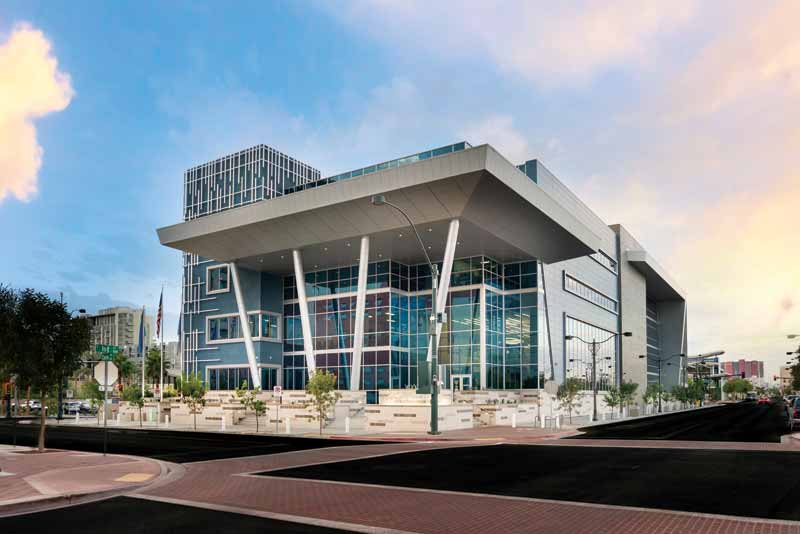
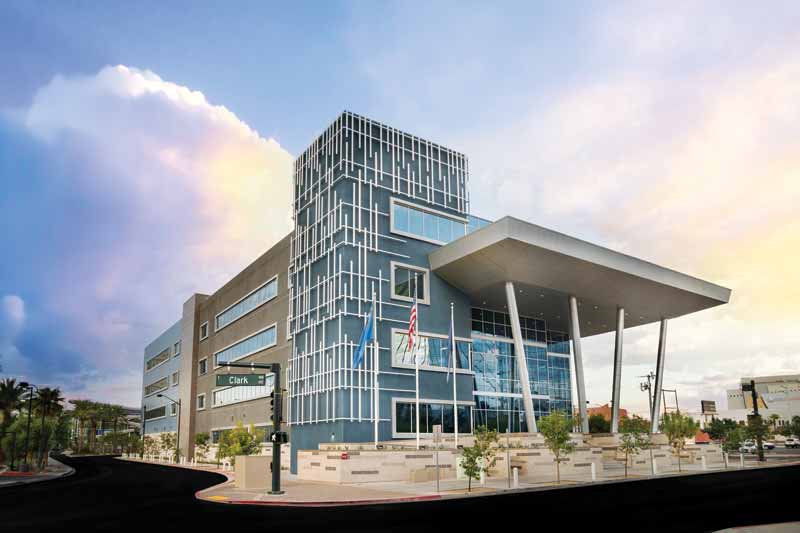
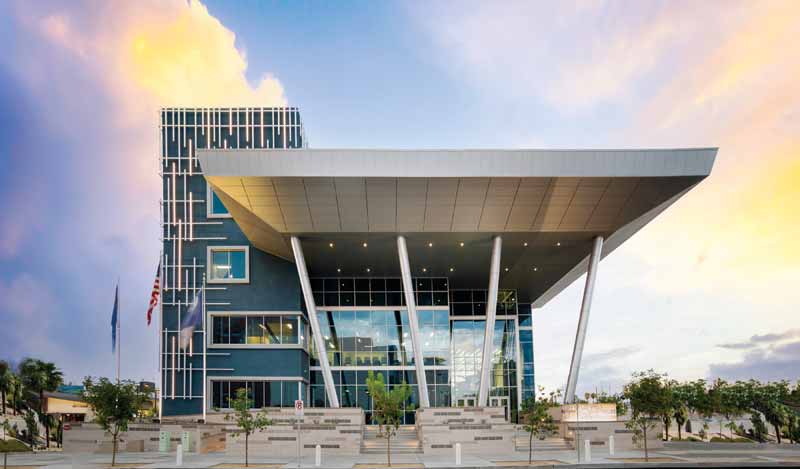
In Las Vegas, Nevada, new buildings, which are constantly rising as part of the ever-changing skyline typically consist of casinos, resorts, and hotels. When the City of Las Vegas envisioned a new courthouse, the shorter two-story structure was designed to serve the community as an attractive, sustainable facility. Upon arrival, visitors come across metal walls and glazing, including an entry canopy constructed with IMPs.
Architects designed a courthouse compatible with the surrounding neighborhood and municipal buildings, while providing an efficient structure where employees would enjoy working and serving the community.
“IMPs were chosen because the R-value they offered for building envelope efficiency and performance,” says Lance Berrey, senior associate at PGAL, Las Vegas, who was also the contractor on the project. “Additionally, the panels helped create a smooth, contemporary facade that fit the aesthetic of a new modern and forward-thinking municipal court.”
More than 1,950 m2 (21,000 sf) of 50.8-mm (2-in.) IMPs comprise the entryway of the courthouse, delivering an R-value of 17.5 for the facility. The flat profile of the panels improves the performance of the building and enhances the interior for staff and visitors.
The IMPs make up the canopy and most of the exterior walls of the building and are integrated with a glass curtain wall at the entrance for a warm and inviting entryway.
Enduring performance
Choosing IMPs for a building’s facade is a sound investment, as they deliver durable and enduring aesthetics, longevity, ecologically friendly materials, construction efficiency, and energy savings, and more. In an evolving construction market which requires sustainable, high-performing, and eye-catching building materials, IMPs are a single-component solution.
In the same way that a thermos keeps cold water cool without causing condensation on the outside, IMPs provide a comfortable interior environment for occupants without thermal energy loss and moisture penetration. A protected building envelope is guaranteed by the improved thermal protection and decreased air leakage.
Kevin Franz is the southeast business development manager at Metl-Span, a Nucor company. He is also a member of AIA, and accredited in NCARB, BECxP, CxA+BE, USGBC and GBCI, CSI, and CDT.