


Photo ©Florian Holzherr
At the edge of Boston Harbor, an unlikely structure has emerged as one of the city’s most distinctive destinations for contemporary art. The ICA Watershed, a seasonal satellite facility of the Institute of Contemporary Art (ICA), occupies a formerly derelict 1,394-m2 (15,000-sf) factory in East Boston’s historic shipyard. Once home to copper pipe and sheet metal production, the industrial space has been thoughtfully reimagined into a luminous venue for immersive installations and public programming.
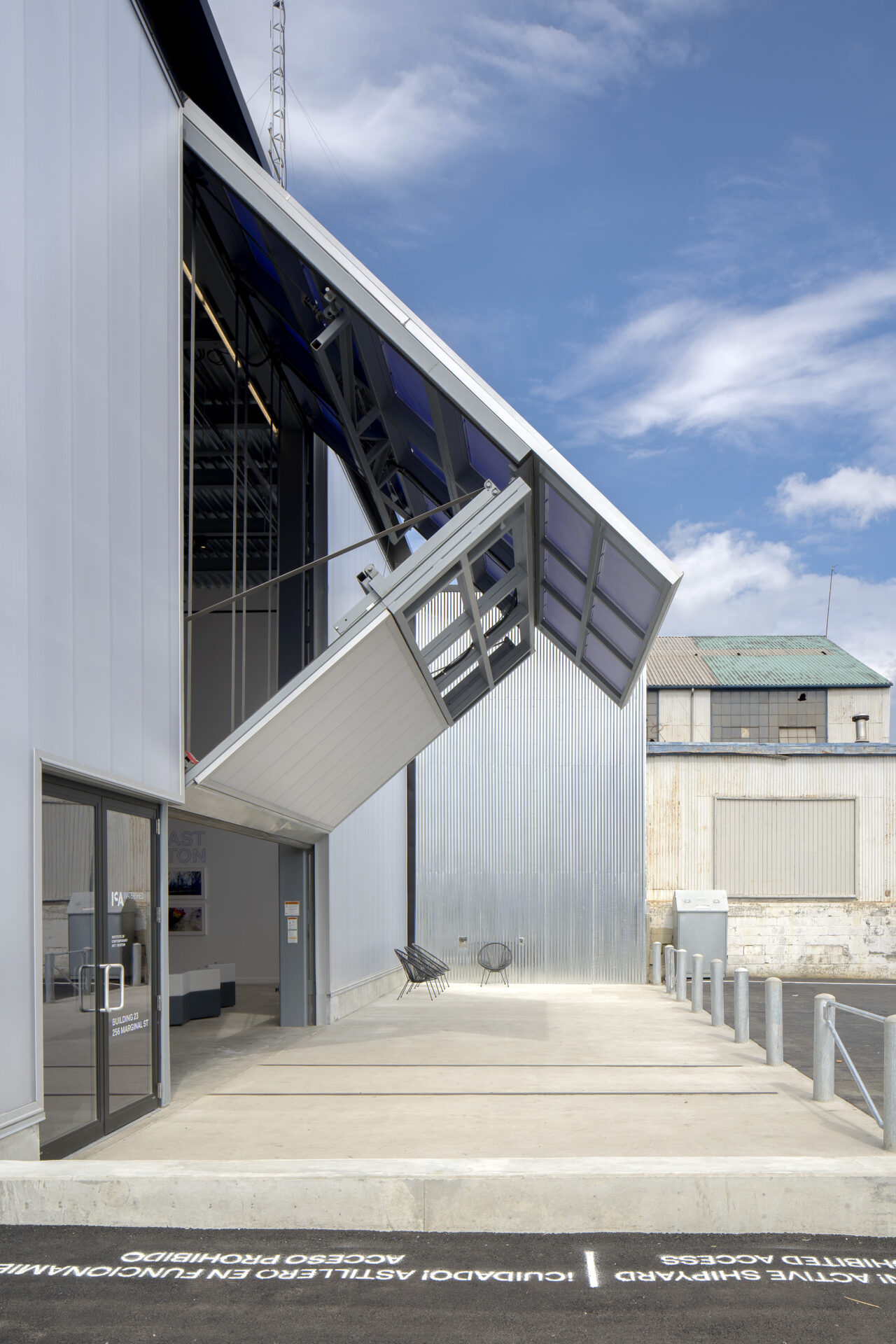
Photo ©Florian Holzherr
Two large bifold designer doors are crucial to the building’s transformation and architectural expression. Custom-engineered for aesthetic and performance requirements, the doors reflect not only the ICA’s goal of accessibility but also the architects’ commitment to honoring the building’s industrial heritage while opening it to new public life.
The ICA Watershed’s renovation was led by Anmahian Winton Architects (AW), a firm recognized for its inventive adaptive reuse work. According to ICA chief operating officer Michael Taubenberger, the design team’s vision from the outset was to create a facility that physically and symbolically welcomes the public.
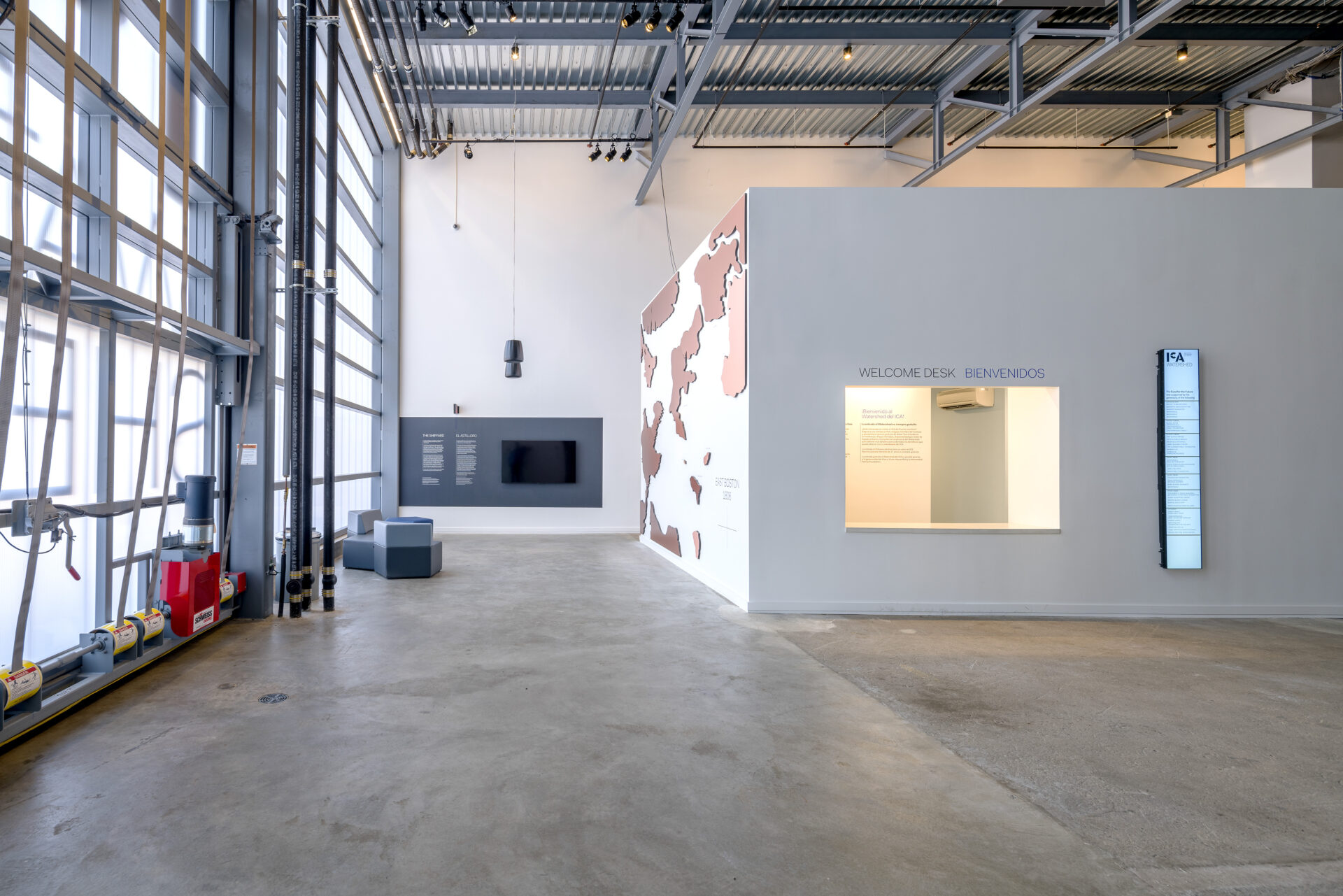
Photo ©Florian Holzherr
“[The architects] wanted to create a dramatic and inviting opening on both ends of the building with the goal of reinforcing the welcoming and inviting mission of the ICA Watershed,” Taubenberger explains. “From the beginning of the project, we had imagined using these walls and the large doors as a big, inviting sign to draw visitors to the space.”
Schweiss Doors collaborated closely with the project team to bring this vision to life. The result was a pair of bifold liftstrap doors—each 4.8 m (15.75 ft) wide, one standing 6.02 m (19.75 ft) tall and the other just slightly taller at 6.1 m (19.9 ft). While bifold doors are commonly specified for industrial and aviation applications, their use in this cultural setting demonstrates their architectural versatility.

Photo ©Florian Holzherr
For this project, designers engineered the doors to include a unique overlapped panel design. Brent Krzmarzick, engineer and draftsman at Schweiss, notes how this requirement posed an interesting technical challenge. “The architect wanted us to design and engineer the door so that a secondary frame for the top half of the door would overlap our primary doorframe members for the bottom half of the door,” he says. “This appealing design was a challenge because we have never done this concept in the past.”
The result is a striking visual element that complements the Watershed’s exterior cladding and enhances functionality. When open, the doors form a canopy-like effect, offering shade for the building’s outdoor terrace on one side and creating a distinct threshold on the other.
Industrial materials meet modern performance
In keeping with the shipyard’s industrial character, the ICA and AW architects selected translucent polycarbonate cladding for both the doors and the adjacent walls. The material, supplied and installed by Extech Exterior Technologies, delivers high impact resistance, daylighting performance, and a lightweight profile ideal for bifold applications.
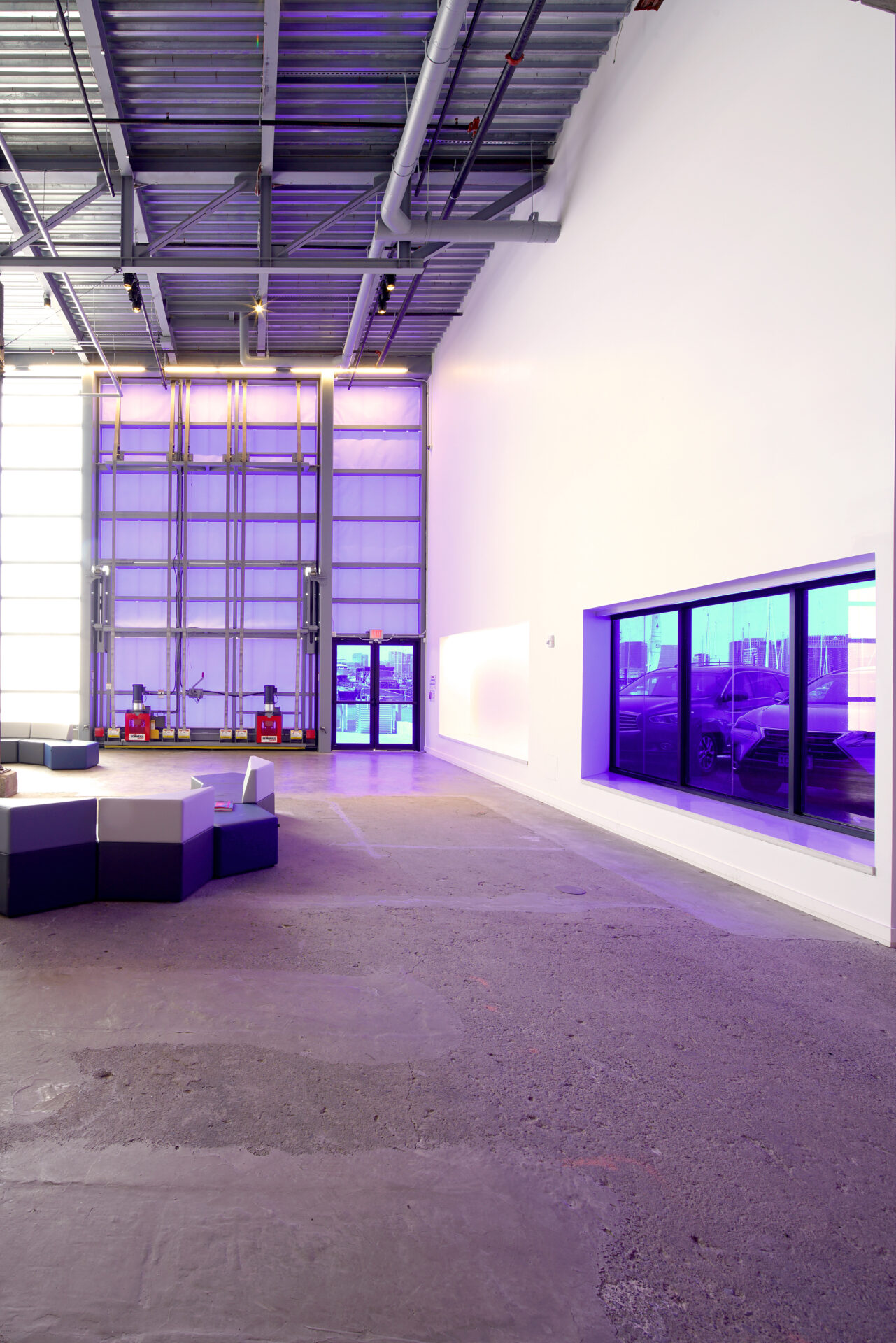
Photo ©Florian Holzherr
“Translucent polycarbonate cladding was selected for the door for a number of reasons,” says Taubenberger. “Since the building is only 15.2 m (50 ft.) wide by 91.4 m (300 ft.) long and the two short ends were the only opportunity to bring daylight into the space other than skylights, a material that would allow these ends to be as luminous as possible was necessary.”
The design allows natural light to penetrate deep into the interior during the day while enabling the building to emit a soft, diffuse glow in the evening, making it visible from across the harbor and helping it stand out from neighboring metal-clad industrial structures. “The architects also wanted a material that resonated with the industrial nature of the shipyard,” Taubenberger adds. “The translucent polycarbonate allowed us to completely cover each end of the building with light-diffusing panels.”
This material choice was familiar to AW, who had previously used it on a smaller bifold door project. “We liked it for a few reasons,” says architect Nick Winton. “It allowed us to hinge the door in the middle of the wall to give a maximum opening. It also creates the illusion that the opening underneath was smaller, and my favorite thing is that when the door is open, it creates a nice canopy effect.”
Inside, the doors provide consistent diffuse lighting that is ideal for art viewing. Outside, they maintain visual continuity with the surrounding building envelope while offering high performance in coastal conditions.
Function, flexibility, and identity
In addition to daylighting and aesthetics, the bifold doors meet critical operational needs for the facility. Their generous height and width provide the clearance necessary for transporting large-scale artworks directly into the exhibition space, a requirement for a venue focused on immersive, site-specific installations.
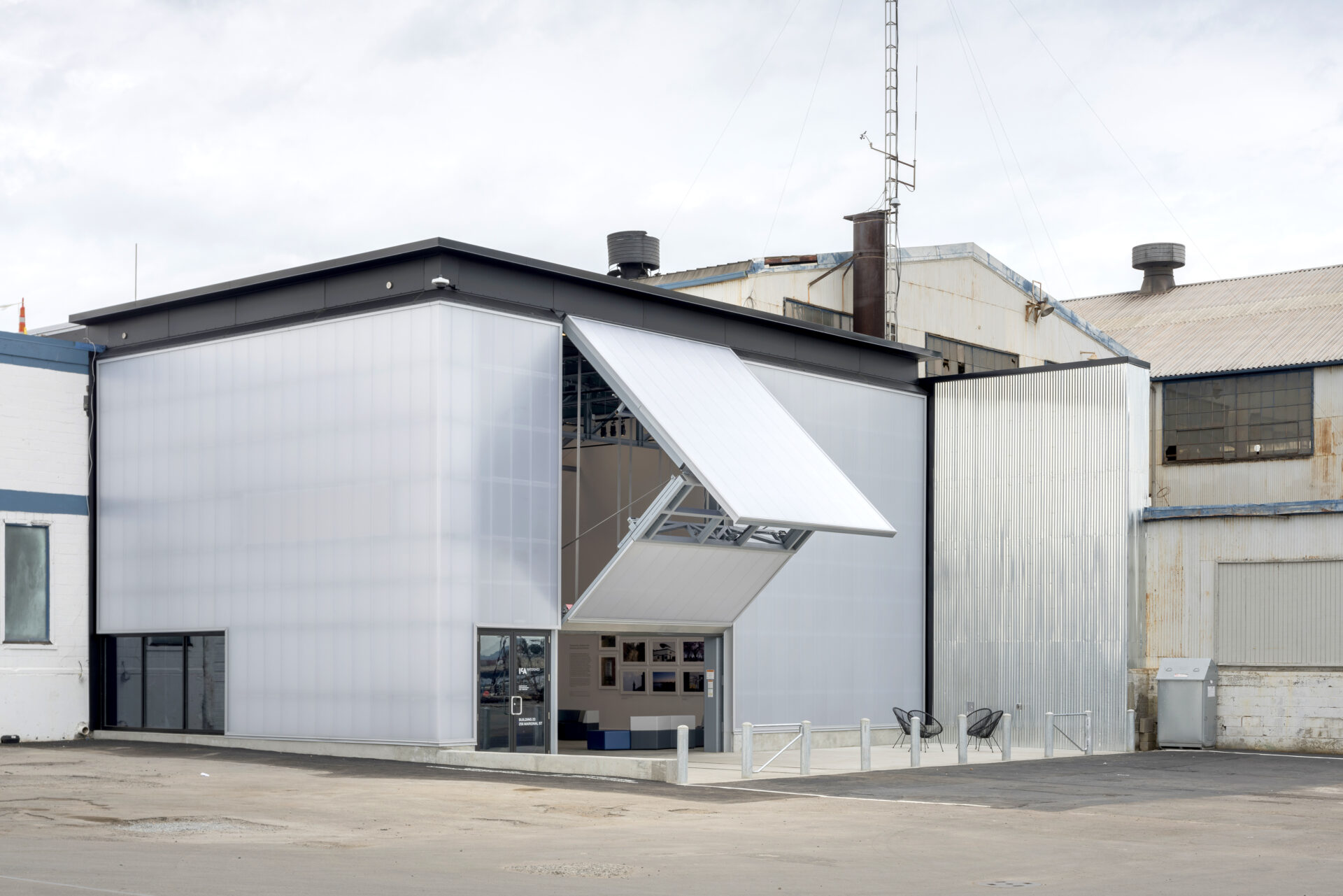
is just slightly larger than the entrance door. The big doors, usually kept open during the day, are convenient for cross ventilation and for bringing in large art displays.
Photo ©Florian Holzherr
“We wanted big doors that could give the double duty of ventilation and to bring large art displays in,” says Winton. “We also wanted to be able to connect the interior space of the Watershed to the surrounding site, making it more a part of the shipyard that it is in.”
Both doors were fitted with electric photo eye sensors, door base safety edges, and an emergency backup system to ensure public safety and reliability. The doors’ liftstrap system—which Schweiss offers as an alternative to traditional cable-driven mechanisms—allows for fast, smooth, and quiet operation. “The liftstraps are great, and the doors are very heavy-duty, work well, are very quiet, and open very fast,” notes Casey Wilcox, project manager for general contractor Stack + Company.
Aesthetically, the bifold doors also serve as brand signifiers. The front door is emblazoned with the ICA’s Watershed logo, designed in partnership with international design consultancy Pentagram. The logo is split between the upper and lower panels of the door. It remains visible even when the door is partially open, reinforcing the ICA’s visual identity and the sense of invitation that defines the building.
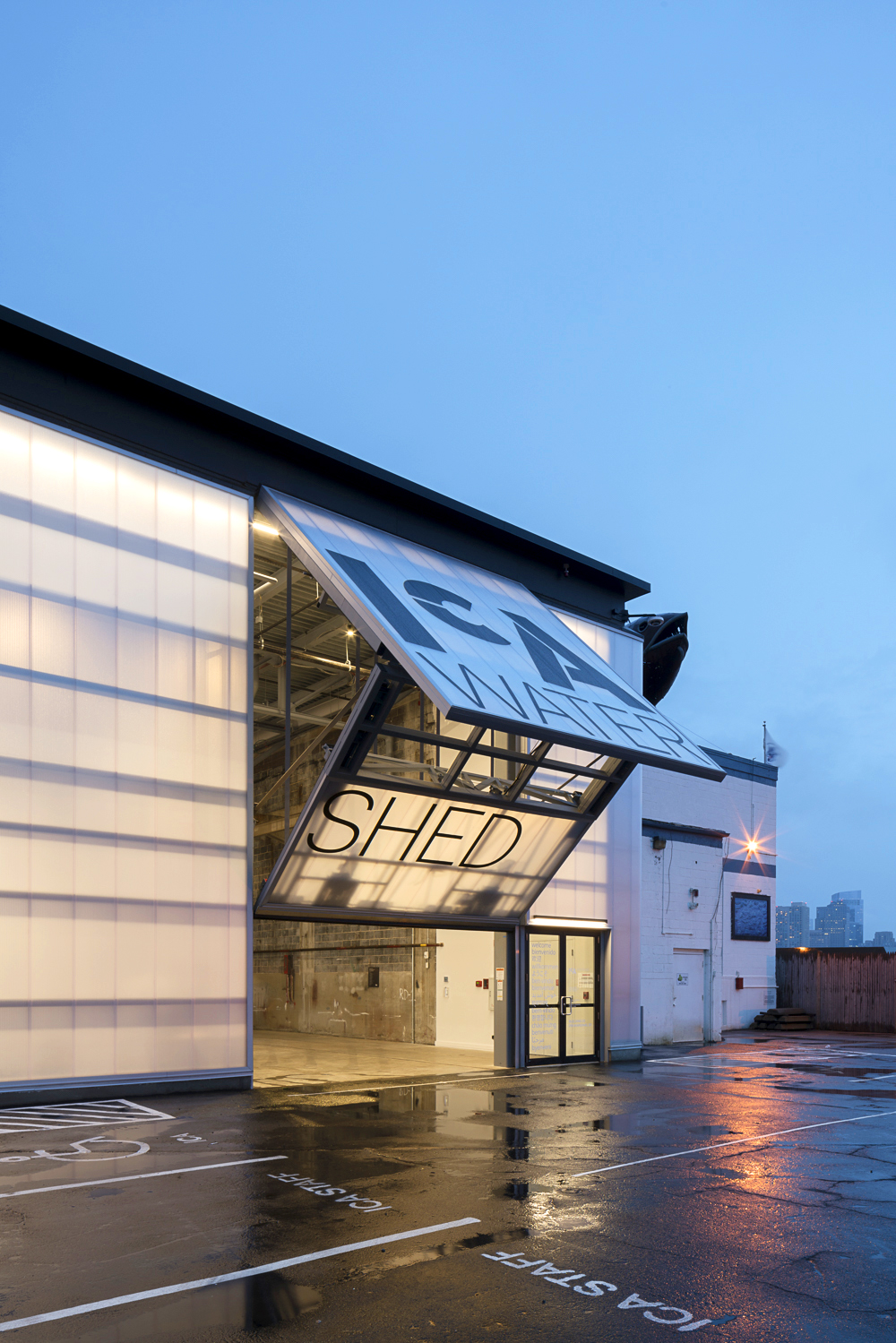
Photo ©Florian Holzherr
Taubenberger notes that the architectural team originally considered a range of door solutions, including sliding panels and traditional overhead models, before deciding upon the bifold design. “Ultimately, the bifold door worked best to achieve AW’s design intention,” he says. “The architects really liked that the bifold doors did not impede any of the interior space and were able to accommodate the large opening they had designed.”
Doorway to the future
Open during the warmer months, the ICA Watershed has quickly become a vital extension of the ICA’s mission, offering visitors immersive experiences that reflect contemporary social, political, and environmental issues. The building’s accessibility is symbolic and physical, with the bifold doors playing a central role in realizing the institution’s goal of openness.

on the opposite side
of the entrance.
Photo ©Florian Holzherr
As Taubenberger puts it, “The doors are intended to be open during regular hours for visitors to use and to bring in larger-than-usual art displays, as well as a welcoming gesture—a big open door to the community.”
The ICA Watershed exemplifies how metal doors can go far beyond utility to become powerful design elements by blending architectural vision, industrial materials, and custom-engineered functionality. In doing so, they helped turn a former metal factory into a beacon of culture, light, and community on Boston’s historic waterfront.