

Photos courtesy Archimania
The visual appeal and practical benefits of copper panels continue to spark interest from architects and building owners who appreciate this distinctive, high-performing material. Copper’s exceptional workability enables design teams to add unique perforated patterns to elements such as textured exterior rain screens and decorative interior panels. Further, the proven durability and low maintenance requirements of copper materials provide the potential for a service life measured
in centuries.
Innovative perforation approaches generate nearly infinite customization possibilities. Architects and designers can use perforated copper panels not only to enhance the aesthetic intent of a project, but also to serve practical purposes such as allowing ventilation, managing daylight and solar heat gain, and establishing privacy.
Academic, institutional, religious, and residential structures in particular feature complex architectural elements that need to last for decades. Several winners of North American Copper in Architecture (NACIA) awards from the Copper Development Association (CDA) and help illustrate excellent design and fabrication possibilities.
Circular perforations: Ballet Memphis
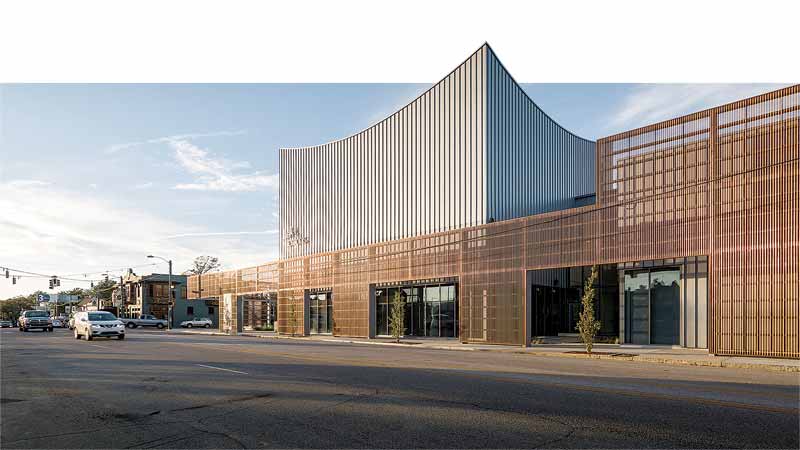
In their design of a new rehearsal and teaching space for Ballet Memphis, Grinder, Taber, & Grinder created a screen of semi-transparent copper facade panels that shield the front of the building. Copper panels from Petersen feature undulating profiles with circular perforations, providing both shade and a level of privacy from passing cars and pedestrians. The design team cited copper’s “inherent sculptural quality and natural patina process” as critical to the transformative look they sought to establish.
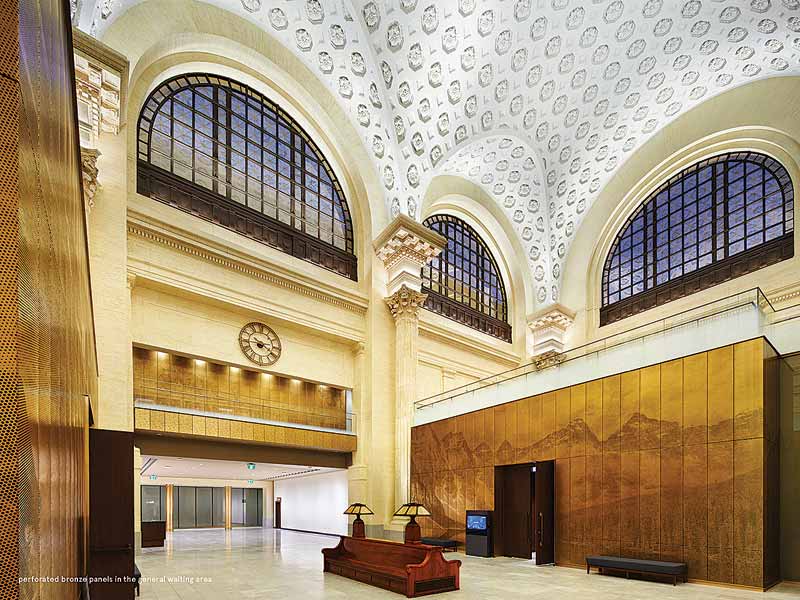
Photo courtesy Tom Arban
Decorative bronze panels: Senate
of Canada Building
A renovation led by Diamond Schmitt Architects and KWC Architects in joint venture converted the Union Train Station in Ottawa, Ont. into a government administration building. Decorative panels formed from bronze (typically an alloy blending copper and tin) help define two Senate committee meeting rooms, showing scenes from both nature and history. The design team described their intent to purposefully include “both traditional and modern craft, establishing a rich narrative of distinctly Canadian landscape, imagery and identity.” Fabricators MCM 2001
perforated the panels to create detailed renderings employing a process similar to that used for halftone photographs in newspaper printing.
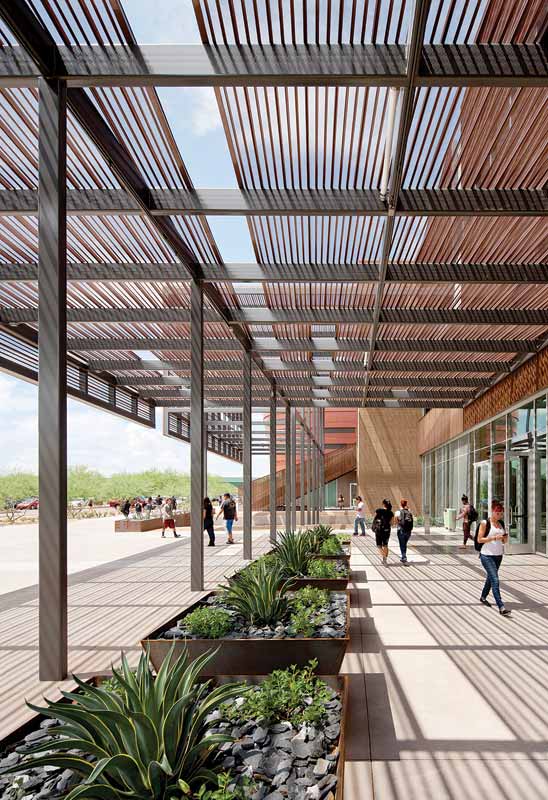
Perforated copper panels provide “breathable shade” in harsh temperatures.
Photo courtesy Bill Timmerman, Liam Frederick
Perforated copper panels: GateWay Community College
When selecting a cladding material for this Phoenix, Ariz.-based urban campus, SmithGroupJJR weighed the location’s desert climate, specifying copper for its resilience and low maintenance. They created a screen of perforated copper panels across the entire south-facing elevation to provide “breathable shade” in the harsh temperatures. The perforated panels also define a number of sheltered outdoor spaces, including terraces, balconies, and stairways. Carefully calculated panel configurations minimized waste by optimizing spans and sizes.
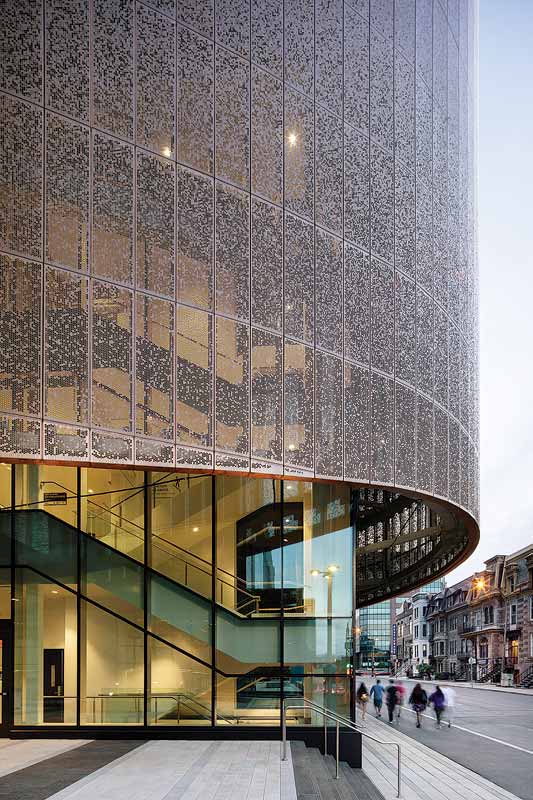
Photo courtesy Adrien Williams
Fine diaphanous lace: CHUM Auditorium
A triangular auditorium serves as a focus of the Centre Hospitalier de l’Université de Montréal (CHUM), a leading health center and medical research facility. Perforated copper panels envelop the structure, called the Pierre Peladeau Amphitheatre, beckoning visitors onto the CHUM campus. A blend of opaque copper panels and perforated, semi-transparent screens preserve the intimacy of interiors while also maintaining appropriate connections with the surrounding environment. The perforated sections have a multitude of small circles that recall “fine diaphanous lace,” according to the design team. The copper material also nods to copper featured on historic buildings across Montreal, Que. including City Hall, Windsor Station, and countless churches across the city.
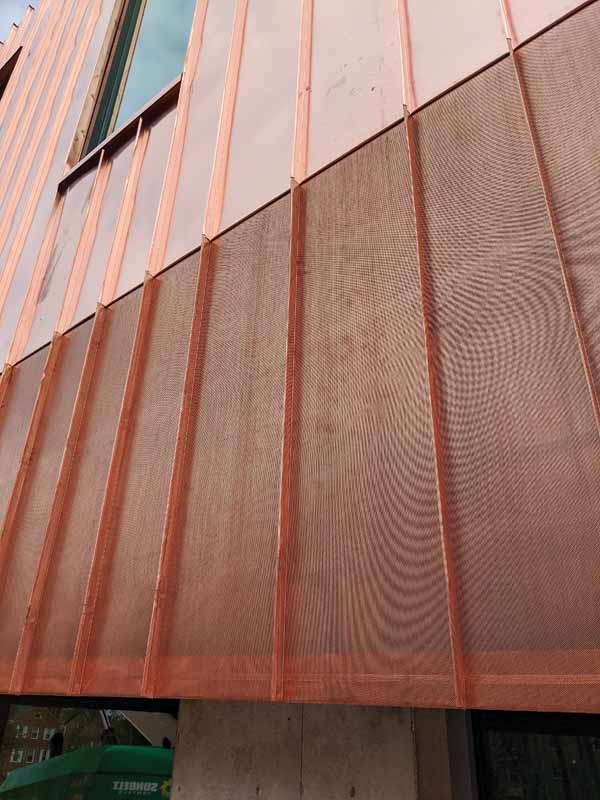
Photo courtesy Bill Timmerman, Liam Frederick
Custom-perforated square
and rectangle pattern: Wood House
The visual impact of copper combines with a custom-perforated pattern of squares and rectangles to define a unique aesthetic for this residence in Chicago, Ill. Architects Brininstool + Lynch worked with Chicago Copper & Iron Works to design and fabricate the panels, some of which also included embossed designs. The team then hand-treated the panels to create a patina that blends hues of blue, green, and bronze, complementing the brick, steel, and glass structure. Additional considerations for selecting copper included its corrosion resistance and low maintenance needs; both are a particular benefit for perforated surfaces.
Standing-seam panels: Lubber Run Community Center
Designed by VMDO Architects, this recreational facility and community gathering place replaces a facility originally built in the 1950s. The exterior features a rainscreen facade clad with standing-seam copper panels selected to naturally patina and require little care. In several locations, the panels were perforated to allow daylight and views from interior spaces, while maintaining a consistent appearance around the building perimeter.
As these projects show, the ability to perforate and customize copper panels helps them suit various styles and design preferences. Their visual appeal and resilience create distinctive architectural elements that can enhance building exteriors, complement interiors, or both. Considering issues such as environmental conditions, panel configurations, patination, transparency, privacy, and light control will ensure alignment with technical and aesthetic specifications. CDA’s project managers and architectural applications specialists can assist in a variety of ways—from project design assistance to document and specifications review—assisting architects, specifiers, engineers, and contractors involved in any type of copper project. Visit the Architectural section of CDA’s website to learn more
Larry Peters is project manager and architectural applications specialist for the Copper Development Association (CDA), a U.S.-based, not-for-profit association of the global copper industry, bringing together the North American copper and copper alloy semis fabricators and global copper mining and production industries. To view more examples of how architects and designers are incorporating copper in today’s building systems and more, visit www.copper.org.