


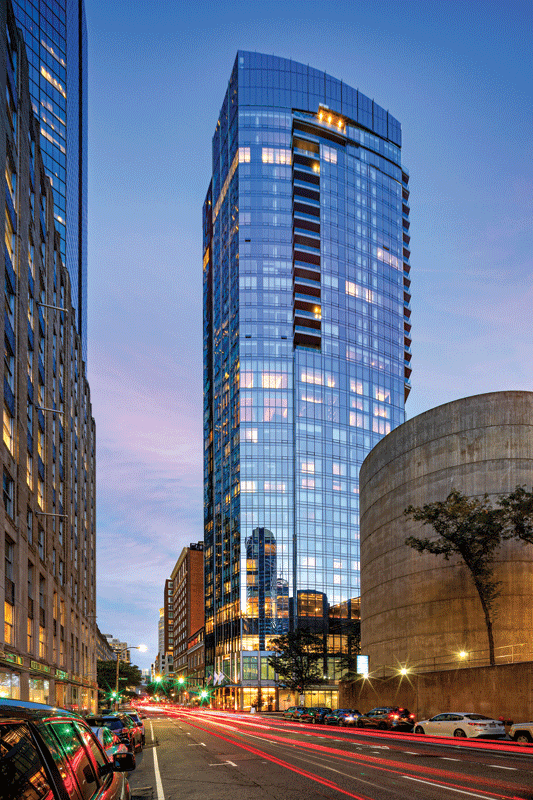
When the time came to revamp a narrow urban site into a new standard for urban high-rise architecture, innovative design and engineering strategy were needed. What is considered rare for Boston real estate development, the project team secured air rights over the historic neighborhood, allowing for a creative solution by TAT and structural engineer McNamara Salvia. At the new tower’s fourth floor, above the party wall with the University Club, a bold 9-m (30-ft)
cantilever now extends overhead and supports the tower’s upper 29 stories—another 104 m (340 ft) into the sky, with a second cantilever at the 17th floor. The cantilever approach yielded both programmatic and urban design benefits, granting the tower a contextually scaled street presence while also allowing the building to express itself as a sculptural form on the upper levels.
Complex cantilever processes
This solution first required demolishing the eight-story Boston Common Hotel and Conference Center and separating its steel structure and walls from the University Club. To support the cantilevered structure, a dense field of 1.8-m (6-ft) wide caissons was drilled approximately 46 m (150 ft) into bedrock, followed by 680,389 kg (1.5 million lbs) of steel plate girders and more than 1,091 m3 (1,428 yd3) of concrete for the building’s 2-m (7-ft) thick mat slab.
“The complex process behind the cantilever design serves as a testament to the deeply collaborative approach that defined the entire Raffles project from start to finish,” says TAT principal Gary Kane, AIA, NCARB, LEED AP BD+C. “This landmark development, with a one-of-a-kind hospitality offering, called for unusually complex design and construction techniques—resulting in a design that seamlessly blends the qualities of global and local influences.”
High-rising challenges
The appropriate design solution required integrating the contemporary structure into a neighborhood defined by a dense low-rise historic architectural fabric. Another critical design challenge for TAT and its collaborators arose from the Raffles tower’s proximity to the Hancock, one of Boston’s most infamous skyscrapers. The juxtaposition to the 1976 tower created additional design constraints, resolved by the interdisciplinary team. TAT senior project manager Alexander Donovan explains, “A key challenge was not just visually differentiating the new structure from the iconic Hancock Tower but also accommodating the extraordinary wind conditions resulting from the Hancock’s scale and orientation.”
To address these considerations, TAT’s designers arrived at the Raffles tower’s profile, with its curves effectively responding to the intense wind load and distinguishing the design from its famously angular neighbor. “We thoughtfully chose glass curtainwall assemblies whose darker color provided a harmonious contrast to the Hancock while also granting an optimal mix of vision and reflectivity for both residential and hotel uses,” adds Donovan.
Next level lobby
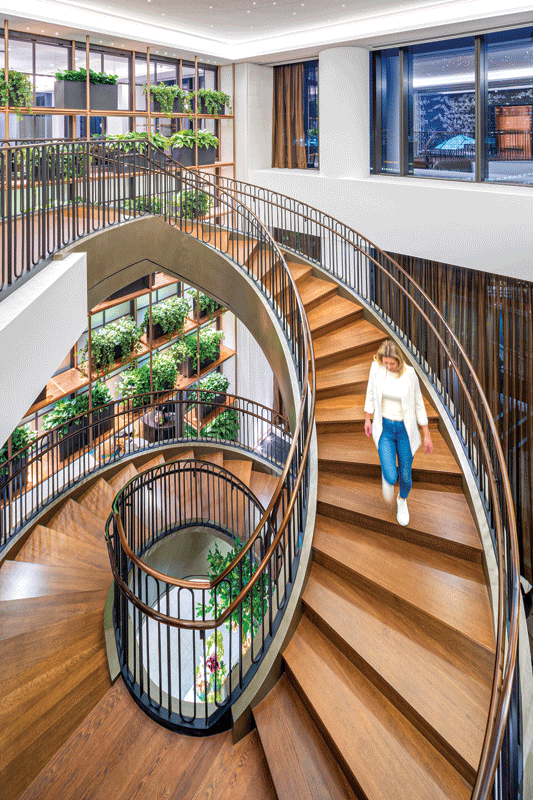
With an intricate mixed-use program, the Raffles tower project team deployed an equally creative approach to the building’s interiors with the residential palette relies on warm materials, greenery, and a focus on the outdoors. Upon entering, hotel guests ascend to the 17th floor Sky Lobby, and its Grand Stair—a signifier of the Raffles brand—which spirals through the three-story area.
According to Alexander Donovan, TAT’s senior project manager. “The design concept for the stair and living garden wall were by Stonehill Taylor, who designed the hospitality interiors.” Donovan says the garden wall is intended to be evocative of Frederick Law Olmsted’s Emerald Necklace, an 11-km (7-mi) long chain of parks, parkways, and waterways woven throughout Boston. The extents of the wall and plantings work in conjunction with the city-facing glass curtainwall to accentuate the height and proportions of the 3-story grand stair.
Donovan also says the structure of the wall is painted, welded steel, with copper clad shelving for the plantings and copper laced accents at the intersection of horizontal and vertical tubes. “These copper lashing details at the joints as well as the copper shelving are part of a larger historic nod to Paul Revere’s copper mill.”
Teamwork makes a grand stair work
Michael Liu, AIA, NCARB and TAT senior partner and design principal says, “Approaching the stair, new vistas open up to the 2-story sky terrace to the left. It is constructed of mild steel and concrete, with an ornamental balustrade—with traditional details and yet very contemporary.”
The structural analysis and sizing of the steel members for the garden wall was provided by Stone Fleet, Inc. Structural Engineers. The construction and assembly details were developed by TAT. The system was fabricated and installed by McGregor Industries, of Dunmore, Pa. Copper shelving was provided by Provincial Store Fixtures Ltd. The teamwork does not end there.
The structure for the grand stair was developed by McNamara Salvia. Construction details for the stair, steel rails, and finish materials were created by TAT. The stair is composed of formed steel plates welded into box sections to achieve the curved freestanding aesthetic while providing the required structural rigidity of a 3-story public stair. The guardrail balusters are painted steel sections with solid, extruded, oil rubbed bronze rail caps and bronze handrails. Like the garden wall, the steel fabrication and installation were done by McGregor Industries.