

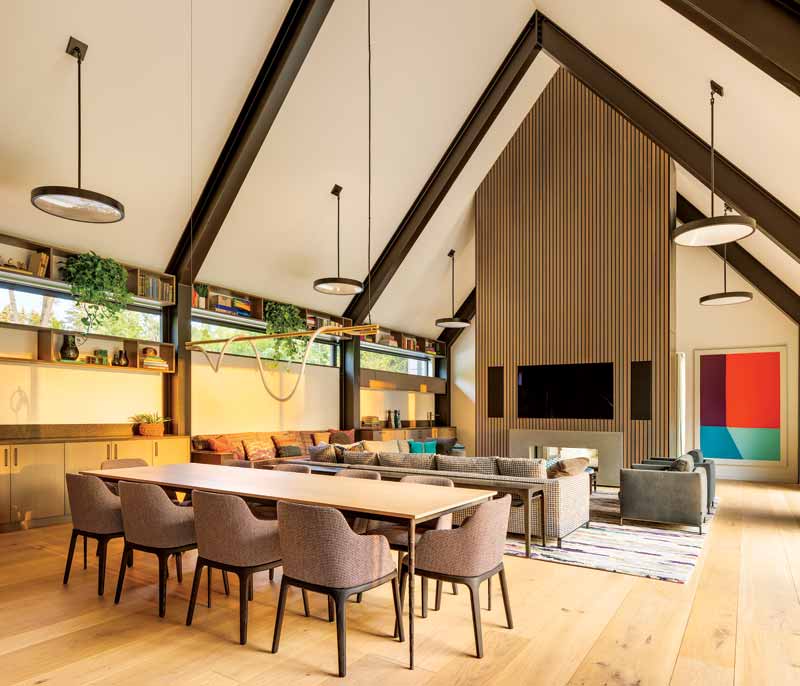
Tucked away on a private park-like 1.4 ha (3.5 acre) in Franklin, Mich., Briarcliff has been described as “a house in two acts.” Balancing a historical sophistication with a playful interior, it is perfect for the residents who are big on music and theater. The home’s design was inspired by rural Michigan farmsteads—collections of gabled-roof structures built over generations. These familiar forms connect the home to its historic context, but modernized by building techniques, materials, and innovative detailing.
Metal infused charm
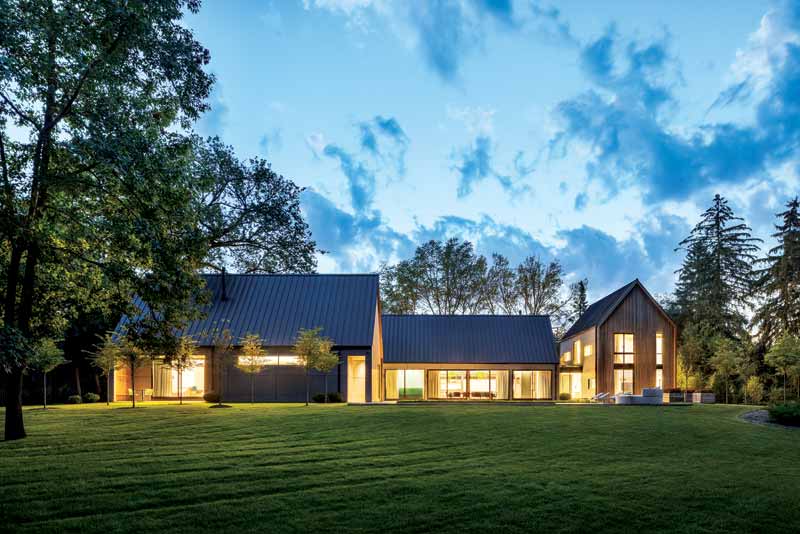
The home is separated into four distinct pavilions, creating clear separations. The programs of the four pavilions are:
- Primary bedroom suite
- Living and entertaining
- Private family area
- Garage
The living and entertaining pavilion, which is the longest of the four, runs side-to-side across the property. This program features exposed steel bents. According to David Iannuzzi from Iannuzzi Studio PLLC in Ferndale, Mich., they are called “bents” because they are both a column and a beam at the same time. They are a single, welded structural element, unlike a beam resting on a column.
Iannuzzi says the primary metal features are the standing seam metal roof and wall panels on the exterior.
A wall of custom millwork creates privacy from the front yard and the pavilion is bookended with forms that house, on one end, the hearth, clad in stained cedar and blued steel. Opposite, the kitchen features stainless steel counters and panels of emerald green urethane and stained walnut.
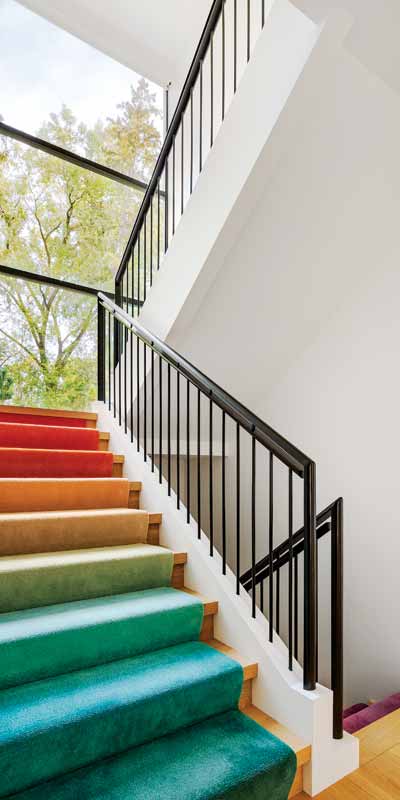
The kitchen has a monumental island fabricated entirely of stainless steel and the handrail is custom welded steel.
Style and performance
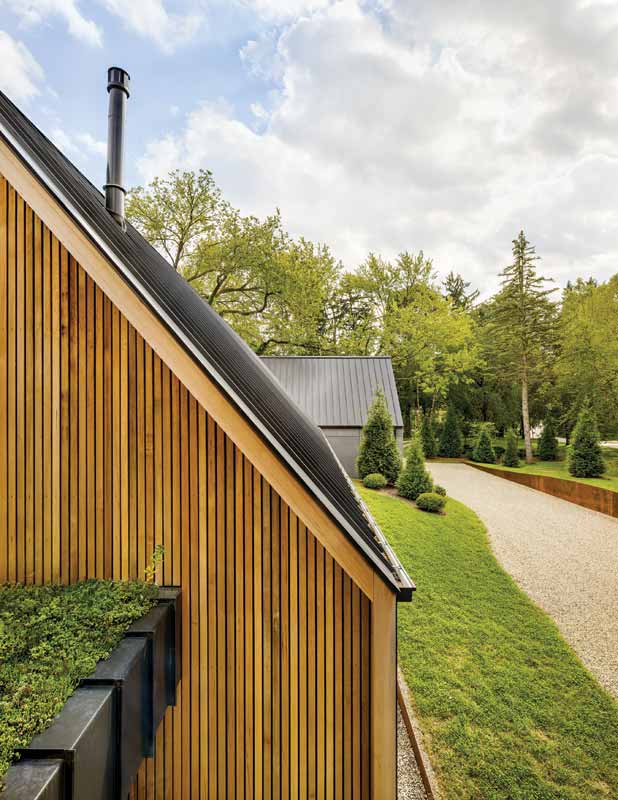
In considering the materials for the home, the client had two primary goals: durability and low maintenance. Each material on the home was selected with these goals in mind, especially the roof. Eco-friendly structural insulated panels (SIPs) form the roof, allowing 3.7-m (12-ft) spans between the steel bents without need for rafters or a ridge beam. Working with a reputable and experienced installer, Ianuzzi and team were confident the metal roof would provide the clients with decades of worry-free performance.
According to Iannuzzi, a standing seam metal roof fit the design team’s aesthetic concept. The home’s overall character is reminiscent of the classic form of a midwestern barn. The building’s simple profile and gables call to mind the landscape’s agricultural and industrial buildings. To blend those archetypes into a modern residence, the team selected a hidden fastener standing seam roof for its streamlined and minimal style.
Privacy maintained
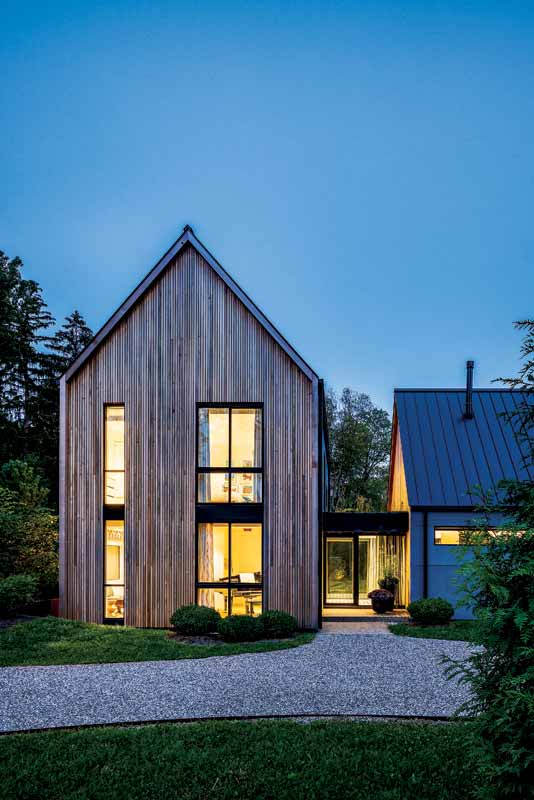
On the exterior, clear vertical-grain cedar planks clad the gable ends of each pavilion, accentuating their height and lightness. Adjacent to the cedar planks, the low, broad facades are clad in high-density cement fiber panels to ground the building and accentuate the length of these elevations. The cedar planks meet the cement fiber panels—both materials serving as open-joint, ventilated rainscreens—at a uniquely detailed “eyebrow,” creating a delicate shadow line over the sweep of the gable ends. The unfinished cedar planks will age as the building melds into the landscape. The flat roofs over the connecting hallways are covered in native grasses, contributing to a high-performance, low-maintenance structure.
From the perimeter of the site, the house seems tucked behind rolling hills, while a submerged motor court and Corten-walled walkways face the house. Iannuzzi says the 25 mm (1 in.) thick Corten retaining wall defines the border of the motor court. There are also 25 mm diameter Corten rods driven into the ground, acting as a fence around the perimeter of the home.
The combined effect aids privacy while revealing the clients’ whimsy and playfulness as one nears the home.
Creating conversation
The layout of clustered pavilions creates a sense of the building unfolding as it is experienced. The siting was not only minimally disruptive to trees, but also created a feature of a 100-year-old American Elm and Climbing Hydrangea. The home’s zones were carefully positioned with respect to environmental factors such prevailing winds, seasonal sun angles, and balancing privacy and view. Windows frame views of the beautiful natural setting and other components of the home itself. In this way, the outside is constantly invited into the home, for an ongoing conversation among the modern exterior, the warm interior, and the natural surroundings.