


People end up obsessing over things that I think are just purely about looks,” says Rick Harlan Schneider, FAIA, LEED AP. “I’d like to say that we’re delivering something that’s beautiful and it serves the community. You have to help mitigate the bad stuff that our buildings actually do. To me, that’s harder.”
A foundation of sustainability and community
Schneider is the principal of Washington, D.C.-based iSTUDIO Architects, which he founded in 1999. Earlier in his career, he had worked for other firms, and during that time he got involved in sustainability issues, and, when he founded his firm, that combined with a desire to community and civic work became driving forces. The firm was, he says, “dedicated to artful, sustainable community.”
He served on the board for the D.C. chapter of the U.S. Green Building Council in 2000, and was often called on to be a spokesperson for the sustainability movement. He worked with the National Park Service on sustainable building projects such as a demonstration of different green technologies for a sustainability fair on the National Mall, and was called on to consult with the U.S. Forest Service to work with sister agencies on international projects such as a nature center in Uganda.
Schneider has kept iSTUDIO relatively small. Currently, it has seven people in the firm. During the COVID-19 pandemic it jumped to 10 and has been as small as three.
Resilience and energy efficiency
For iSTUDIO, sustainability is in the DNA, but there’s more to the design philosophy than just that. Sara Alkhatib is a project architect at the firm, which she joined in 2020. She connects the sustainability to the aesthetic and the importance of metal panels this way. “We use metal components to create an identity to a building. The metal panels draw the eye and create a neighborhood icon. The other thing is we need to have a resilient design. We want something that’s durable. And we’re big on aesthetics, especially using vibrant colors. The buildings have a unique look, and with metal panels and components we can play with and customize it because they come in array of colors looks and textures.”
But sustainability comprises more than durability, and the metal components need to perform in other ways as well. “One of the aspects that matters the most is being energy efficient,” says Alkhatib. “The metal components for roofing or a wall must support LEED strategies or net zero strategies in a way that reduces the energy used by a building or maximizing the energy produced by a building.”
Schneider puts the final point on how metal components fit into the design philosophy. “Metal is an incredibly malleable and flexible material,” he says. “There are so many different ways to use it. I think the ability to do something thin and light and does a lot with a little is really great. Using it as an efficient resource.”
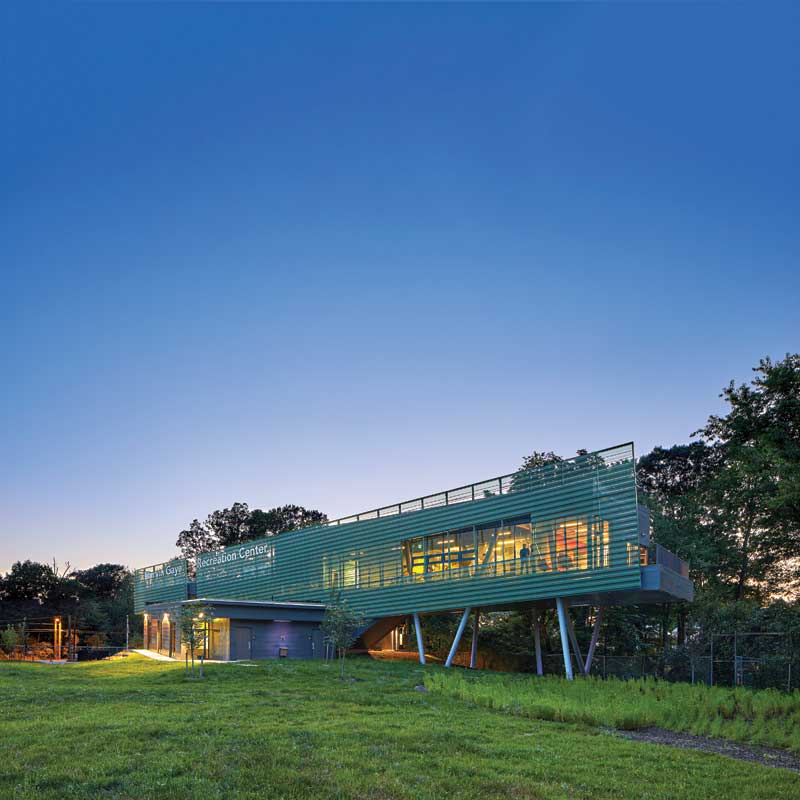
Schneider points to the Marvin Gaye Recreation Center as an example of how iSTUDIO flexed these attributes of metal wall components. The 7,200-square-foot facility was completed in 2018 and is LEED Gold certified.
“The second floor cantilevers out over a stream bed and faces south. It’s got a beautiful view over the green fields, so we put glass there, but glass is tricky,” says Schneider. Part of the motivation for doing that is to allow community members to enjoy the nearby woods and stream even if they are physically challenged. “All that south-facing glass is going to be a big problem with glare and heat issues. We designed it with a perforated metal screen that both controls glare and cuts down on solar gain in the building. That feature of the architecture is directly related to its purpose.”
A flexible use
The Van Ness Elementary School addition in Washington, D.C., showcases another way that iSTUDIO uses metal to support its philosophy and sustainable and beautiful design. The copper-clad walls match the existing masonry building and provide a durable material that will perform over time. Daniel Blair, AIA, NCARB was the project architect for iSTUDIO. He notes that the flat panels blend well with the curtainwall and the ribbed, perforated panels that clad the stairwell of the two-story building reduce heat gain. “It checks a lot of boxes,” he says. “We use it at the stairwell and the perforated panel keeps the space visually open, but also help it make it feel enclosed.”
The Washington, D.C., public schools (DCPS) were concerned that the building would need to be expanded again. This addition was the second, so iSTUDIO designed the project so two more stories could be added. “If DCPS ever changes its mind and says it wants to have the stairwell be enclosed, they can come in and close it. But the idea is that the canopy that is up there can be removed and the green roof can be taken apart, disassembled and then moved up two stories and reassembled. That is why we went with metal for that whole exterior piece.”
That approach, those philosophies, fit the foundational ideas that Schneider put in place when he established the firm in 1999. He says it succinctly this way: “You can design a building that’s beautiful. I think that’s easy, but I don’t know that you should get awards for doing just that. That’s the baseline, right? It should be beautiful and functional and green. To do all of that is hard. It’s a challenge to us as architects and designers that that we should rise to.
Photos courtesy Hoachlander Davis