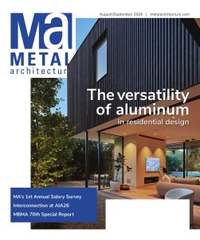
Aluminum, copper and zinc are all-natural metals found in a variety of architecture projects around the world. Known for having a long life cycle, their ability to be recycled and their durability, there are many reasons architects and designers turn to natural metals for both their residential and commercial projects. While these versatile natural metals have been used in architectural applications for hundreds of years, we turned to experts on each to discover the benefits and recent design trends of using natural metals in architecture.
Trends in architectural natural metals

Trade Fair, Frankfurt, Germany. Photo courtesy of Kalzip.
ALUMINUM
When it comes to aluminum, building and construction is the third largest single market in North America, behind transportation and containers/packaging. “Shipments to the market totaled around 3.4 billion pounds in 2017, around 12 percent of total shipments,” says Matt Meenan, senior director of public affairs with The Aluminum Association, Arlington, Va. “This was a 4 percent increase from 2016, continuing a trend of year-over-year growth dating back to 2011.”
Meenan adds that aluminum remains a primary material of choice for sustainable building. Scott Condreay, architectural engineering manager for Hydro Extrusions North America, Coraopolis, Pa., agrees, saying, “With energy efficiency and sustainable design top of mind for architects and developers, aluminum has grown as an alternative material solution as its overall life cycle promotes a much greener footprint, given the ability to easily recycle and reuse the metal.”
“Aluminum’s exceptionally high strength-to-weight ratio makes it especially useful as a structural material in building—reducing the need for other materials like steel, cement and plastics,” Meenan explains. “Architects can design lighter structures with greater design flexibility, while minimizing expenditure on foundations. Aluminum’s durability and corrosion resistance means it can remain functional in a building for many decades, often with little to no upkeep, reducing maintenance costs.”
Recent years have brought about a number of retrofit projects using aluminum to meet evolving environmental standards. “In terms of achieving sustainability, aluminum is an ideal low maintenance and structurally strong solution for retrofitting to meet high energy standards,” Condreay says. “Additionally, aluminum can help improve building ratings through energy performance, acoustic performance, renewable energy production, thermal comfort, optimization of daylight, raw material sourcing, material ingredients and innovation.”

Théâtre de Quat’Sous, Montreal, Canada. Photo: Yien Chao
Condreay expects the push for a more circular economy is a trend we should expect to continue. “The first step in a project should always be the deliberate choice of a sustainable material,” he explains. “With aluminum, you already have the added benefits of its ability to be recycled and reused without losing any properties and the re-melting process can save energy consumption by as much as 95 percent.”
Condreay notes anticorrosion finishes like zinc or Hydro’s HYBRAZTM/ or HYCOT M/ tube coating are currently trending. “By using these finishes,” he says, “buildings are made to last longer and it helps to cut down on the costs of maintenance, making aluminum a great lightweight and durable option.”
Aluminum is also being increasingly used in building interiors. “Using aluminum helps to reduce energy consumption, waste and helps with thermal insulation,” Condreay says. “With open-concept office spaces on trend, we’re also using a number of aluminum extrusions to frame glass walls/partitions, giving the illusion of an open-concept. Additionally, a number of the office furnishings are also made from aluminum, due to its durability and attractive cradle-to-cradle characteristic.”
“The future looks bright for aluminum in the building and construction segment,” Meenan says. “With a continued robust economy, increased demand for sustainable building products and a push for new infrastructure spending in the United States, the trend lines look positive for aluminum in the sector.”

Arizona State University, Biodesign Institute C in Tempe, Ariz. Photo: Nick Merrick, courtesy of CDA
COPPER
With sustainability and wellness emerging as two of the biggest trends in the architectural community, Stephen Knapp, director of sheet, strip and plate for the Copper Development Association, McLean, Va., says copper’s applicability to a variety of installations, including cladding, façades, solar screens and more, has led to these being tied to a project’s sustainability goals.
Copper installation trends are dramatically different from the way things used to be. “A few decades ago, the metal was most often used as a roofing material for religious, government and institutional buildings,” Knapp says. “Now we’re seeing the metal extend down from the roof onto the walls as a durable façade option, especially for commercial and residential structures.”
Ginny Bruce, senior inside sales representative at CopperCraft Inc., Fort Worth, Texas, notes that the company has been seeing more quotes for custom items such as domes and cornices. “We’ve had a spike in our decorative dormers, and a lot of that is in residential projects,” she says.
“The economy has helped,” Bruce says, “and in our business, we are more of a want business instead of a need. When people have more money to spend, they tend to buy higher valued items to add to their homes.”
The same applies to cities and governments. “When they have larger budgets to work with, instead of going with wood dormers, they are able to upgrade in the materials,” she adds. “And those are materials that will last longer than your typical wood frame.”

Cupolas for a residence in Austin, Texas. Photo courtesy of CopperCraft.
Additionally, Knapp says today’s designers are seeing copper as a viable option for sustainable building demands. As an environmentally friendly material, copper often requires no maintenance to keep its natural finish and appearance once installed. “As sustainability becomes a construction centerpiece, we expect the specification and creative installation of copper to increase,” Knapp adds.
Copper’s recyclability makes it one of the greenest building materials available. At the end of its service life, copper panels or shingles can be recycled with no subsequent loss to performance or material characteristics. “[Copper] boasts the highest recycling rate of any engineered metal and when considering only the copper used for the architectural sector, 72 percent is sourced from recycling,” Knapp says.
And, architectural copper can help achieve building certifications such as LEED, ASHRAE or WELL. For example, Knapp says, as more designers aim to achieve WELL Building Standard certifications, which is awarded to structures that provide their occupants advanced comfort, enhanced performance and overall wellness, copper’s use throughout building interiors will also increase.
Traditional copper comes in salmon-colored alloy C11000, but Knapp says they’re seeing a variety of alloys (different bronzes and brasses) being used. “These can take the form of panel or shingle systems and often can be different shades of yellows, browns, and even silver appearances. The other notable point about these alloys is that they don’t tend to patinate to a mature green as quickly as alloy C11000—or at all—in many parts of North America. Instead, these alloys often darken and develop a weathered appearance.”
Prepatinated or treated copper is available from various mills. “Architects and designers can obtain copper from some suppliers that is already a mature green or a variety of other natural colors, such as reds, browns, golds, silvers and more,” explains Knapp. “Regardless of the patina color, all carry the same life span and performance of traditional copper.”

High Street Residence Hall at Dickinson College in Carlisle, Pa. Photo: Chris Cooper, courtesy of RHEINZINK
ZINC
Charles “Chip” McGowan, president of RHEINZINK America Inc., Woburn, Mass., notes that in the past, zinc was traditionally used in roofing and for flashings associated with roofing. Due to more familiarity with architectural zinc than in the past, McGowan says there’s been an increased use on façades. “Zinc provides low-maintenance cladding as part of a system that will last a very long time,” he says.
When it comes to coatings and finishes, “There are quite a few companies offering specialty patinas in various colors,” McGowan says. “Coatings are being applied to zinc that do not replicate natural patinas, but offer alternative colors.”
“Architects and owners are embracing the natural weathering evolving appearance,” McGowan adds. And, they are embracing zinc for more creative applications beyond the traditional applications. These include zinc being used in counter tops and bar tops.
As architects and specifiers increasingly understand the attributes of zinc, McGowan notes there has been extensive use of perforated and textured zinc panels, including on parking structures and for sunshades. When perforated, McGowan says zinc forms a patina in areas that are perforated, eliminating the need for post painting. And, textured zinc offers a distinctive appearance as well. “Special finishes and patinas provide a range of colors and appearances,” he adds.
“Owners and developers are choosing zinc to make their buildings stand out,” McGowan says. “Architects and owners understand that it is only a small percentage of the overall cost to upgrade to zinc, and that life cycle cost is far less than other metals.”