

As building envelopes continue to evolve, facades are no longer conceived as passive cladding or simple weather barriers. Increasingly, they function as active design elements—shaping perception, expressing identity, and reinforcing architectural intent. For architects, the exterior wall has become a primary opportunity to communicate design values while meeting ever-growing performance expectations. Metal has emerged as one of the most versatile mediums within this shift, thanks to its ability to accommodate variation in form, finish, depth, and scale while meeting demanding performance criteria.
At the same time, expectations around constructability, schedule, and longevity have grown more complex. Architects are asked to deliver increasingly expressive facades while navigating tighter budgets, evolving codes, and intricate coordination requirements. In this environment, the relationship between design teams and manufacturers has become more integral than ever. The most successful metal facades are rarely the result of isolated specification decisions; they come from early collaboration that aligns architectural vision with fabrication realities.
Three recent projects—the Steel Dynamics installation at Fort Wayne International Airport, the Delaware Technical Community College (DTCC) Terry Building renovation, and the Burns & Scalo Roofing Headquarters—illustrate how metal facade systems can adapt across building types, aesthetic goals, and technical constraints. Though distinct in character, each project demonstrates how system flexibility, fabrication intelligence, and collaborative execution can expand what is possible in architectural metal.
Central to each case study is NEXGEN Metal Design Systems, a manufacturer whose approach positions metal systems as adaptable design tools rather than fixed products. Through these projects, NEXGEN’s role reflects a broader evolution in practice: manufacturers are increasingly embedded in the design process, helping architects translate ambitious concepts into durable, buildable systems.
NEXGEN Metal Design Systems: A collaborative approach to architectural metal
NEXGEN Metal Design Systems operates at the intersection of architectural vision and fabrication precision. With decades of experience in metal manufacturing and system engineering, the company supports projects from early design development through fabrication and installation coordination. NEXGEN focuses on high‑performance exterior wall systems, offering architects the expertise of a team that understands the building enclosure from rooftop to foundation.
Rather than offering narrowly defined, off‑the‑shelf products, NEXGEN emphasizes collaboration. Its technical design group works closely with architects, engineers, and contractors to shape systems that respond to project‑specific goals. The team leverages AutoCAD, Revit, Inventor, 3D laser scanning, and computer‑aided manufacturing tools to develop coordinated shop drawings, structural design calculations, and installation drawings. This integration between design and fabrication allows complex geometries, precise jointing, and performance‑driven details to be resolved before they reach the jobsite.
A defining aspect of NEXGEN’s approach is system flexibility. Its panel systems are engineered to accommodate variation in material, finish, depth, module size, and orientation without compromising performance or constructability. Across modular cassette systems like MOSAIC+ and fully tested rainscreen systems such as EVOLVE, this flexibility allows architects to use metal as an expressive medium, adapting it to different building scales and contexts while maintaining technical consistency.
Early engagement plays a critical role in this process. By participating during schematic and design development phases, NEXGEN can provide insight into panel optimization, constructability, and fabrication constraints before details are finalized. This collaborative model helps preserve architectural intent while reducing downstream risk—particularly on projects where geometry, finishes, or installation conditions introduce added complexity.
MOSAIC+ metal wall panels: modularity and dimensional expression
Two of the three featured projects utilize NEXGEN’s MOSAIC+ Modular Panel Series, demonstrating how a single modular system can support distinct architectural expressions. MOSAIC+ is a pre‑engineered cassette‑style rainscreen, designed as an architectural back‑ventilated panel system and manufactured with computer numerical control (CNC) technology to deliver economical precision. Panels are designed to accommodate variation in size, depth, orientation, material, and finish while maintaining clean lines, concealed fastening, and consistent alignment.
Rather than functioning as a flat cladding solution, MOSAIC+ can be used as a three‑dimensional design tool. Architects can introduce rhythm, shadow, and movement across a facade by varying panel depths, staggering modules, and shifting orientation from horizontal to vertical or angled layouts. The interlocking dry‑joint design supports back‑ventilated performance and compatibility with engineered facade attachment solutions that help address thermal bridging and energy‑code requirements.
Case Study 1: Steel Dynamics at Fort Wayne International Airport
Digital finishes and material innovation at civic scale
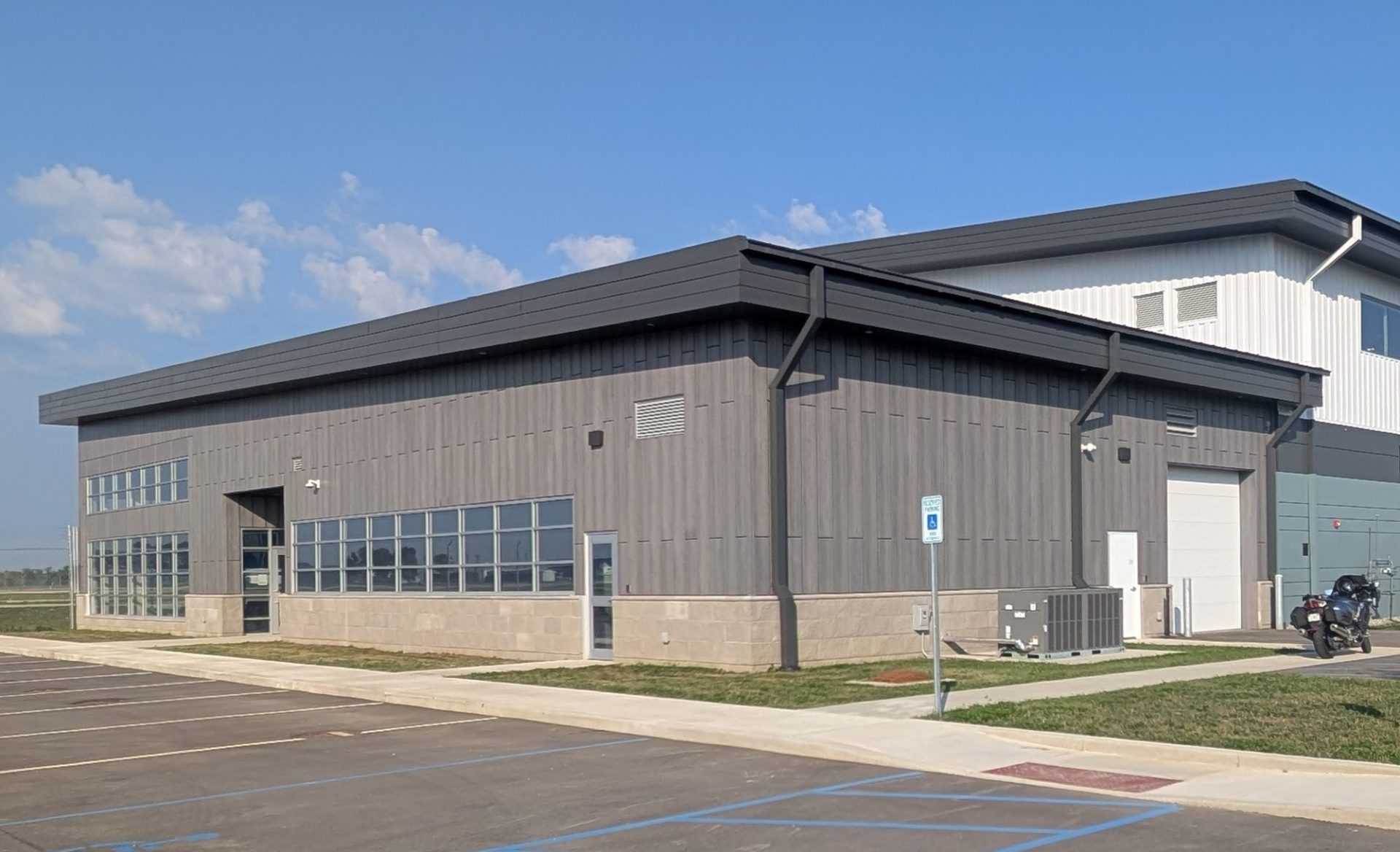
The Steel Dynamics installation at Fort Wayne International Airport represents a significant milestone for both NEXGEN and the MOSAIC+ system. This project marked the first use of MOSAIC+ panels fabricated in steel, responding to the durability demands of a high‑traffic transportation environment while supporting a visually expressive architectural statement.
Constructed from 22‑gauge Galvalume, the panels provide the rigidity and longevity required in an airport setting. Beyond material performance, the design sought to create a facade that communicated warmth, identity, and regional character within a large civic space. To achieve this, the project employs a layered palette of silver metallic, dark charcoal, and green tones, complemented by a digitally printed woodgrain finish.
The woodgrain application is particularly notable, representing the first use of SDI HD digital print technology on MOSAIC+ panels using customer‑provided artwork. By translating the visual qualities of wood onto a steel substrate, the facade challenges traditional assumptions about the aesthetic limitations of metal. Architecturally, this approach gives designers access to the familiarity and warmth associated with wood while retaining the durability, fire resistance, and maintenance advantages of steel. Fabrication required careful coordination to ensure color consistency, finish durability, and alignment across a complex, multi‑panel installation.
NEXGEN’s involvement extended beyond panel fabrication into finish integration and system coordination, ensuring that advanced surface treatments remained compatible with panel forming and installation requirements.
Architectural takeaway:
Digitally printed finishes, when integrated early into system engineering and fabrication planning, significantly expand the expressive range of metal facades without sacrificing performance.
Case Study 2: Burns & Scalo Roofing Headquarters, Columbus, Ohio
Depth, orientation, and corporate identity
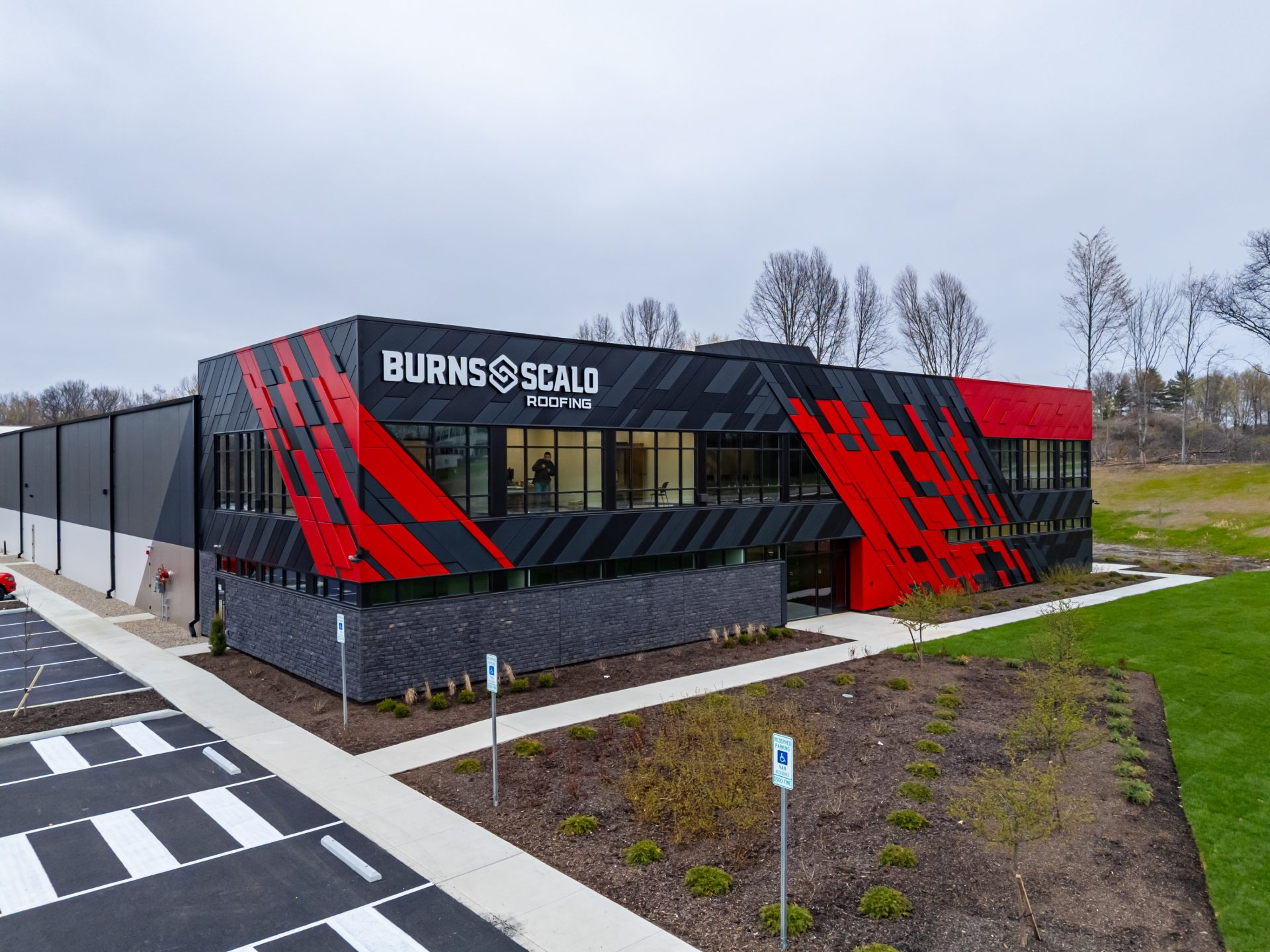
While also utilizing MOSAIC+, the Burns & Scalo Roofing headquarters delivers a markedly different architectural outcome. Here, metal becomes a primary branding and identity element, translating corporate values into a dynamic, dimensional facade.
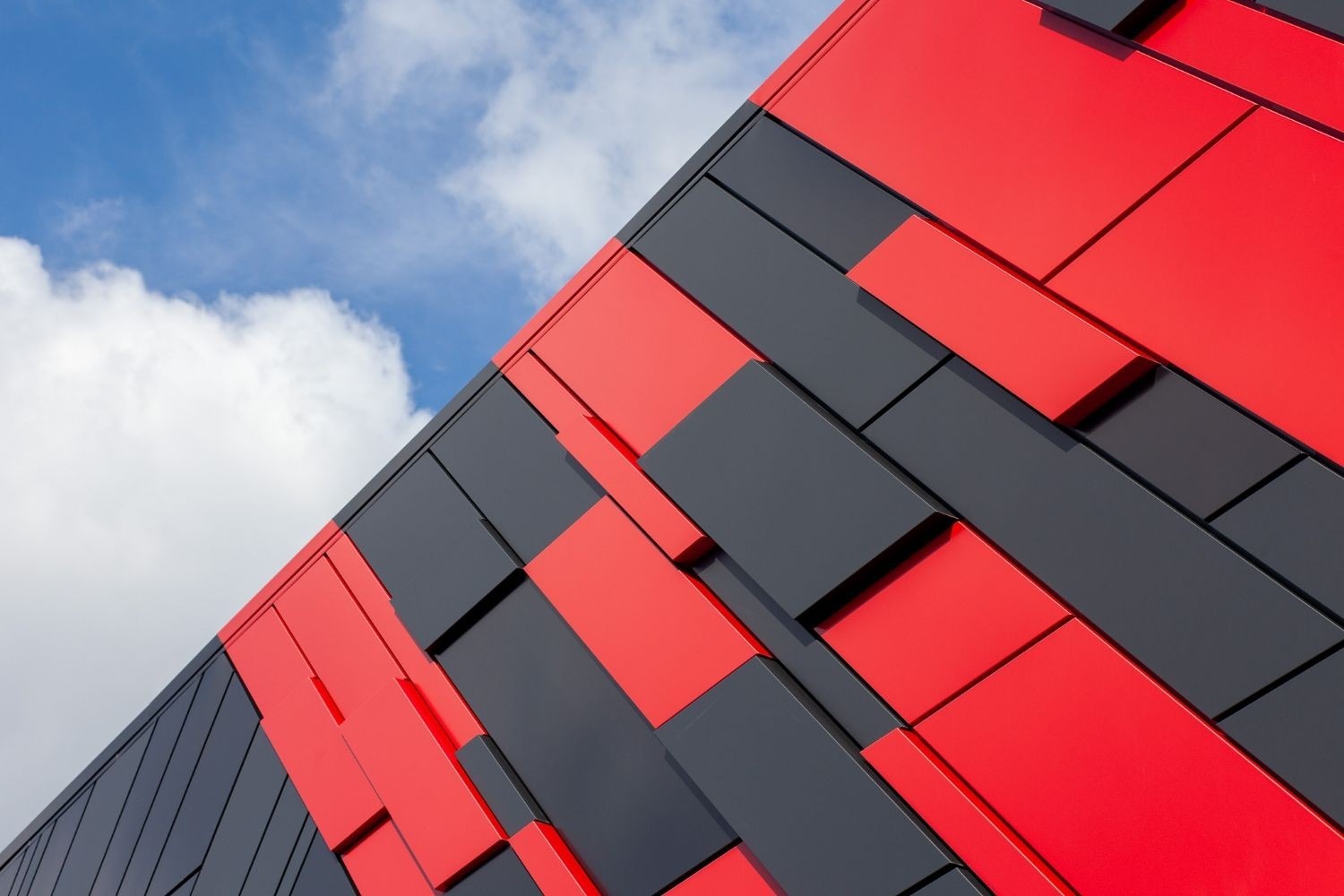
Panels are fabricated from 1.6mm (0.063 in.) aluminum, selected for its lighter weight and flexibility in accommodating complex geometry and installation conditions. The facade combines three colors—bright red, smooth black, and matte black—with four panel depths, installed at a 45‑degree orientation. This interplay of depth, angle, and color creates a horizontal rhythm that shifts with light and perspective, giving the building a sense of movement and energy.
Rather than relying on applied graphics or oversized signage, the facade itself becomes the primary communicator of brand identity. Variation in panel depth and orientation introduces visual intensity while maintaining material consistency across the building envelope.
Executing this design required precise fabrication and coordination. NEXGEN’s CNC‑driven manufacturing and detailed modeling ensured alignment, tolerance control, and installation feasibility across a facade defined by angular transitions and layered composition. Panel sequencing and attachment strategies were carefully coordinated to maintain visual continuity while supporting efficient installation.
Architectural takeaway:
Panel depth and orientation can function as primary design drivers, allowing metal facades to communicate identity and movement without relying on applied graphics or secondary materials.
Case Study 3: DTCC Terry Building—EVOLVE ACM Architectural Panels
Refinement and continuity in education
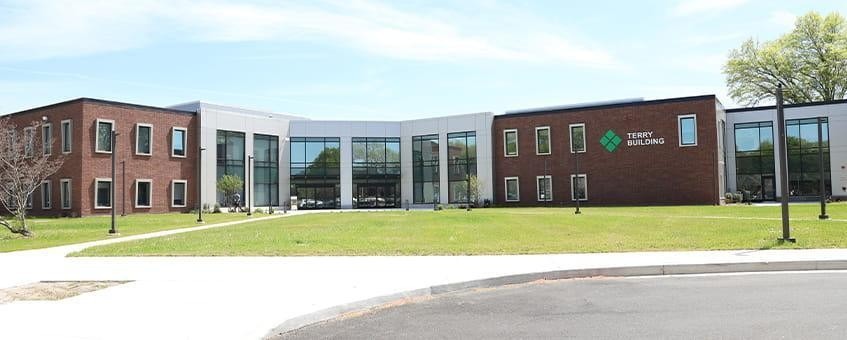
In contrast to the dimensional expressiveness of MOSAIC+, the DTCC Terry Building renovation utilizes NEXGEN’s EVOLVE Architectural Panel system to achieve refinement, continuity, and visual restraint. EVOLVE is a fully tested dry‑joint rainscreen system built around NEXGEN’s proprietary EVO extrusion, designed to create a continuous expression wall across the building surface without visible fasteners.
Fabricated from 4 mm (0.16 in.) aluminum composite material in a Champagne Metallic finish for this project, EVOLVE is characterized by smooth surfaces, concealed attachment, and clean transitions. These qualities make it well suited to institutional and civic projects where clarity, durability, and long‑term performance are prioritized. In the Terry Building renovation, the system reimagined the existing envelope while respecting the structure’s role as a central campus facility.
Rather than introducing dramatic dimensional shifts, the design focuses on material continuity and proportion. The uniform finish modernizes the facade without overwhelming the building’s function as a hub for student services, resulting in an environment that feels contemporary and welcoming.
Behind the scenes, EVOLVE’s tested assemblies and available NFPA 285‑compliant configurations support the life‑safety and code requirements typical of higher education and public‑sector work. NEXGEN’s comprehensive shop drawings, structural design calculations, and coordinated details helped streamline approvals and provided clarity for both the architect and the construction team.
Architectural takeaway:
When continuity and longevity are primary goals, refined panel systems with concealed attachment can modernize existing structures without competing with program or context.
Selecting Metal Systems as Design Tools
Across these projects, system selection plays a critical role in shaping architectural outcomes. Rather than treating panel systems as interchangeable cladding options, the case studies show how different systems support different design objectives.
MOSAIC+ lends itself to projects where depth, variation, and visual rhythm are central to the architectural concept. Its modular nature allows architects to explore dimensional expression while maintaining system consistency and constructability.
EVOLVE, by contrast, prioritizes smoothness, continuity, and precision. It is particularly effective in renovation and institutional contexts where clarity of form and material restraint support the broader architectural narrative.
Understanding these distinctions early in the design process allows architects to align system selection with design intent, rather than retrofitting aesthetic goals onto predefined products.
Fabrication technology and project execution
Across all three projects, NEXGEN’s fabrication infrastructure and technical services are as critical as the panel systems themselves. The company employs 3D scanning, CNC manufacturing, and facade-specific software workflows to translate architectural models into precise panel layouts, cutting paths, and attachment details.
Early collaboration allows panel grids to be rationalized, repetition managed, and transitions at corners, openings, and parapets resolved before fabrication begins. This proactive approach reduces field modifications, improves installation efficiency, and supports predictable project outcomes.
For architects, this level of coordination helps protect design intent through construction, ensuring that expressive facades perform as envisioned when realized at full scale.
Architectural implications: metal as identity, not just enclosure
Taken together, these projects reflect a broader shift in architectural practice. Metal facade systems are increasingly viewed not as static enclosures, but as adaptable design instruments capable of shaping identity, experience, and performance. As this shift continues, the role of manufacturers evolves accordingly.
NEXGEN’s involvement across these case studies illustrates how fabrication expertise, system flexibility, and collaborative engagement can expand architectural possibilities. Whether through digitally printed steel panels in an airport, refined aluminum composite material (ACM) applications in higher education, or boldly dimensional corporate facades, metal systems become more powerful when design and manufacturing are aligned.
To learn more about NEXGEN’s approach to architectural metal systems and collaborative design support—or to discuss an upcoming building enclosure project—visit nexgendesignsystems.com and connect with the NEXGEN team.