

IHS Global Insight U.S. Economist Patrick Newport’s analysis and commentary on February Construction Spending follows:
Bottom Line
-Construction spending fell 1.3% in February. -Excluding improvements—a category that is badly estimated—spending fell 0.9%. -December’s estimate was revised down to minus 3.4% (previously -1.2%). January’s estimate was revised down to minus 1.4% (previously -0.6%). -Private construction and public construction were down 1.2% and 1.7%, respectively. -Single-family home construction slipped 0.2%, after posting eight straight gains. -Multi-family housing construction was flat. -Private nonresidential construction dropped 0.4%, but is still freefalling. -Public construction fell for the 7th straight month. Outlook This was an awful report. Not only did construction take it on the chin (spending fell by more than 1% for the fourth straight month), data revisions cut January’s spending level by $26 billion dollars—hardly chump change in the national income accounts. Half of the revisions were to nonresidential construction. But public and private residential spending also took hits. The one bright spot in this report may be the flat reading for multiple-family construction spending—but this followed massive declines in November, December, and January. Single-family construction slipped 0.1%, the first drop in nine months. Private nonresidential construction slipped 0.4%. However, data revisions indicate that conditions in this market were much worse than previously thought. Nearly every category in this sector is in a meltdown, with lodging (down 53%, year-over-year), amusement and recreation (down 46%, y/y), manufacturing (down 35%, y/y), office (down 38%, y/y), commercial (also down 38%, y/y) and religious construction (down 24%, y/y) declining the most over the last 12 months. The only nonresidential construction category showing sustained growth was power, which is up 9% (y/y). This category, we believe, is being driven by a surge in spending on wind and solar energy projects. Public construction posted solid gains during the first half of 2009, but has now fallen for seven straight months. The categories one might classify as “infrastructure spending” (highways and streets, sewerage and waste disposal, transportation, water supply, and power) have dropped by 10% in the past five months. Apparently, federal money from the stimulus bill to finance infrastructure is being spent, but this boost is not enough to stop infrastructure spending from declining. At this point, it remains unclear if real infrastructure spending will be any higher in 2010 than it was in 2009.
Construction spending down, according to report
This Month’s Features

Sealants for Metal Building Systems
Sealants may seem minor, but they are crucial for metal buildings, ensuring moisture protection and thermal integrity for lasting performance.

Getting Started with IMPs
As construction costs rise, insulated metal panels (IMPs) offer cost-effective solutions with superior thermal and moisture protection.
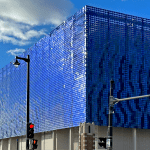
Kinetic Facades Rise on University Campuses
Unlike conventional cladding, these systems rely on natural forces to animate buildings, providing design functionality and reducing environmental impact while producing striking visual effects.

Case Engineering: Strength, Steel, and Structural Appeal
Working with a diverse range of industries, Case Engineering encounters opportunities to use innovative metal solutions.