Photo by Matt Winquist/courtesy v2com
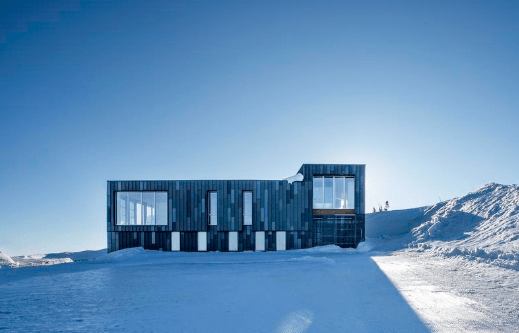
A ski-in/ski-out mountain sanctuary within the Powder Mountain Ski Resort in Eden, Utah, uses steel in its eye-catching Kirigami-inspired facade design.
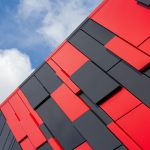
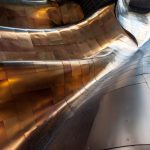
The formidable expanse of stark terrain surrounding the home inspired the design team to explore a dichotomy of undulation versus permanence within this blank canvas. The home’s custom bent-metal steel exterior wraps around the structure, a mix of solid and perforated panels. The team selected the particular steel material for the facade’s exterior cladding for its ability to bend and fold around the home’s upper level and throughout the courtyard, with standing seams that then turn into the corners. The highly corrosion-resistant steel-zinc composite is perfect for the elements. One section is perforated, with standing-seam panels, while some are opaque.
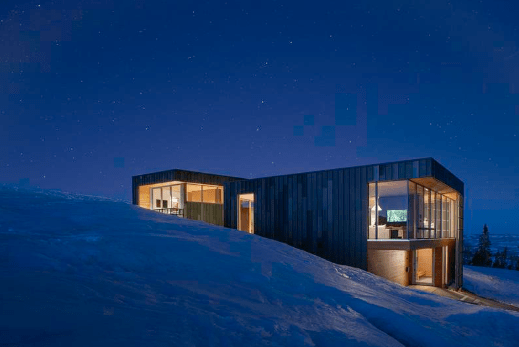
The sustainable design goals centered on creating a form and approach that would have minimal impact on the native landscape while still providing opportunities for interaction with nature.
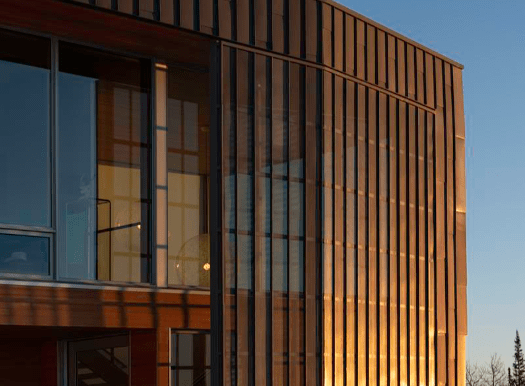
Photo by Matt Winquist/courtesy v2com
Desiring a clean, modern aesthetic, the home’s interior design and art were chosen with this aesthetic in mind, resulting in an eclectic yet curated space. This home was built to accommodate visitors of all ages and life stages; the clients considered their current and future needs, as well as those of their parents, who may also need to reside in the home. Occupants and visitors can travel from the garage into a corridor where the elevator is located, then up to the main level and out into the kitchen. The house, therefore, facilitates aging in place and multi-generational living.
Due to its remote location, the home is run entirely on propane and heated by highly efficient radiant heating throughout. The southern facades feature overhangs, and temperatures are controlled with operable windows at key locations to provide any necessary cooling, ensuring a sustainable design approach.
The multi-level layout includes a primary suite with a private deck and steam shower on the upper level, which is raised 1.54 m (5 ft) above the main level and can be completely separated from the rest of the home.
The dining room, with its multi-slide door system, opens onto the courtyard. At the same time, the main kitchen is completely open with no ceiling-based cabinetry, fixtures, or fittings to allow for an uninterrupted flow of energy and viewpoints. The scullery kitchen, with a small built-in bar, is located near the media room.
The high-elevation mountain site is completely exposed and receives an average annual snowfall of 5715 mm (225 in.), requiring the home to be designed to withstand wind speeds of 177 kmph (110 mph) and support a snow load of 1,113.2kg/m² (228lbs/sf).
The building orientation and the high-performance glazing, along with 50.8 mm (2 in.) of continuous exterior rock-wall insulation and 50.8 mm (2 in.) of spray foam for a total of 101.6 mm (4 in.), and R-13 batt insulation over that, result in a very robust system.
The roof assembly achieves an R-70, and the walls are insulated to R-38. Two Tesla Power Walls are installed in case of a power outage, and the home also features a separate electric car charging station. Marvin windows and multi-slide doors were specified.