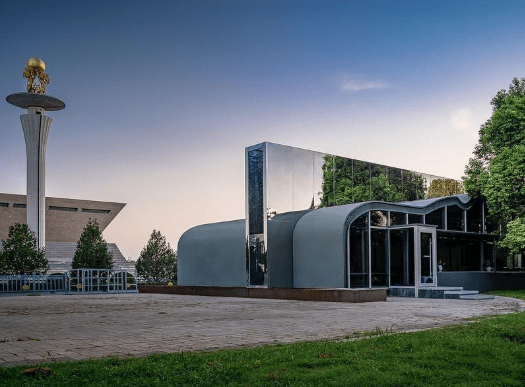
A sculptural steel-clad cafe whose undulating roofline echoes the ancient mountains of central China, anchoring a new cultural destination beside the Luoyang Museum.
Designers Zhijiang Shan and Fan Li have completed LIAO LIAO Cafe, a new specialty coffee destination situated on the grounds of the Luoyang Museum in Henan Province, China. The project transforms an underutilized roadside site into a gathering place that bridges the museum’s cultural gravity with the everyday ritual of coffee. Measuring at approximately 350 m² (3767.4 sf) of floor area, this serene setting offers significant recreational space, offering a place to reflect and recharge after taking in the cultural wonders the area has to offer.
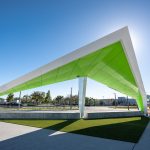
The building’s most prominent feature is its continuous, wave-form roof: a sweeping steel canopy whose curves reference the silhouette of the Qinling and Funiu mountain ranges visible from the region. The undulating profile rises and dips along the length of the structure, creating varying interior heights that define distinct zones for seating, circulation, and the bar. From across the street, the roofline reads as a single, fluid gesture set against the sky, signaling the cafe’s presence without competing with the museum’s nearby monumental architecture.
Materiality and contrast
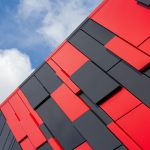
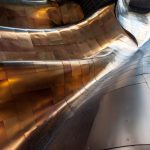
The exterior pairs a mirror-finish stainless steel volume at one end with weathering/Corten steel panels and dark-toned metal cladding along the main body. The mirror-clad box reflects the surrounding parkland and sky, dissolving the building’s edge into its context. At the same time, the Corten surfaces introduce warmth and a sense of geological time that resonates with the museum’s archaeological collections. A perforated concrete-block screen runs along the lower portion of the facade, filtering views between the interior and the covered terrace.
Structure as expression
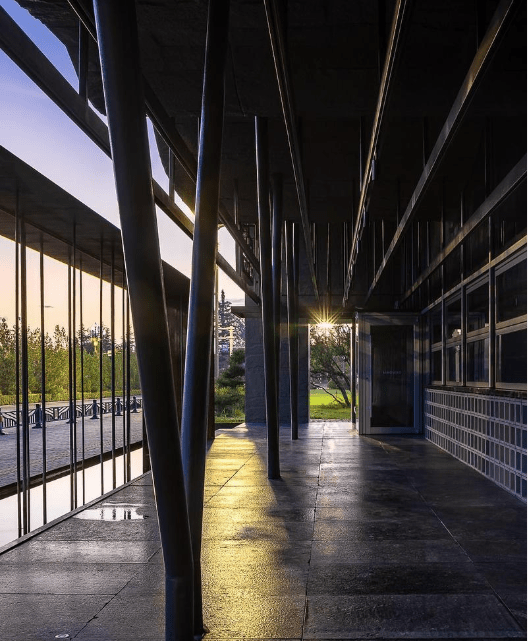
Exposed steel columns branch upward at varied angles beneath the canopy, supporting the roof while evoking the trunks and limbs of the mature trees that populate the museum grounds. The structural members remain visible inside and out, lending the space an honest, workshop-like character. Overhead, the raw concrete soffit of the roof shell is left unfinished, its textured surface catching the light from linear track fixtures that run along the steel beams.
An interior shaped by daylight
Floor-to-ceiling glass walls wrap the seating areas, dissolving the boundary between the cafe and the surrounding landscape. A continuous skylight slot runs along the roof’s ridge, allowing daylight to wash down the stone-textured interior walls and shift in color from morning to dusk. At sunset, the narrow glass gap frames the sky like a vertical painting, creating a moment of pause for visitors seated below. The interior palette — dark stone flooring, leather-and-wood lounge chairs in green and caramel tones, and blackened steel fixtures — is deliberately restrained, letting the changing natural light serve as the primary decorative element.
The bar and social core
A long service bar occupies the center of the plan, its front face built from the same concrete block used on the exterior, creating material continuity between inside and out. The open-kitchen format allows guests to watch the preparation process, reinforcing the cafe’s identity as a craft-focused establishment. Seating is arranged in a sequence of intimate clusters rather than uniform rows, encouraging small-group conversation.
Dialogue with context
Positioned directly beside the Luoyang Museum—one of China’s major repositories of Bronze Age and Tang Dynasty artifacts—LIAO LIAO Cafe serves as a threshold space where the museum’s contemplative atmosphere meets the informality of daily life.
The project demonstrates that commercial hospitality architecture within a cultural precinct need not default to timidity or pastiche. By responding to the terrain, the climate, and the institution next door through form and material rather than stylistic imitation, Zhijiang and Fan have produced a building that earns its place beside one of China’s most important museums.