Every pedestrian, cyclist, driver, and ferry passenger in New York City has had firsthand experience with the Department of Transportation’s work. The DOT, which facilitates the design, planning, construction, and management of much of the city’s infrastructure from stoplights to bridges and beyond, has been housed in a structure built in 1934. As the historic building no longer meets the needs of this substantial department, a $121 million project to redevelop and revitalize the administration building and yard is underway.
Urbahn Architects associate principal Ijeoma D. Iheanacho, NOMA, AIA, LEED AP, explains the scope of the project: “The redesigned facility will address the current deficiencies and limitations, including creating more efficient workflows and traffic pathways, increasing on-site safety for pedestrians and vehicles, increasing protection from flooding and implementing sustainable strategies to meet LEED Gold certification. The site’s existing maintenance/repairs building and fuel monitoring and fueling stations will not undergo renovations; however, three other structures will be demolished and replaced.”
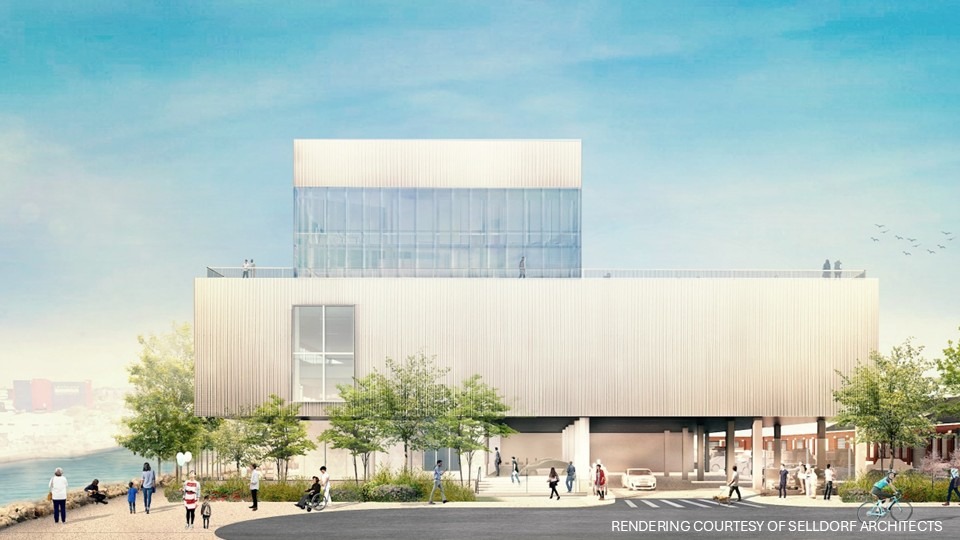
On designing the structure, Selldorf Architects partner Kevin G. Keating notes, “With the utilitarian nature of the building and designed a scheme that was seen as a clean backdrop for the chaos around the building.” He explains, “Metal is more utilitarian in nature and more sustainable in many ways.”
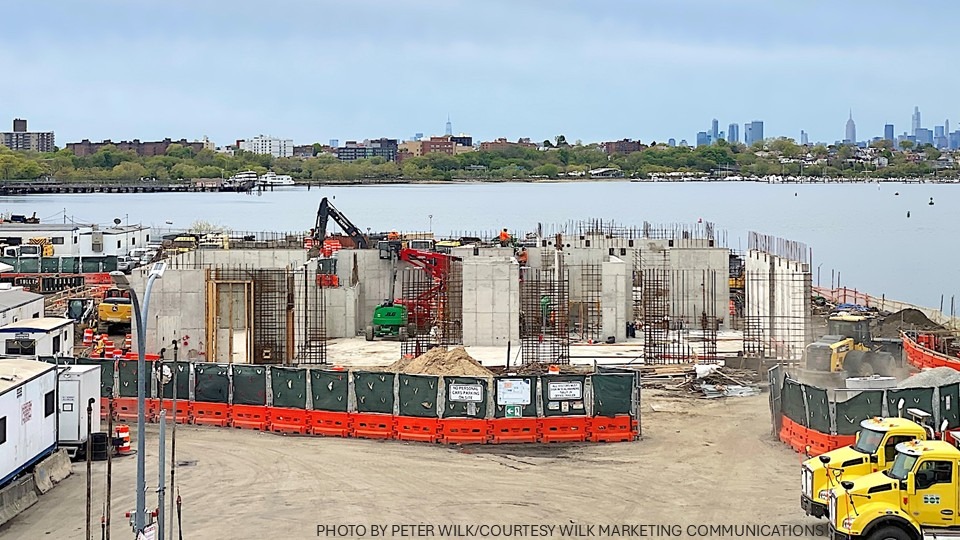
The project uses a steel superstructure along with a concrete core and base elements.
Keating observes that the structure has “beauty in its geometric volume and shape.” Galvalume panels allow this geometry to remain the focal point, providing what he calls “simplicity and quiet tonality.“
These panels cover the large plinth and the crown of the building. A major design factor for the project was flood elevation due to its proximity to Flushing Bay. The metal-clad plinth is raised above the floodplain to accommodate this consideration. The crown encases mechanical systems while maintaining a sleek, consistent aesthetic.
Visually, the galvalume panels articulate the light at different times of day. Keating explains, “The refraction and reflection that you get on that material is really beautiful whether in the sun or at dusk, even on cloudy days.“ This dynamic quality of the metal allowed the material palette for the cladding to be kept simple.
“It was also vitally important to the team to future-proof the administrative building and the entire facility, so it remains disaster resilient, new technology-ready and utilizes maximum amount of sustainable design concepts, systems, and materials,“ says Urbahn Principal Rafael Stein, AIA.
The staff offices are located on the top floors to take advantage of the Flushing Bay and Manhattan skyline views. This strategic placement also provides acoustic comfort, keeping employees away from exterior noise.
On the southwest side of the multi-story office element, in an internal communal space, an exposed metal staircase weaves two floors together. The railing and staircase include pickets offset every 4 in. (101.6 mm) atop flat bar. This transparent element uses steel to create a visual openness, connecting the floors.
For such a robust project, there is a suitably substantial project team, including The New York City Department of Design and Construction (DDC), New York City Department of Transportation (DOT), lead architect Urbahn Architects, design excellence architect Selldorf Architects, builder Scalamandre-Tully JV, landscaping architect Quennell Rothschild & Partners, HVAC engineer Legacy Engineers, plumbing and electrical engineer Collado Engineering, sustainability consultant WSP, lighting designer Lumen Architecture, and civil/structural/geotechnical/flood resilience/traffic engineer McLaren Engineering Group.
Together, this team has created a resilient foundation for the NYC DOT as it continues to manage transportation infrastructure across the city.
—With files from Urbahn Architects, Selldorf Architects, and Scalamandre-Tully JV. via Wilk Marketing Communications