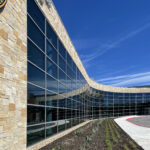
The $615 million, 736,000-square-foot (68,374-m2) Palomar Medical Center West in Escondido, Calif., is presently the largest single building under construction in California. Construction on the project began in 2007, and is expected to be finished in 2012.
Selected in 2003 by Palomar Pomerado Health, Los Angeles-based CO Architects was chosen to help initiate an innovative and participatory design process to plan for the construction of a replacement facility for the Palomar Medical Center. PPH leadership chose to use an evidence-based design process in which individuals from all departments in the hospital were invited to participate in researching new and emerging ideas in health care design.
 A Garden Hospital
Located on a greenfield site that is part of a 186-acre
(74-hectare) business park currently under development, the 360-bed hospital is regarded as perhaps the greenest and most advanced hospital ever designed. The functional and flexible garden hospital will be infused extensively by natural light and plantings, including a 1 1/2-acre (0.6-hectare) green roof and public terrace that will be placed atop the surgical wing. Accessible to staff and visitors, the rooftop garden is also visible from patient rooms. The hospital will also feature a ground-floor central garden, while each patient floor will feature garden conservatories. Studies have shown that while natural gardens and terraces are green and desirable for their own sake, they are also therapeutic for staff and patients, producing more-content employees, and possibly even shorter hospital stays for patients.
 Designing the Plan
The plan positions the hospital at the north end of the site, where there is the greatest width to accommodate necessary access points and circulation. The signature patient tower-with its gently curving form-figuratively opens its arms to welcome patients. A vertical garden at the center of the south façade overlooks the extensive landscaped roof and garden terraces above the two-story diagnostic and treatment wing. The conservatory element is repeated at the east and west ends to reinforce the garden hospital concept. Site planning, landscaping, non-institutional architectural expression and materials selection were all strongly influenced by the desire to merge nature and building, with each aspect informing the other to create a unified whole.
Patient rooms adopt an acuity-adaptable care model, incorporating intensive in-room infrastructural connections that will reduce the need to move patients from room to room, as their conditions improve, with the goal of keeping a patient and visiting family in one room throughout a visit. In addition to the evidence-based design, the building will have high interstitial spaces, 105-foot-
(32-m-) long span trusses, and a minimum of permanently fixed columns, shafts and other vertical elements, allowing for easy adaptation in the future for unanticipated needs.
 Sustainable Features
Healthy indoor air quality, a soothing and healing environment, and the materials and methods employed all reflect the commitment of the client and the architect to sustainability. The project includes strategies for energy and water conservation, stormwater treatment, maximum interior daylight, glare reduction, building orientation, and recycled or renewable materials.
By the Numbers
The hospital is being built with 10,600 tons (9,540 metric tons) of primary structural steel, along with 450 tons (405 metric tons) of HSS green steel, that includes three AESS and framing tubes, and 3.8 million linear feet (1.2 million m) of light-gauge steel studs, track, backing, strap, angles and cornerbeads for the interiors.
There will also be 160,000 square feet (14,864 m2) of aluminum-mullion unitized curtainwall; 156,000 square feet (14,492 m2) of aluminum-mullion stick curtainwall; 21,000 square feet
(1,951 m2) of vertical glass screenwalls; 2,700 square feet (251 m2) of glass skylights and canopies; and 2,700 square feet (251 m2) of aluminum mullions with glass infill at entrances.
 Additionally, there are 50,000 square feet (4,645 m2) of perforated and corrugated aluminum panels used for sunscreens; 34,000 square feet
(3,159 m2) of aluminum panels for soffits and eaves; and 18,500 square feet (1,719 m2) of panel systems from Moon Township, Pa.-based CENTRIA for soffits.
Palomar Medical Center West, Escondido, Calif.
Client: Palomar Pomerado Health, San Diego
Architect: CO Architects, Los Angeles
Construction management: DPR Construction Inc., San Diego
MEP engineer: M E Engineers, Culver City, Calif.
Structural/civil engineer: KPFF Consulting Engineers, Los Angeles
Structural steel installer: Herrick Corp., Stockton, Calif.
Glazing contractor: Shengxing Glass & Cladding Systems Inc., Corona, Calif.
Metal soffit panels: CENTRIA, Moon Township, Pa., www.centria.com
Steel framing: CEMCO, City of Industry, Calif., www.cemcosteel.com