Photos courtesy Tim Griffith
The University of Cincinnati had a master plan, and for years, one of the goals for Clifton Court Hall was to provide a continuation of a path to the edge of campus, reinforced with nodes of activity. The intention was to swap out the path that fizzled out at the parking lot of Arts & Sciences Hall, and instead create a pedestrian experience.
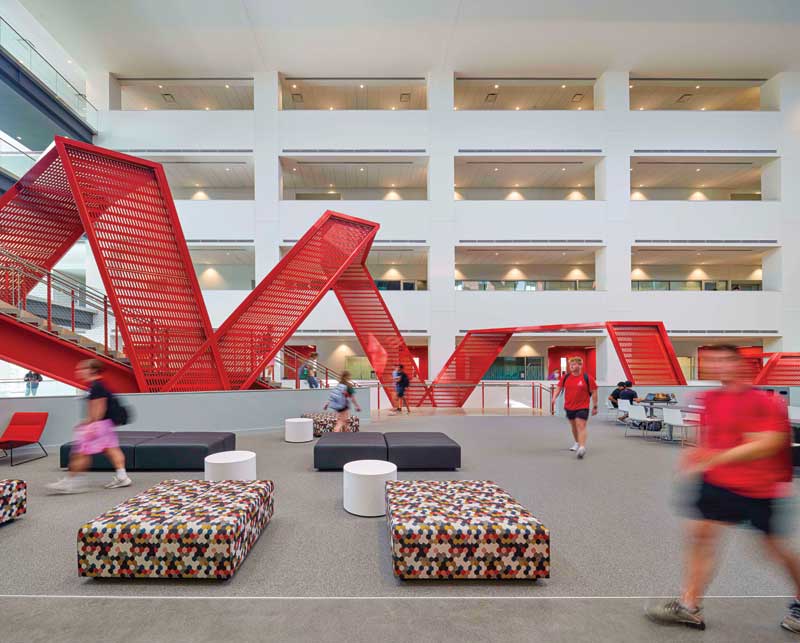
The building is organized around a central atrium infused with daylight from skylights and large north- and south-facing windows, creating a strong visual connection to the surrounding campus spaces. The five-story atrium serves as a community hub for the college, fostering academic discourse and social exchange through a series of community and collaboration spaces, and adjacent team rooms.
Clifton Court Hall unites a range of academic units from various buildings across campus to form a new home for the College of Arts and Sciences. The academic hub encompasses the Departments of Political Science, Communication, Psychology, Journalism, German Studies, and Romance and
Arabic Languages and Literatures.
Pedestrian experience
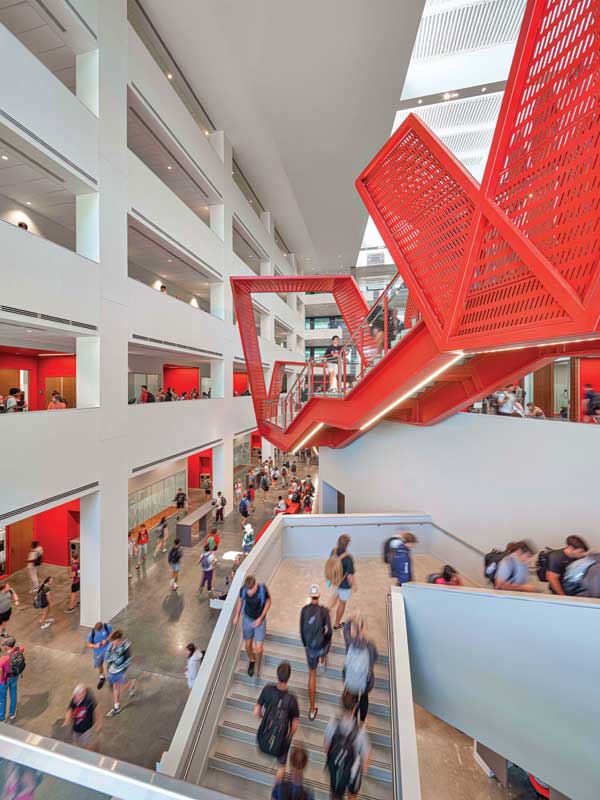
A sculptural red stairway extends three stories diagonally through the atrium, serving as a major campus pathway, and connecting the interdisciplinary communities within. This stair can be used by either building occupants or anyone needing to pass through, says Steve DelFraino, principal at LMN Architects, and Evgeniya Plotnikova, associate from LMN Architects. The stair is designed as a folly to increase the use of the stair and help create a memorable experience.
“Right from the beginning we knew it was going to be an element crossing diagonally through the building. Once the Atrium space was established, we wanted something sculptural to anchor the space. By adding this ribbon with gates to the stair, it creates volume, making it a sculpture.”
DelFraino and Plotnikova said the red color of the atrium stair matches the University of Cincinnati branding standard. “It was chosen to reinforce the building’s association with the university, create immediate branding recognition for those entering the building from off-campus, and heighten the intent for the stair as a folly. The use of this specific color was reserved throughout the rest of the building.”
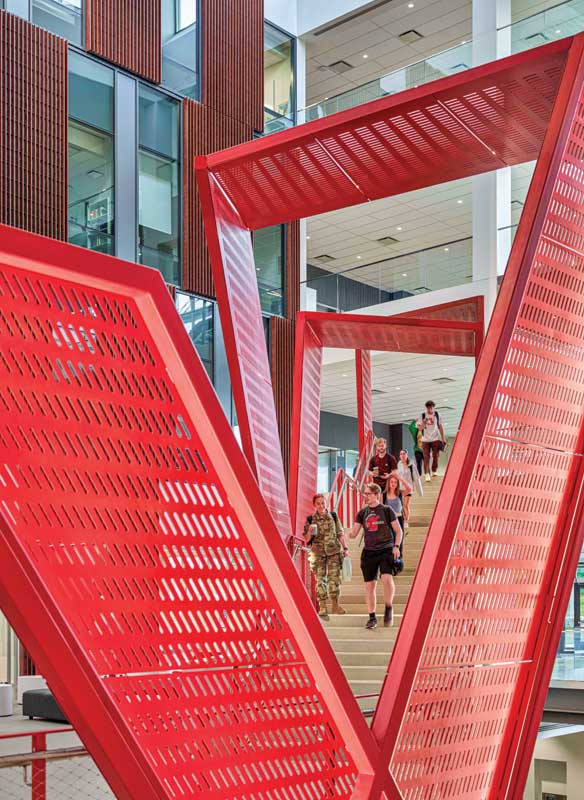
One element used to heighten the pedestrian experience is the up lit canopy “gates.” DelFraino and Plotnikova say they create a ribbon effect, as one traverses from Level 3 down to Level 1.
Social media metal sensation
The atrium stair is composed of structural steel stringers and landings supporting precast concrete treads. The canopy elements that appear as a ribbon are supported on hollow structural sections (HSS) framing members and are infilled with steel plates having a custom perforated pattern. The perforations allow for some visibility through the stair as well as provide some surface area for the uplighting to shine on. Though based in Seattle, WA, DelFraino is a graduate of the University of Cincinnati, and this project was very close to his heart.
“We perforated the gates to create transparency and to keep it visually interesting, to see through and see others walking on the stair. It’s a two-way connection.”
Plotnikova said the space turned out to be very Instagram-able and the reaction has been positive, not just from staff and students but also from people passing by the atrium and the building.
According to the local associate architects, KZF Design, the large stringers of the stair comprise approximately 36 linear m (120 linear ft) of W27x281 on each side with 18 HSS tread supports throughout, primarily HSS 10x10x0.38. The canopy elements are composed of approximately 60 HSS 5x5x0.5 tubes to create the structure and 46 6.35 mm (0.25 in.) thick steel plates, custom perforated for the canopy skin.
KZF Design states the staircase was prefabricated in the fabricator’s shop, disassembled, transported, and reassembled on-site. The assembly and final installation, including handrails and lighting, were completed approximately 18 months after the approval of the initial steel shop drawings. The fabrication and installation of the steel components took approximately 10 weeks.
Flattering facade
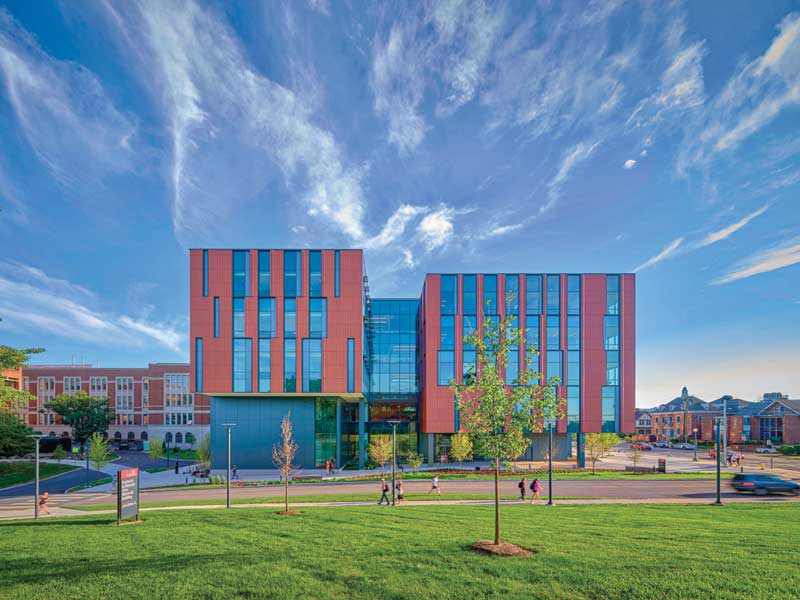
Inside, the bold red stair sculpture creates a modern atmosphere, and the exterior expression complements the rich architectural heritage of the campus. The terracotta is also meant to express a more modern interpretation of the classic brick colors found throughout the university campus. As a complement to the wood slat “skin” found on the interior of the atrium, the terracotta is detailed as a thin “skin” creating “L” shaped features on the west and east bars of the building. In contrast, the remainder of the exterior facades are clad with composite metal panel. DelFraino and Plotnikova add, “The shifting of the terracotta panels and punched openings over most of the facade is meant to break down the scale of the elevation by creating distinguishing ‘shear lines’ at each of the floor levels.”
For added interest, vertical angular terracotta elements adjacent each window are glazed in a glossy finish to reflect differing lighting conditions as one moves across the facade or drives by the building. “As a composition animated by natural light and shadows the materials create an ever-changing facade and dynamic building elevation.”