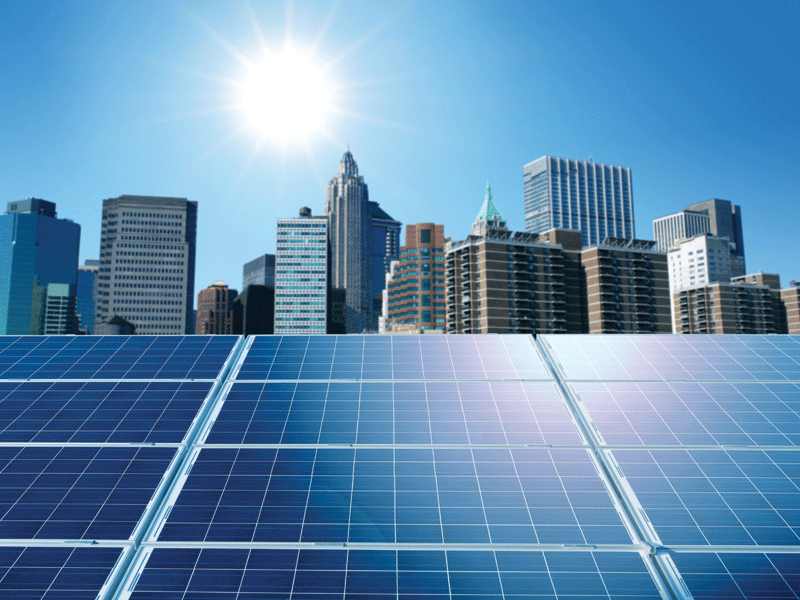
What is a zero-emissions building? Various organizations have tried to answer this question in recent years, and it has been the subject of vigorous debate among building professionals. The U.S. Department of Energy (DOE) developed a “National Definition of a Zero Emissions Building, Part 1 Operational Emissions from Energy Use,” released in June to provide a common understanding. In short, a zero-emissions building is highly energy efficient, does not emit greenhouse gases directly from its energy use, and is powered entirely by clean energy.1

So, what does this new definition mean for the building industry, and how does it compare to previous classifications of buildings with zero net greenhouse gas
(GHG) emissions?
First, why is a definition important? Buildings account for more than 37 percent of GHG emissions globally, and dramatic cuts in these emissions are required to avert a global climate crisis. Having standard and measurable minimum criteria for what constitutes a zero-emissions building is critical to guiding the transition to an emissions-free built environment.
The DOE’s zero emissions building definition is not a regulatory standard. Still, it is designed as a framework for new and existing buildings that public and private entities may adopt to guide the assessment and self-disclosure of projects under their jurisdiction. It is also not a certification, and the DOE will not validate compliance. The definition also does not replace other statutes and executive orders that established policies or definitions for zero emissions from federally owned buildings.
The definition’s scope includes GHG emissions from the operations of both commercial and residential buildings, including emissions due to tenant use of the buildings they occupy. It is important to note that this definition (Part 1) excludes GHG emissions associated with building materials (embodied carbon) and refrigerants, but future parts may add this.
The DOE’s definition has three components, stipulating that zero-emissions buildings are “energy efficient, free of on-site emissions from energy use, and powered solely from clean energy.” This is a simple and common-sense approach: first, keep building occupants comfortable while reducing the demand for energy, then eliminate the sources of emissions under the control of the building owner, and finally, meet the remaining demand with renewable sources. The details of the definition are important:
- Energy efficient—Existing buildings eligible for ENERGY STAR® certification must score 75 or higher. Ineligible buildings must either achieve a whole building site energy use intensity (EUI) at least 35 percent better than the median EUI for buildings in the same category or a whole building EUI that is less than the specified EUI for the same type and location of the building in American National Standards Institute/American Society of Heating, Refrigeration and Air Conditioning/ Illuminating Engineering Society (ANSI/ASHRAE/IES) Standard 100, “Energy and Emissions Building Performance Standard for Existing Buildings.”
There are also several options for new buildings to demonstrate efficiency, including a simulated whole-building energy use at least 10 percent better than the model energy code, achieving Designed to Earn ENERGY STAR® (for eligible building types) with a score of at least 90 or being certified under the ENERGY STAR® Residential New Construction program or Zero Energy Ready Homes program.
- Free of on-site emissions from energy use—Achieve zero direct GHG emissions, which means no combustion equipment for heating and domestic hot water. When grid power is interrupted, the definition includes an exception for the use of emergency backup generators.
- Powered solely from clean energy—All energy used by the building must come from GHG emissions-free on-site and off-site sources. The definition encourages but does not require, maximizing potential on-site renewable energy before procuring off-site sources. The purchase of carbon offsets is not permitted under the definition.
How does the DOE zero emissions building definition compare to other established definitions? The most significant frameworks in the market come from the World Green Building Council’s (WorldGBC) Advancing Net Zero program,2 the International Living Future Institute’s (ILFI) Zero Carbon certification,3 and the U.S. Green Building Council’s (USGBC) LEED Zero Carbon certification.4 These are all fairly consistent with each other and the DOE definition, with a few distinct contrasts.
Similar to the DOE definition, all three encourage energy efficiency, but the WorldGBC program is the only one that does not set minimum efficiency requirements. ILFI Zero Carbon certification requires efficiency in new construction and major renovation projects tied to improvement over the ASHRAE 90.1 standard. LEED Zero certification is a supplement to LEED certification, so new construction projects must be more efficient than ASHRAE 90.1, and existing buildings must perform well with ENERGY STAR certification. A draft update to LEED Zero for existing building projects sets LEED Gold as a minimum prerequisite, raising the bar.
These frameworks differ in requirements for on-site combustion and renewable energy. The WorldGBC Advancing Net Zero program defines three levels: net zero energy buildings that meet 100 percent of energy demand from on-site renewable energy, net zero operational carbon buildings that rely on a mix of on-site and off-site renewable energy for energy demands, and net zero whole life carbon for new buildings that folds in embodied carbon along with operational GHG emissions but allows purchasing carbon offsets for residual on-site emissions and embodied carbon that cannot be eliminated.
IFLI Zero Carbon prohibits combustion equipment and requires 100 percent on-site and/or off-site renewable energy, except for existing buildings where a phase-out plan is allowed for on-site combustion equipment with additional renewable energy production to offset emissions. The current version of LEED Zero Carbon relies on a carbon balance calculation, using on-site and off-site renewable energy and carbon offsets to balance out on-site GHG emissions and emissions from occupant commute transportation.
The draft update for LEED Zero Carbon prohibits GHG emissions from on-site combustion, except for emergency generators, and adds requirements to limit refrigerant leakage. ILFI Zero Carbon also requires monitoring and maintenance practices to limit fugitive refrigerant emissions.
The WorldGBC encourages independent verification of compliance with requirements but does not offer certification, while ILFI and USGBC both include certification as part of their frameworks.
Reducing GHG emissions as much as possible, as fast as possible, remains paramount. A consistent and measurable definition for zero-emissions buildings will bring focus on the goal of reducing building emissions by 65 percent by 2035 and 90 percent by 2050. It is anticipated that the DOE will address embodied carbon and refrigerants in future parts of the definition and that other certification frameworks will begin to align with the DOE definition in future versions. Creating zero-emissions buildings reduces climate impacts and supports affordability, equity, and resilience in our
built environments.
Alan Scott, FAIA, LEED Fellow, LEED AP BD+C, O+M, WELL AP, CEM, is an architect and consultant with more than 35 years of experience in sustainable building design. He is the director of sustainability with Intertek Building Science Solutions. To learn more, follow him on LinkedIn at linkedin.com/in/alanscottfaia/.
Notes
1 energy.gov/eere/buildings/national-definition-zero-emissions-building
2 worldgbc.org/advancing-net-zero/
3 living-future.org/zero-carbon/zero-carbon-certification/
4 usgbc.org/programs/leed-zero