What if the building envelope could do more than shield occupants from the elements? Imagine a facade that collects sunlight to heat interior spaces or generates electricity to reduce reliance on fossil fuels. As energy efficiency and sustainability become central to building performance, solar technologies are emerging as powerful tools, offering a glimpse into the future of smarter, more responsive envelope design and construction.
What is solar air heating?
Solar air heating is an innovative and sustainable technology that harnesses the sun’s power to warm air for commercial, industrial, and agricultural use. Unlike traditional heating systems that rely on fossil fuels or electricity, solar air heaters use solar collectors to absorb sunlight and convert it directly into heat. This
eco-friendly solution reduces energy costs and minimizes carbon emissions, making it an attractive option for those looking to improve energy efficiency and reduce their environmental impact.

A solar air heating metal panel, also known as a transpired solar collector, is not just a metal wall panel but a solar collector and fresh air heating system. The transpired solar collector is mounted a few inches from the building’s outer wall. The precision perforations in the wall panels allow outside air to travel through the face of the panel. Solar-heated air at the panel’s surface is drawn through the perforations where it rises between the two walls and enters the building’s central ventilation system or supply fan.
Transpired solar collectors can be used in new construction or retrofit projects. The performance of a solar air heating system on a building depends on several key factors, including the orientation of the building, sunlight availability, geographical location, local climate conditions, the size of the system, and airflow requirements.
Designing and installing a solar air heating system requires collaboration among several professionals to ensure the system is safe, effective, and tailored to the building. Key professionals may include:
- Mechanical engineer or HVAC engineer
- Solar energy specialist or solar designer
- Architect or building designer (if part of a new build or major retrofit)
- Structural engineer
- Electrical engineer or electrician (for fans and/or controls)
- General contractor or solar installer
- Building inspector or code official
- Manufacturer of the solar air heating system
Having an integrated team ensures the system is functional,
cost-effective, durable, and compliant with building codes.
Solar air heating case study
The IBM Bromont plant, located in Bromont, Quebec, Canada, opened in 1972. Fifty years later, the facility remains a leader in innovation, technology, and continuous improvement, with more than $10 million invested yearly in product and process development.
IBM Bromont is a 24-hour-a-day, 365-day-a-year facility where more than 100,000 microelectronic modules are manufactured weekly. Fully aligned to IBM’s commitment to sustainability, IBM Bromont is a role model in environmental leadership. Greenhouse gas emissions from the plant in 2021 were 63 percent lower than in 2005, and nearly 100 percent of the electricity consumed by the site comes from hydroelectricity. It is little wonder the plant has striven to reduce its annual energy consumption and related carbon footprint by four percent year after year since the early 2000s.
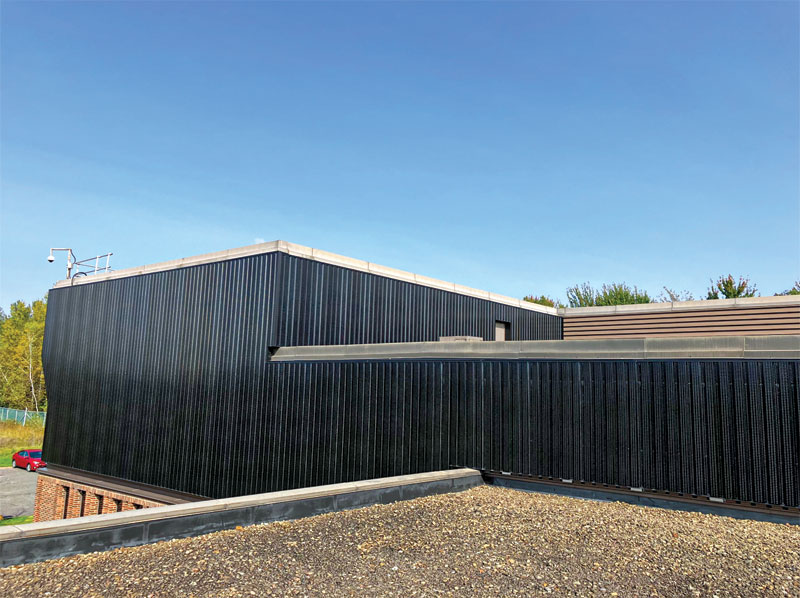
In 2015, IBM Bromont installed 278.7 m2 (3,000 sf) of solar air heating metal wall panels to preheat the combustion air of its central boilers, which are responsible for steam production and heat for the entire industrial complex. With several energy efficiency projects in planning, IBM called on SOFIAC, an energy service company (ESCO), to support the company’s ongoing implementation program in energy conservation and efficiency, including heating, lighting, and fuel switching, which makes both environmental and business sense. SOFIAC projects, to be implemented over multiple years, are anticipated to save more than 43,000 gigajoules of energy while avoiding associated greenhouse gas (GHG) emissions.
Based on its positive 2015 experience and the improvements made on the solar air heating system with a new, higher efficiency surface, IBM wanted it to be part of the latest energy-saving opportunities implemented by SOFIAC. The new 185.8 m2 (2,000 sf)
solar air heating system, installed in October of 2023, preheats 10,194.1 m3/h (6,000 cfm) of outside air feeding the plant while reducing its carbon footprint by 11.2 tonnes (12.3 tons) of CO2, year after year, for the next 25 years. The solar air heating wall system will remain in place, with no moving parts and virtually no maintenance, and provide monitored natural gas savings for decades. Trigo Energies of Quebec, Canada, provided and installed the panels. Installation was supervised by the general contractor Ecosystem, located in Quebec City. Ecosystem and IBM will be monitoring the thermal energy output of the solar air heating system over its 30-year-plus service life. The new high-performance finish of the metal wall panels was chosen, not only because it supplies 35 percent more energy than any traditional polyvinylidene difluoride (PVDF) paint finish, but also for its aesthetically pleasing look.
Solar-ready metal roofing
In addition to a solar air heating metal wall system, standing seam metal roofing has emerged as the perfect platform for solar-ready construction, ideal for mounting photovoltaic (PV) solar panels without roof penetration or structural complications. One of the biggest benefits of installing solar panels over standing seam metal roofing is that metal roofing has a long life span, more than most roofing materials. The useful service life of typical solar panels is often 25 to 30 years before their output drops to less than 80 percent. The metal roofing service life is usually twice that, at
60 years or more. Therefore, there is no concern about removing and reinstalling solar panels when it comes time to replace the roof, an often costly and potentially damaging process. There is no need for concern for those interested in metal roofs and solar panels, but those who are currently only able to invest in roofing. The two systems are compatible, and solar installation can be done when the budget allows.
Solar-ready metal roofing allows for budgeting the expense of a metal roof system with solar panels in stages. Building owners can have a standing seam metal roof installed now and then add the solar panels years later. Even 10 or 20 years down the road, that metal roof will still last longer than the average life of solar panels.
Standing seam metal roofing is the perfect platform for solar panels because, with special clamps, the solar panels attach directly to the metal seams on the roof panels, avoiding roof penetrations. Also, solar panels installed over metal roofing are more energy efficient because the metal roof’s reflective properties reduce heat absorption, which prevents the panels from overheating. This leads to better performance and higher electricity generation.
Implementing solar for smarter, cleaner structures
As demand for cleaner energy solutions intensifies, solar air heating and solar-ready metal roofing reshape how buildings are designed and retrofitted. These technologies do not just represent an upgrade; they signal a shift toward buildings that actively contribute to carbon emissions reduction, energy production, and climate resilience. Looking ahead, the challenge is no longer technological feasibility, but adoption at scale. Municipalities, architects, and builders now have the tools to champion a new standard: Structures that not just consume energy but help create and conserve it from the top down.
Lee Ann M. Slattery, FCSI, CDT, CCPR, LEED PA BD+C, is the sales support manager for ATAS International and the vice-chair of the Metal Construction Association (MCA). She has 30-plus years of experience in sales and marketing within the architectural building products industry. Slattery served as the Middle Atlantic Region Institute director on the Construction Specifications Institute (CSI) board for four years and was elevated to Fellowship within CSI in 2020. She serves on the National Women in Roofing education committee and is a director for the Lehigh Valley Let’s Build Construction Camp for Girls, founded in 2017. In 2024, she received a Lehigh Valley Women of Influence and a Circle of Excellence award from Lehigh Valley Business.