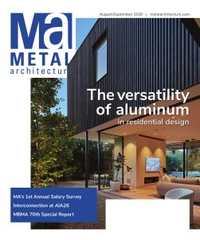
Zig zagging down a hillside in Carrboro, N.C., a black-clad house blends into a wooded site. The home is the vision of partners and design duo Douglas Pierson and Youn Choi, pod architecture + design PLLC, Chapel Hill, N.C.
A metal-clad, cantilevered house leverages its wooded location

Photo: Allen Weiss
The house comprises three forms that are connected. At their simplest, they are rectangles that connect to form a Z pattern, descending the slope of the hill toward a creek.
Corrugated metal panels give texture to the lengthy façades that are punctured by horizontal windows, which emphasize their length. To keep the lines clean, the architects specified limited trim.
Two Appearances
The home blends in with other houses in the neighborhood in terms of size and scale, but because of the slope, the two lower forms disappear from the street view. The buildable area on the hillside site was limited to a triangular, northeast corner of the site. Instead of facing the streetside to the east, the house faces the creek bed to the southwest.
Choi, design principal at pod architecture + design, says, “An interesting thing is in creating the Z shape, we wondered what the house would look like from the street because traditionally that’s the front yard. In our case with this side, it’s inward looking from the front. The yard is really the creek, valley and grove, and that’s where our views are projecting to. But also, as we developed it, we were keen to get the scale right as seen from the street. When you drive down the street, you only see one leg, the upper area, the flipped box, from the top of the hill. As you drive down, you only see that top box, and that’s similar in scale and proportion to the other houses on that street. It’s a lining street and everybody is on a hillside basically. We kept the scale and proportion of the neighborhood, which has nice frontages and bungalows that are kind of peppered on the landscape. This reflects that same idea, even though it becomes something different as you walk around it. When you come down the lower side, then it changes quite a bit.”

Photo: Youn Choi
Rather than placing the garage in the top form of the house and having the driveway lead into directly from the road, Choi says the best place for it was the southeast corner of the house.
Pierson, AIA, LEED AP, BD+C, architect at pod architecture + design, says, “We didn’t want to have a house where the first thing you see is a two-car garage, and then the house is just behind it as an afterthought. By lifting up the house, it naturally created a place for the cars, but kept the integrity of the house at the same time, which is in that sense very successful.
“As you approach from the southeast from the road, it’s dramatic. And as you approach from the northeast from the road, it’s in scale of proportion and subdued, so you never expect it. So, it’s like you get two different first impressions, and that’s interesting about the house. We didn’t expect that, but that was interesting to see. I think people really get excited about it.”
Interior Core
Inside, wide-open, connected spaces balance against smaller, intimate spaces. Abundant windows provide outdoor views throughout. Spaces are organized around a circulation core and a mezzanine enclosure occupies the middle of the house. The core, which contains some of the mechanical systems, is clad with Loblolly Pine panels produced with trees removed from the site for construction.
Pierson says, “The core wraps around the inside of the house. So, the wood itself is almost like a structure inside the structure. We created cavity spaces up high that run horizontally and travel up and down, and then distribute locally to different spaces. We also have radiant heating in the floor slabs, which are in the concrete floor itself.”

Photo: Youn Choi
The placement of the central core allowed space on walls for ample windows. “When we put all [of the mechanical systems in the] core in the middle, it divided the space between bedrooms and where the passage corridor is,” Choi explains. “By doing so, we open up the skin; both sides have windows, and it really connects to nature. It doesn’t matter where you are, you always have a view to outside. And that was our goal.”
Pierson and Choi designed the core not only so it wouldn’t obstruct, but it would also serve as a threshold between spaces. “Each way you go through it, it ends up with a place with a view to outside,” Choi says. “There are a lot of these little spaces within this kind of little vessel. And, at same time, there are a lot of open spaces, key moments where you can actually connect, spaces you can see each other from a corner space to another. So, it feels very contained. You feel like you’re definitely inside of a space, but also very open at the same time.”
Detailed Metal
The black, corrugated metal panels adds to its distinctive look. Depending on the season, the black color of the house makes it stand out in the landscape or recede into the background. Chapel Hill-based Newphire Building Corp. installed Louisville, Ky.- based Metal Sales Manufacturing Corp.’s corrugated metal panels in Black.
“In the wintertime or the fall aren’t many leaves, so you can see the house and not so much the trees,” Pierson shares. “But in the summertime when we are surrounded by trees, when you look in between spaces of the trees, the house gets really dark and shadowy. The house kind of reflects the in between spaces of the trees and sets in and recedes into the trees, which we thought was a nice way to approach it for the summertime.”
“We wanted to let the pattern of the metal be expressed as much as possible without a lot of angles and connection points,” explains Pierson. “So, we tried to limit that in the corners, for example. The metal pattern comes all the way up to the corner, and then we put a fin at the edge to capture that corner. It’s just a little detail that minimizes all the trim around it, so it doesn’t become a massive trim condition. We did the same thing on the roof at ridges and valleys. And then, since the windows are just cutouts of the wall, we folded the metal outward to create this little baffle, a picture frame around each window. It’s a small detail, but it was enough to keep water off the glass and to express the opening.”
Pierson and Choi specified corrugated panels on the roof to help manage rainwater runoff. Choi says, “We used the patterns of the corrugation to slow down the water flow and slightly reduced the slope in certain areas, but also to distribute water evenly across the valley so it wouldn’t get inundated within a huge amount of water.”