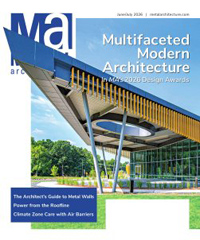
The LA Garage at Nike’s world headquarters in Beaverton, Ore., is no ordinary parking structure. By drawing upon themes of play, movement and community, SRG Partnership Inc., Portland, Ore., interpreted Nike’s globally renowned culture of innovation to design not just a place to park, but an all-encompassing experience.
Inspired by athleticism and themes of play, movement and community

Photo: Andrew Pogue
Identifying Themes
Jeff M. Yrazabal, AIA, LEED AP, NCARB, principal at SRG Partnership, says the design was driven by the challenge of redefining the role of the traditional parking structure by drawing upon the three key themes of play, movement and community. The 409,000-square-foot LA Garage energizes and engages guests and employees by blending architecture inspired by athleticism with storytelling themes about Los Angeles sports including the 1984 Summer Olympics and professional sports teams. Designed to upend the unremarkable routine of parking in a garage, the design features a unique, community-oriented courtyard where employees can gather. “The design and program elements fuse to celebrate interaction, activity, fitness and a healthy lifestyle,” says Yrazabal.
Since Nike has a culture of innovation, Yrazabal says that even with a parking garage it was important to find unique solutions that reflect the company’s brand while concealing the cars within. “The garage was also part of a major expansion that represented the next chapter of developing the campus, so design excellence was prioritized with every building to create architectural significance and continuity,” he explains. “The LA Garage experience shifts the sequence of a branded workplace experience from one that typically begins at a front door to one that starts before a driver leaves their car.”
When designing the parking garage, the first step was identifying themes. “As a hub of transportation and the place where people become pedestrians, the design embodies the idea of movement and community,” Yrazabal explains. “The dynamism of the canted walls and layering of façade elements integrates a modulation and rhythm that provides movement in the design.”

Photo: Andrew Pogue
Public Courtyard
One of the key features of the parking garage was to create a community-oriented design. By breaking the typical parking structure mass, the architects were able to provide a public covered courtyard carved into the center of the building as a way to encourage chance encounters, collaboration and events. A curved glass covering provides rain and wind protection, allowing the space to be used all year long. The courtyard incorporates many activities and playful elements, including three sides of backlit glass that showcases iconic Olympic athletes.
One of the main sustainability features of the garage is daylighting. By offsetting each of the seven 60-foot parking bays, the architects were able to allow the undulating roof and end walls receive daylight throughout the structure, which is enhanced with linear skylights that help brighten the garage further. “Both visitors and employees experience welcoming, amply daylit interior spaces enhanced with the dappled light filtered by the structures’ perforated skin, and a courtyard that, on any given day, may be filled with the energy of an event or a pack of excited kids from the adjacent daycare,” Yrazabal adds.
The courtyard gives employees and their children a chance to enjoy playful elements such as a slide, rubberized pyramids, a balance beam and a running track. Additionally, bikes are provided in the courtyard to easily connect people in the space to the campus.

Photo: Andrew Pogue
Dynamic Movement
To embody the theme of movement, the exterior walls are canted and tilted. This gives the perforated metal panel and glass building skin a dynamic quality while still hiding the cars within. By aligning the panels in a pattern along a diagonal grid, the architects were able to create a sense of leaning, making the building appear ready to spring forward. Layering of the façade elements provide both natural ventilation and adds to the garage’s dynamism.
According to Yrazabal, the biggest driver for choosing metal panels was because of the light nature of the material and that they allowed perforation, which was needed for air and light to pass through while still obscuring the vehicles.
“Other buildings on the expanded campus were also using metal panels, so finding ways to visually tie into campus was another key benefit,” he adds. “The detailing of the metal façade was an interesting challenge,” Yrazabal says, “because there were no precedents for how to attach the metal panel pieces diagonally to the building. By working collaboratively with the builder, manufacturer, structural engineer and installers, the team was able to make this innovative idea into a reality.”
Another challenge was making the exterior scale of the garage relatable to the human experience. “By carving out the courtyard in between the 60-foot bays, it prioritized daylighting and created an inviting portal to connect users to the campus. The layering of the diagonal metal panel grid on the façade was also intentional in breaking down the scale of the building to relate to the users and rest of campus.”
Additionally, the team got creative in how they integrated the client’s brand in a sophisticated way throughout the parking garage. The metal panel perforations are actually a custom Morse code message with Nike’s iconic slogan “Just Do It” running diagonally across each façade in four colors in four different positions on a custom aluminum extrusion.
The parking garage is wrapped in 26,471 square feet of metal wall panels. Morin Corp., a Kingspan Group company, Bristol, Conn., supplied the perforated metal panels and its Morzip 18-inch standing seam metal roof panels. Keith Panel Systems, Burnaby, British Columbia, Canada, supplied the orange metal panels. The metal panel coatings are from Sherwin-Williams Coil Coatings, Minneapolis. Additionally, Structurflex, Kansas City, Mo., supplied its ethylene tetrafluoroethylene (ETFE) system for the project, and Encore Glass LLC, Salem, Ore., supplied the glass.