Over the years, the concept of sustainability in architecture projects has shifted from nice-to-have, to optional, to priority, to now a requirement for many. The coordinating design aesthetic connected to sustainable practices has also evolved over recent years. Designers today no longer need to sacrifice creativity, beauty, or distinctiveness when designing a sustainable structure.
Material selection plays a pivotal role in both the look and function and, importantly, sustainability of a building. Facade design itself is an important factor in designing energy-efficient buildings. Incorporating continuous insulations (ci) and air-tight assemblies is critical to meet building and energy codes and can make a world of difference in the overall efficiency of a building throughout its lifecycle. Beyond these technical aspects, the aesthetics of facade design make an even more powerful impact when working with metal.
Metal facades provide the opportunity to create stunning, intricate designs that pack impressive environmentally friendly benefits. The use of metal in facades can come in many variations, from rolled steel sheets, siding, or composite metal panels. It uses less overall material than many other building materials like masonry and cement products, which are fossil fuel intensive. Metal fabrication options can have even lower carbon footprints when manufactured using electricity from renewable resources like wind, solar, or hydroelectricity. The ability to recycle and upcycle metal materials also increases its prospective sustainable impacts.
The environmental benefits of metal facades can be further amplified through proper planning and the use of Building Information Modeling (BIM). BIM contributes incomparable value to integrated planning and design processes to ensure a project is set up for success to meet sustainability goals from the start.
Maximize energy savings with sun shading systems
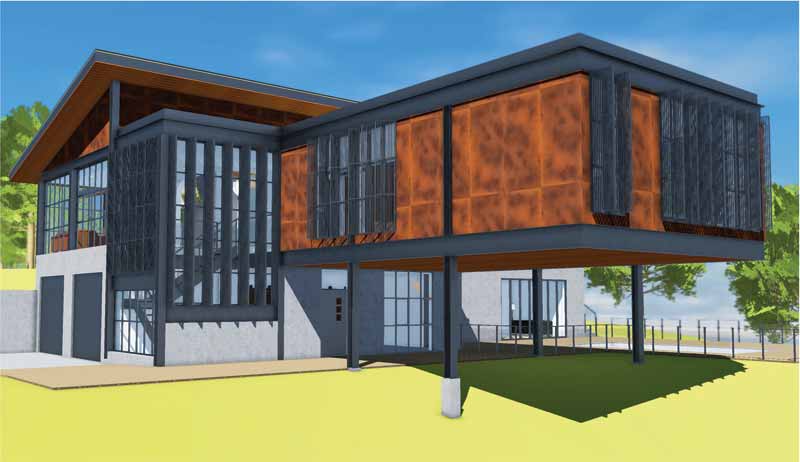
While materials, including metal, have a set amount of embodied carbon locked into place once a building is constructed, a noteworthy method to offset this impact is to make intelligent design choices upfront. Considering essential factors like building orientation or how to implement sun shading devices in the design stage will go a long way in impacting a structure’s cooling and overall efficiency in the future. A key advantage BIM software provides is the ability to visualize, test, and analyze a designed building before even breaking ground. BIM software allows one to utilize algorithms and visualization tools to inform them in advance how a project will fare in its designated site and against natural elements.
Implementing sun shading systems is an effective practice for reducing solar heat gain. Customizing and automating these systems can help to optimize a building’s energy consumption further. Algorithms-Aided Design (AAD) tools bring endless opportunities for customization and analysis. For example, with algorithmic modeling, one can connect their data with real sun positions through objects like hybrid symbols so they can interact with each other, allowing one to accurately interpret and analyze sun shading studies to optimize their facade designs.
Use material data to inform carbon emission calculations
As important as material selection is for a project, utilizing BIM tools to calculate their impact in the design stage can be even more impactful. For instance, one can use material resources representing specific building materials to support an effective BIM workflow. These act as a receptacle for a wide range of information, like graphic attributes such as fill or texture, but also real-world physical attributes such as gravity, yield strength, tensile strength, density, embodied carbon, and other data that can be found in a product’s environmental product declaration (EPD). All this data within the material resource can be used to create accurate reports and show data visualizations, which help when making design decisions in an efficient and informed manner.
Through BIM software and tools, data can be used to assess a project’s embodied carbon. Using a manufacturer’s EPD, one can specify accurate global warming potential values into the material data that is used directly in each building component of a wall system. This allows for accurate reporting/calculating embodied carbon of the specified building systems using worksheets. This is also helpful in making informed decisions when evaluating materials and determining any required changes to reduce a building’s environmental impact.
Assessing material selection based on its embodied carbon can be as simple as changing the exterior wall system with various types of facades and the data can speak for itself, weigh in pros and cons, based on cost, availability, etc. In the example shown above, composite aluminum panel can be an interesting alternative over more traditional material like clay brick or even steel sheets.
Go green with facade design
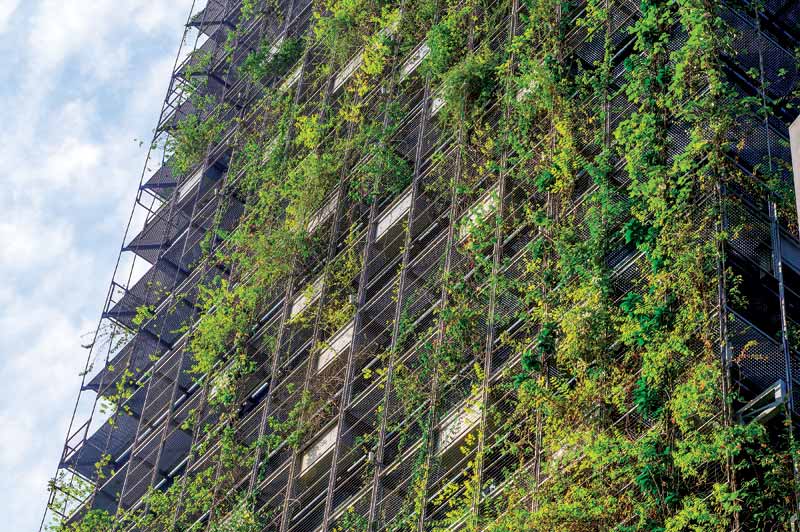
Similar to the reduced energy consumption benefits sun shading devices provide, green or living facades—a design strategy growing in popularity—can provide even more benefits for the environment. Green walls and living wall systems are a mainstay of biophilic design—a design philosophy centered around connecting people with nature within built environments and communities. Green facades, like other biophilic design techniques, promote calmness, boost creativity, and provide several environmental benefits; plus, they look amazing and can be incorporated nicely within metal accents and facade structures.
The natural landscapes of green facades can help to reduce urban heat island (UHI) effect, making them an excellent option for neighborhoods in urban development. Green roofs and facades can also assist with water management, acting as a sponge to contain water, reducing potentially damaging stormwater runoff. They also play a pivotal role in carbon sequestration, aiding in the fight to reduce the amount of carbon dioxide in the atmosphere, and can even help with sound insulation.
Some green facades, such as lattice structures, require little to no soil since the included plants can creep up the wall or building using ropes and cables. As a bonus, these lattice structures act as natural screens or additional sun shaders.
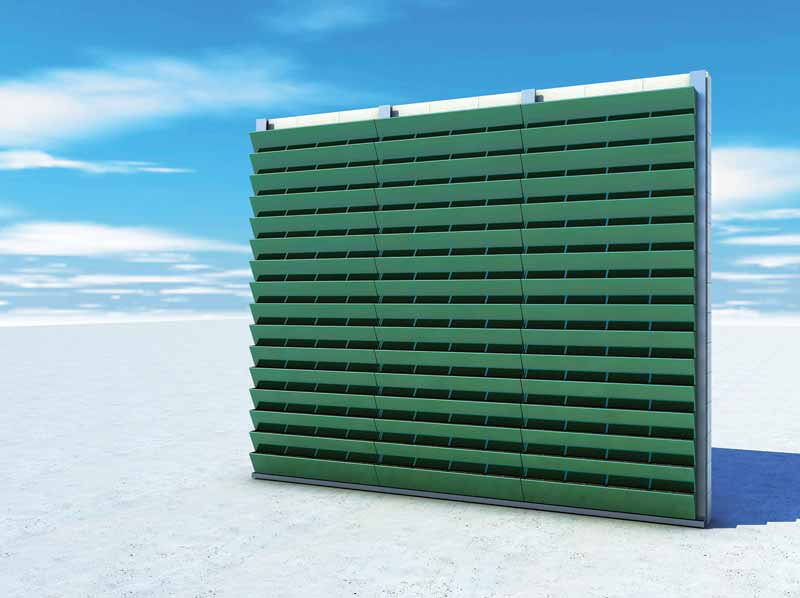
Modular tiles and trays can also create living walls and facade systems, providing a structure for plants and soil. These structures can contain holes for irrigation and roots to live in.
While this design strategy may sound complicated and somewhat daunting in a 3D model, flexible BIM software with integrated, easy-to-use freeform 3D modeling tools lets one create and visualize these systems. Using hybrid symbols in 3D design software makes this process not only more manageable but can also be used to quantify and evaluate quantities and costs.
Hybrid symbols contain 3D objects and 2D graphics, which make it easy to visualize and create the required documentation. A symbol can contain any 3D shapes, plant objects, image props, and even foliage to help visualize the proposed system. The “foliage” tool lets one create 3D foliage by drawing polylines or closed 3D shapes and has different options for the density of leaves and leaf type. Again, the power of BIM also allows one to use data attached to these symbols to help calculate the system environmental impact.
These strategies, features, and ideas just scratch the surface when it comes to the overall advantages and resources that BIM tools and workflows can provide in the journey toward developing, implementing, and creating more sustainable designs. The combination of data’s power, the critical forward-thinking benefits of sustainability, and the creation of impressive designs becomes more manageable with the right tools and technology at hand.
Luc Lefebvre, OAQ, LEED AP, has 30 years of experience in the architectural field, including architecture project management and BIM management, and as an industry expert in the software and technology industry. Lefebvre consistently strives to find new ways to gain efficiencies in the design process and, more specifically, with BIM projects.