


Ribbed panels help transform strip mall into Montessori campus
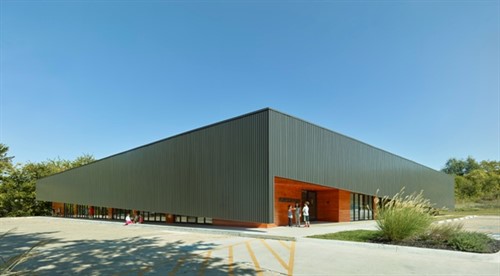
“Rib-ilious,” was the adjective used by a 2016 Metal Architecture Design Award Judges to describe the Fayetteville Montessori Primary School, Fayetteville, Ark., the winner in the ribbed metal wall panel category. One of the judges further expanded their praise, saying it was “one of the top projects in the whole contest,” and another said the architects “used the ribbed metal material judiciously, without overdoing it.”
Montessori Primary is a complete renovation of an outdated suburban office building and strip mall into a nine-classroom school building. When Victoria Butler, longtime director and owner of Fayetteville Montessori School, decided to bring together the school’s primary students (ages 2 1/2-5) under one roof, she opted to buy and renovate this old building complex adjacent to the elementary school rather than build from the ground up. Marlon Blackwell Architects, Fayetteville, was the architectural firm that made the design possible.
 The renovation, completed in 11 months (design through construction) for $132 per square foot, utilizes the original structure of the building, including the storefronts along the south and west walls, which now provide large banks of glass into each classroom. Angled walls, conceived of as a carapace, drop in front of the windows to provide shade and visual separation from the street. An addition on the north side of the building, unseen from the exterior entry of the building, intersects the existing building at the reception area and conference room. The insertion creates a dynamic, acute corner as the corridor extends to three additional classrooms and frames two courtyards, used for outdoor play, between the old and the new.
The new building, although somewhat remote, is an extension of the campus with the material palette-dark bronze, box rib metal wall panels and cypress siding-tying Montessori Primary back to Montessori Elementary, completed in 2012. The elementary school established an identity for the campus.
A Material Logic
 The existing language, budget constraints, item constraints and elegant detailing lead to the decision to use box rib metal panels. “The box rib metal panels unify the campus and give the existing building a new aesthetic,” says Bradford Payne, Associate AIA, project manager, Marlon Blackwell Architects. “The Montessori Primary School was realized at a cost of $132 per square foot, while retaining the refined details of the elementary school. Folding down in front of the windows, the metal wall panels produce lightweight, cantilevered, angled walls. With custom corner details, they seamlessly navigate existing odd angles and help establish a material logic that integrated the existing structure and a three-classroom addition.”
The metal panels were supplied by Metal Sales Manufacturing Corp., Louisville, Ky. The school’s unique design and building requirements made the panels a good fit for metal cladding. “Metal Sales has been a great partner on several of our best projects,” says Marlon Blackwell, FAIA, principal of Marlon Blackwell Architects. “The Metal Sales team understands our vision, and helps to achieve that vision by providing samples and working with us to solve the challenges of our custom details and designs.”
Problems and Solutions
 Metal helped overcome many design problems, and meet the project’s tight budget and short five-month construction schedule. “Metal comes in runs and we are conscious of that; we understand its details,” says Blackwell. “We understand how it turns the corners and how it meets with the wood.” The original building had an asphalt roof set on a wood-framed building with water damage and a 41-degree angle on the corner. It had an 8 1/2-foot-tall parapet on one side and no parapet on the other side. The exterior was supported by 2 1/2-foot-wide columns. Its flat roof was built with several feet of overhang to cover the sidewalk along the front of the building and the design team used this to its advantage. Blackwell Architects removed the dated, ornamental columns along the edge and cut the façade of the canopy at an angle, rather than straight across. This helped control the amount of natural light let in by large windows and also shielded the classrooms from the parking lot.
The fact that the building’s design called for it to look like it did not have any trim on it, only panels, proved to be a challenge for its installer Harness Roofing Inc., Springdale, Ark. James Russell, sheet metal supervisor at Harness says: “All of the trims had to be custom fabricated to match the profile of the wall panel. The panels had to be laid out for every corner in order for the trim to work. Layout and maintaining dimensions was the key. The ‘trimless’ look was the most difficult part of the design, especially since none of the corners were 90 degrees. The corner trim had to tie into the panel while maintaining the same rib and reveal dimensions. Most of the panels had to be field cut to match the slope on the bottom of the wall. The panel was corrugated and 22 gauge so it was not easy. The panels met cypress siding at some of the corners, so we had to make a special trim to match the angle cut on the siding, while still trying to maintain the ‘trimless’ look.”
 In addition to daylighting, another sustainable feature about it was because it reused existing buildings, waste was minimized that would otherwise would go to landfills. Also, its courtyard has a rainwater cleaning system that cleanses rain in gardens before going to creeks. Now finished, the Montessori Primary School’s designers call it and the existing elementary school “cousins.” “They are not replicating each other, they are different,” says Payne. “What ties them together is the materials. They share the same DNA and the palette for the new school was driven by the elementary, but the new school has its own identity because it used so much of the existing buildings.”
Photos: Timothy Hursley
__________________________________________________________________________
Fayetteville Montessori Primary School, Fayetteville, Ark.
Completed: January 2015 Total square footage: 13,414 square feet
Building owner: Victoria Butler
Architect: Marlon Blackwell Architects, Fayetteville, www.marlonblackwell.com
Civil engineer: Bates and Associates, Fayetteville, www.batesengineering.com
General contractor: Nabholz Construction Corp., Rogers, Ark., www.nabholz.com
Geotechnical engineer: GTS Inc., Fayetteville, gtsinc.cc
Metal installer: Harness Roofing Inc., Springdale, Ark., www.harnessroofing.com
Mechanical engineer: HP Engineering Inc., Rogers, Ark., www.hpengineeringinc.com
Structural engineer: Myers Beatty Engineering, Van Buren, Ark.,
(479) 474-4412
Metal wall panels: Metal Sales Manufacturing Corp., Louisville, Ky., www.metalsales.us.com
 |
| The strip mall that was transformed into the school. |