As energy efficiency codes evolve, architects, engineers, and specifiers are expected to incorporate these practices in their designs. One aspect strongly reflected in approved energy codes is the tested air leakage requirements for structures, including metal building systems. Some states are early adopters (California and Washington), but many states—particularly those that have adopted ASHRAE 90.1-2019 and International Energy Conservation Code (IECC) 2021—need to prepare.
Air leakage provisions were developed in response to diminishing returns from adding more mass fiberglass insulation in cavity spaces, and to environmental pressures from various agencies. This article explores air leakage reduction, which goes back to the 2012 IECC, and shows how fiberglass insulation systems meet all current requirements.
In 2012, the IECC introduced an air leakage component and provided three paths to compliance, each governed by a respective ASTM standard and measured at a pressure differential of 75 Pascals (1.57 psf):
- Materials with an air permeability no greater than 0.02 L/s·m² (0.004 cfm/sf)
- Assemblies of materials and components not to exceed 0.20 L/s·m² (0.04 cfm/sf)
- Whole building air leakage test results not to exceed 2.03 L/s·m² (0.40 cfm/sf)
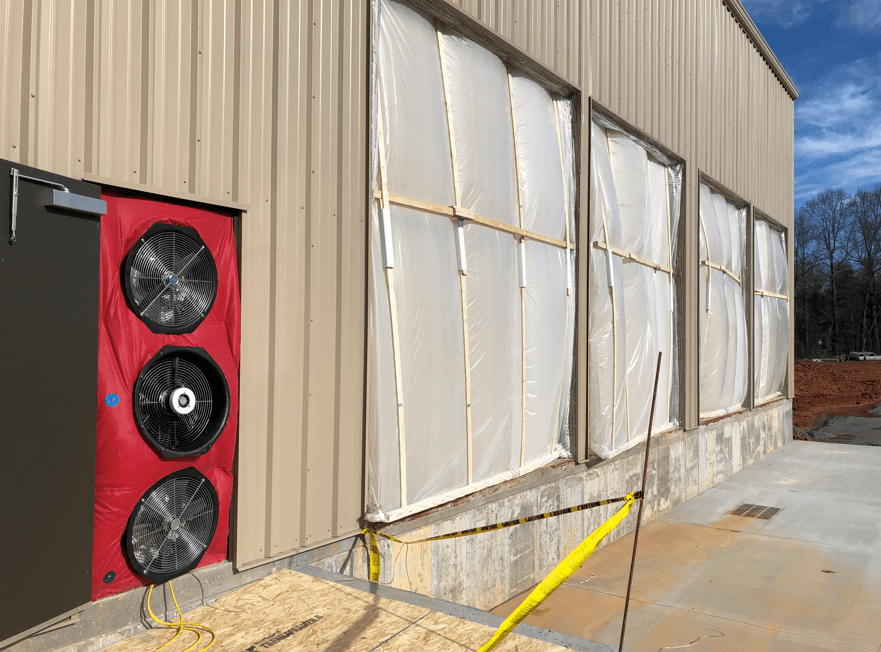
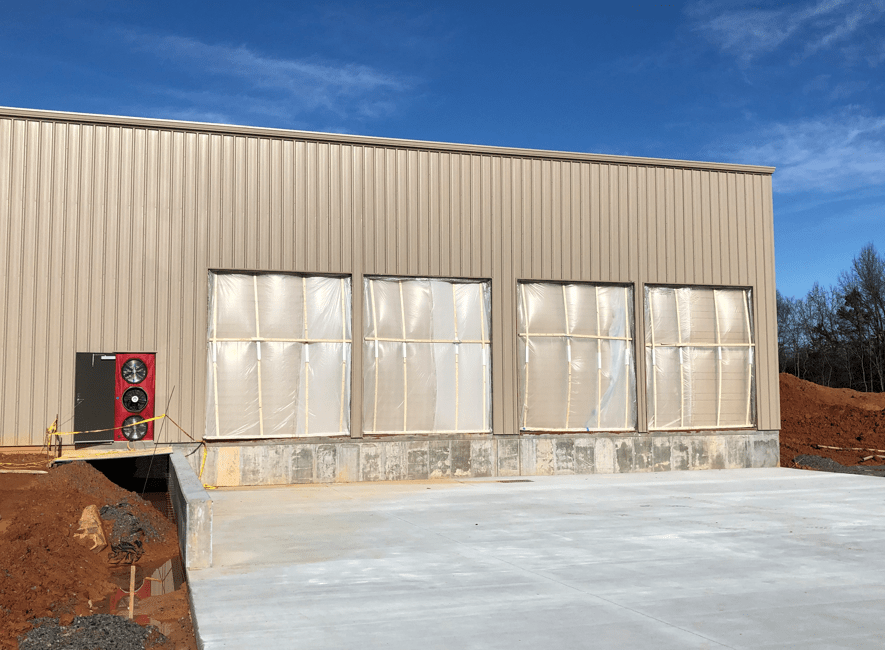
In simple terms, air leakage tests involve a blower door, visual inspection, and infrared images. In a commercial building, the test involves sealing the building, using a fan (or fans, depending on the building’s size) to create pressure differences, and measuring airflow to detect leaks. Data from pressure differentials, visual inspections, and infrared technology identify air-leak points, now mandatory for any state adopting IECC 2021 or ASHRAE 90.1 2019.
It is important to note a key difference between IECC and ASHRAE 90.1: the IECC requires a whole-building test unless an exemption applies due to climate zone or building size, whereas ASHRAE 90.1 allows the use of an installation verification program instead of a whole-building test.
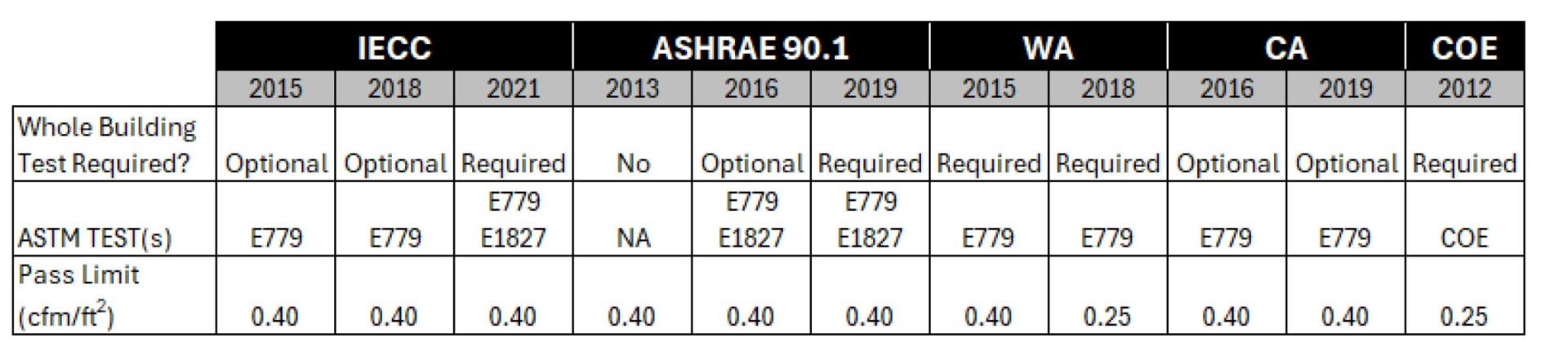
Photo courtesy NIA
Figure 1 shows the progression of whole-building testing requirements (ASTM E779).
Many members of NIA’s Metal Building Laminator Committee are also members of the Metal Building Manufacturers Association (MBMA) and its Air Leakage Task Force. This group, with the help of third-party experts, led tests on several newly constructed metal building systems to evaluate air leakage. These studies encompassed various climate zones, building uses, and fiberglass insulation systems. It was important to test how fiberglass insulation systems perform to ensure they would meet air leakage requirements.
After many tests, it was concluded that all the tested fiberglass insulation systems yielded a positive result under 2.03 L/s·m² (0.40 cfm/sf) threshold. The group’s testing highlighted the importance of, and level of detail needed for, the installation technique used for all materials. Their studies culminated in the MBMA publication “Best Practices to Comply with Whole-Building Air Leakage Testing Requirements for Metal Building Systems.”
IECC 2021/ASHRAE 90.1–2019 has been adopted by 19 states, and it is only a matter of time before other states follow. Additionally, anything after the 2021 IECC will include an air infiltration component. All the more reason to prepare and understand what may be required.
Members of NIA’s Metal Building Laminators Committee and suppliers of fiberglass insulation systems are attuned to and participate in the evolution of energy efficiency and building codes. They are prepared to answer questions or support architecture, engineering, and design (AED) professionals in understanding how air infiltration will affect their projects.
Resources
- Metal Building Manufacturers Association: MBMA_Best_Practices_to_Comply_with_Whole-Building_Air_Leakage_Testing_Requirements_for_MBS_061223.pdf (https://tinyurl.com/yxwv7asv)
- Air Barrier Association of America: www.airbarrier.org/technical-information/whole-building-air-tightness-testing-2/ (https://tinyurl.com/5f5e2jvy)
- ASHRAE: 90.1-2019_ENVELOPE_Final.pptx (live.com) (https://tinyurl.com/5ep2nkrc)
This article was written by a task force from the National Insulation Association’s (NIA’s) Metal Building Laminator Committee. The member companies that make up this committee include Bay Insulation Systems, Inc. (www.bayinsulation.com); DAW Construction Group, LLC (www.dawcg.com); The E.J. Davis Company (www.ejdavis.com); International Insulation Products, LLC (www.iiproducts.com); L&L Insulations (www.llinsulation.com); Silvercote, A Service Partners Company (www.silvercote.com); and Therm-All, Inc. (www.therm-all.com).
This article was reprinted with permission and was originally published in the September 2024 issue of Insulation Outlook magazine, copyright © 2024 National Insulation Association (NIA), all rights reserved. Since 1953, NIA has been the voice of the insulation industry and is dedicated to keeping the commercial and industrial insulation industry up to date on the latest trends and technologies. For more information, visit www.insulation.org or email niainfo@insulation.org. Learn more about metal building insulation at www.insulatemetalbuildings.org.