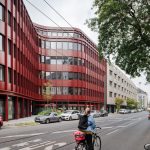
The Washington, D.C.-based U.S. Green Building Council received LEED Platinum certification for its new headquarters, making it the first project to certify under the latest version of the LEED green building rating system. Located in D.C.’s Foggy Bottom district, the building is less than a 1/2-mile (0.8-km) from four Metro stations and numerous bus stops.
The USGBC moved into the office in March after outgrowing its previous space as a result of explosive growth experienced over the last few years. The new space triples the size of its previous space.
“The vision of the space was to exemplify everything a LEED building is: high-performing, resource-efficient, healthy and productive,” said Rick Fedrizzi, president, CEO and founding chair of the USGBC. “Using the newest version of the rating system renders our space on the cutting edge of building science and technology, and will serve as an educational learning lab and highly representative of a transforming building market.”
The planning, design and construction of the new headquarters was a 12-month process from site selection to move-in. Prospective buildings were evaluated on a variety of things, including recycling programs and the desire to seek certification for the entire building. A Vornado Realty Trust property was selected with three out of five tenants and six out of the 10 floors in the building already certified or undergoing certification.
Envision Design, Washington, D.C., was chosen as the architect for its extensive LEED project portfolio. GHT Ltd., Arlington, Va., was the engineering firm, and James G. Davis Construction Corp., Rockville, Md., was the general contractor. All members of the design, engineering and construction teams were LEED Accredited Professionals.
The 75,000-square-foot (6,968-m2) office is divided between two floors and connected by an open staircase in the lobby, behind which is a two-story-tall water feature that helps bring the outdoors inside. The elevator lobby, reception and conference breakout areas are clad in 500-year-old gumwood that was salvaged from the bottom of the Tennessee River. An off-centered relief of the USGBC logo is carved into a two-story section of the gumwood paneling.
 MechoShade Systems Inc., Long Island City, N.Y., supplied an electronic window shade system made from recyclable non-PVC fabric that operates to maximize good daylight and minimize glare in the floor-to-ceiling glass windows. The shades are programmed to be lowered on the east side of the building in the early morning and then gradually rise as the sun moves across the sky. On the west side, the shades are up in the morning and gradually close as the sun moves towards that side of the building. On the building’s south face, the shades are up for 10 months of the year and start to incrementally lower about one month before the winter solstice. The shades can be up for most of the year in the perimeter corridor on the south side of the building because no one is working in the direct sunlight. There is a rooftop sensor that overrides the system on cloudy days, allowing the shades to be up when appropriate.
Armstrong Ceilings, Lancaster, Pa., supplied a variety of ceiling tiles that were used throughout the facility, including the Tierra Ceiling with BioAcoustic Substrate, TechZone Ceiling System with Optima panels, DC FlexZone Grid System, ULTIMA OpenPlan Ceiling System, MetalWorks Vector Ceilings and MetalWorks Plank Ceilings. Made from Jut, a plant that grows from seed to harvest in 90 days, the Tierra Ceiling panels are 45 percent rapidly renewable and are made from 23 percent postconsumer recycled content. The Tierra tiles help achieve LEED points in nine areas. The TechZone Ceiling System is used throughout the conference rooms and open offices and has superior light reflectance and 73 percent post-industrial recycled content. The DC FlexZone Grid System distributes safe, low-voltage direct current power to lights, sensors and other electrical devices in the conference rooms. The ULTIMA Open Plan Ceiling System has a smooth, durable finish that is washable and impact, soil and scratch resistant. The MetalWorks Vector panels are in the pantry and game room, while the MetalWorks Plank panels are in the reception area, and are 25 percent post-industrial recycled.
The office building also features aggressive water and energy reduction, aimed to reduce water usage by 40 percent and energy use to be less than half of a typical office. A dashboard system was implemented to provide real-time feedback on energy usage.
Armstrong Ceilings
MechoShade Systems Inc.