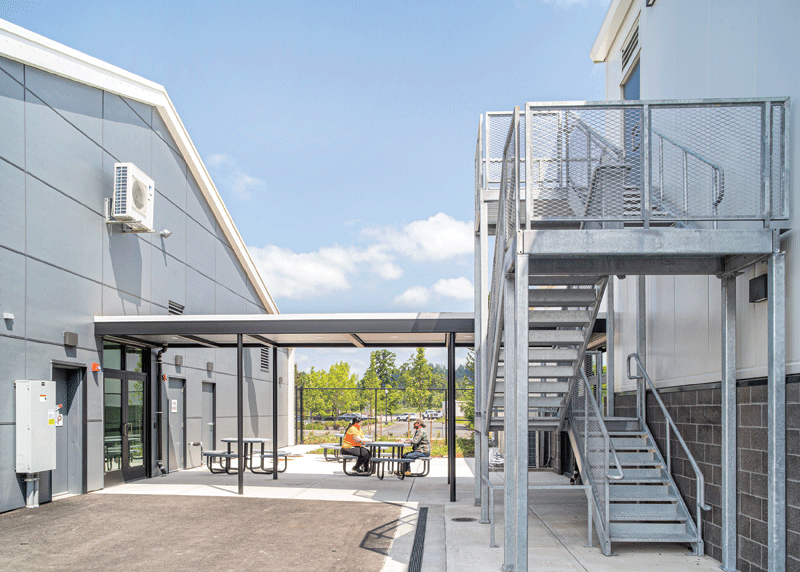
Two connected metal building systems met numerous project goals including providing a variety of training spaces for the Northwest Line Joint Apprenticeship Training Committee (NW Line JATC) in Battle Ground, Wash.
The 3,716 m2 (40,000 sf) headquarters and training facility for journeyperson line-workers for the electrical construction and maintenance industry has indoor and outdoor training spaces.
Scott Wigman, senior project manager at JHC Commercial LLC, says, “To achieve the open training yard and classroom sizes with unobstructed views and high ceilings, a metal building was optimal for both buildings’ construction.”
CIDA Inc. (CIDA Architects and Engineers) designed a main training building and a secondary administrative and classroom building. To complete the project, JH Kelly LLC erected two of American Buildings’ metal building systems.
Long-lasting facility
Rich Brooks, architect at CIDA Architects and Engineers, now retired, says, “The overall system, a pre-engineered metal building, standing seam roof, and IMPs, is highly energy efficient, durable, and allows large open training spaces with ample natural light. Historically, IMPs have fewer leaks and condensation issues than conventional, built-in-place systems. The prefabricated nature of the systems allowed fewer specialty subcontractors to complete the enclosure, thereby improving quality control and expediting the schedule. Our goal was to provide a facility that would be long lasting, easy to maintain, and resistant to damage.”
CIDA Architects and Engineers designed the 2,237 m2 (24,083 sf) main building with a 1,301 m2 (14,000 sf) indoor training yard, free of structural supports. During training, equipment has access to be driven into the facility, and utility poles can be erected. Additionally, to provide daylight in the indoor training yard, JH Kelly installed translucent wall panels.
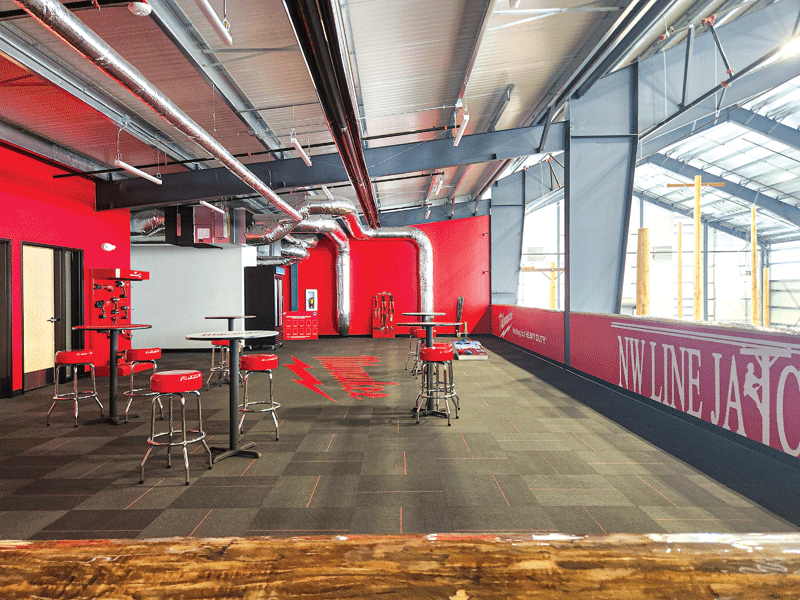
The main training building has a 15 m (48 ft) ridge height and a 10-m (32-ft) tall eave. It houses changing rooms, classrooms, an equipment drying room, a mezzanine viewing deck, offices, restrooms, and storage spaces.
IMP utilization
Regarding the composition of building materials, which include metal roofing and walls, and use of white and gray colors, Brooks says, “A primary design feature was the utilization of standard insulated metal wall panels for the roof and large extents of the exterior walls. The design intent for the interior spaces was to keep the roof structure exposed to maximize space and light, and further convey the industrial aesthetic. Only in areas where we needed additional sound control did we provide suspended tile ceilings.

“The white color was selected to minimize solar heat gain through the roof, and the same colors were provided on the eave sides of the sloped roofs. Accent colors were provided at the buildings’ gable ends and in the recessed areas where overhangs are provided for shade.”
On both buildings’ roofs, JH Kelly installed American Buildings’ SR2 insulated metal panel (IMP) standing seam roof system in warm white.
CIDA Architects and Engineers designed walls for both buildings with a combination of IMPs, concrete masonry units (CMUs), and fiber cement panels. JH Kelly installed All Weather Insulated Panels Inc.’s (AWIP) ST40 Striated IMPs. The IMPs have 26-gauge steel skins with a heavy embossed finish; the exterior is warm white and the interior is imperial white.
Wigman says, “Insulated metal panel roofs and partial wall facades helped in achieving the stringent Northwest energy code requirements, while incorporating CMU, flat panel siding, and wall lights achieved the design requirements for the district.”
At some places on the buildings, white metal roofing wraps down into white metal walls. Brooks says, “The wrapping of the roof and wall panels at the eaves articulate the continuity in material between roof and wall, and the extended roof and wall rake detailing differentiate the building from the typical pitched roof metal buildings of the past. The additional detail creates shadow lines at the building ends that change as the day progresses, which brings dynamism to the facade.”
The 1,735 m2 (18,679 sf) administrative and classroom building houses a board room, break room, commercial kitchen, conference room, offices, storage spaces, three classrooms and work room. Two classrooms are separated by an operable partition, which expands the two spaces into a one 465 m2 (5,000 sf) space with seating for 332 people.