Photos courtesy Clopay
Commercial architects, designers, and specifiers tasked with selecting insulated rolling steel doors
for large spaces like industrial and institutional facilities now have options with lower U-factor ratings than ever before.
As door manufacturers continue to focus on staying ahead of the construction industry’s aggressive energy efficiency goals, newer door designs are leveraging engineering principles like double-wall construction and thermal breaks to achieve unprecedented efficiency results. Some manufacturers also opt to have their doors third-party tested to verify their U-factor ratings, which are a more accurate representation of thermal efficiency than R-values. For new construction, renovation, and retrofit projects, this new level of thermal performance can add up to big savings in energy costs when building pros know what to look for.
New approaches to double-wall construction and guide design
Insulated rolling steel doors engineered for climate-controlled environments typically employ double-wall construction with an insulated core to limit thermal transfer. In this configuration, the door curtain is assembled in two layers, leaving a pocket in between for insulating material. This design can also be used to add structural strength to the curtain.
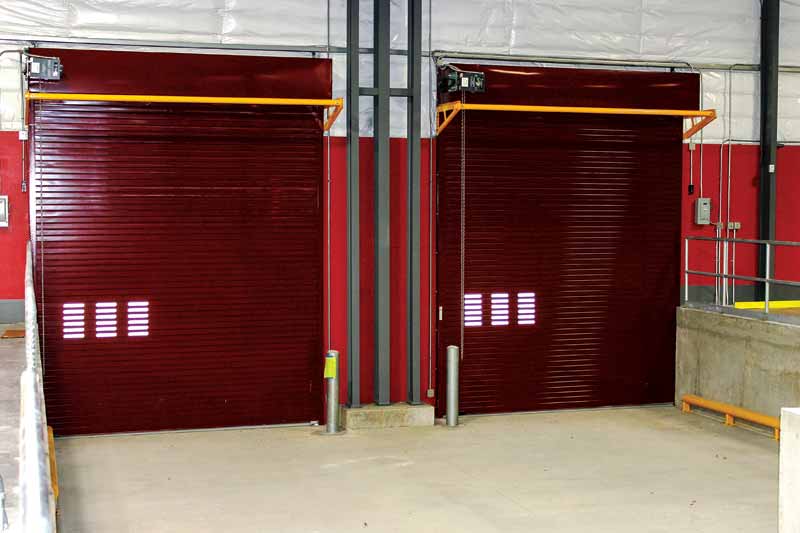
and reduces sound transmission.
Given the interior and exterior layers are separated by insulation (e.g. polyurethane, polystyrene, or in some cases, mineral wool for smoke reduction), the insulation can create a thermal break that interrupts the direct transfer of thermal energy from one steel layer to the other. While double-wall construction and core insulation are common features of highly efficient insulated rolling steel doors, some manufacturers now apply additional thermal breaks to further boost thermal performance.
For example, some manufacturers design the interior layer of the double-wall construction using low-conductivity materials like CPVC. This arrangement effectively eliminates the highly conductive steel-to-steel contact in door designs where the layers comprise steel slats on both sides.
To understand the impact of this simple but significant change, consider the conductivity rates of the two materials. A sample size of 24-gauge galvanized steel has a thermal conductivity of approximately 50 W/m·K (≈ 28.9 BTU/(h·ft·°F)). Comparatively, CPVC of equal thickness (≈ 0.61mm) has a thermal conductivity of around 0.15 W/m·K (≈ 0.0866 BTU/(h·ft·°F)). This demonstrates that steel conducts heat more than 300 times faster than CPVC. While the geometry of the slat bead in an insulated rolling steel door is much more complex than two flat layers, when the two materials are used in double-wall construction with the CPVC on the interior side of the door, the combination produces a significant insulating advantage compared to steel-on-steel assemblies.
Benefits from thermal breaks
Another way manufacturers have achieved unprecedented energy efficiency with insulated rolling steel doors is by identifying other areas of the door that can benefit from thermal breaks. The steel guides, for instance, are the vertical supports of the door that control the curtain’s movement as it opens and closes. While weather seals are commonly used along the guides to block air infiltration, thermal transfer is still present in the steel components that comprise a typical guide structure. By strategically placing low-conductivity material in this area, engineers can create thermal breaks in the guides. This strategy prevents steel-to-steel contact in the guides and significantly slows thermal transfer.
Using combinations like the CPVC backer for double-wall construction and targeted thermal breaks in the guides, manufacturers have set new standards in thermal performance and energy efficiency for insulated rolling steel doors, achieving U-factor ratings as low as 0.532.
Even the U-factor rating is a shift in how the industry measures thermal performance and energy efficiency. After decades of R-value serving as the primary metric of a door’s thermal behavior, manufacturers are now moving to U-factor as a more precise measure for complex, multi-component rolling steel doors. Where R-value represents the thermal resistance of a single element like an insulated wall, U-factor expresses the thermal conductivity of the entire door assembly. To verify U-factor ratings, manufacturers can submit their doors for third-party testing under specific conditions dictated by industry-recognized organizations like the American National Standards Institute (ANSI). ANSI’s DASMA-105 standard, for example, is used to test a door under defined cold and warm conditions to simulate real environments. Insulated rolling steel doors labeled with U-factors and DASMA-105 certification can give architects and specifiers more precise and reliable predictors of energy usage and savings for their end users.
Climate zones that can save the most
Building pros can check the door manufacturer’s website for an energy savings calculator to compare the potential energy and utility cost savings of a low U-factor insulated rolling steel door. One website calculator compares the annual savings that can be realized when upgrading from a standard service door or insulated door to a low-U-factor door. The calculator allows inputs for door height and width and includes a climate zone map and calculated annual savings for each zone.1
When plugging in a 4.8- x 4.8-m (16- x 16-ft) door size and selecting the upgrade scenario from a standard service door to a low-U-factor door, the calculator displays electric utility savings in each climate zone, with Zone 1 at just over $1,500 and Zone 8 at over $6,000 annually. Savings displayed in U.S. climate zones are greatest in Zone 4 (mixed), Zone 5 (cool), Zone 6 (cold), and Zone 7 (very cold) and range from approximately $2,400 to $5,500 annually. Judging by the calculator, any commercial application of the manufacturer’s low-U rolling steel door in a climate zone with four seasons or colder temperatures that require more heating days throughout the year can achieve notable annual energy savings.
Savings without sacrifice
While manufacturers have become increasingly focused on efficiency, they haven’t skimped on aesthetics and other user-friendly features in their door designs. In fact, commercial building professionals now have more options than ever when specifying insulated rolling steel doors. Here are a few highlights of popular features available with the latest high-efficiency, low-U door products:
Colors and finishes: Low-U-factor rolling steel doors are offered in more than 180 colors and finishes that can cater to design palettes and withstand weather conditions. To protect the door’s long-term appearance and prevent exterior degradation, specifiers can opt for specialized powder coatings and clear coats that correspond to installation conditions.
Quiet operation: Along with standout thermal performance, some low-U doors are also impressively quiet and available with a Sound Transmission Class (STC) as low as 27. When paired with the more consistent indoor temperatures afforded by thermal enhancements, quieter operation can further improve personnel comfort. The CPVC backers used on some models produce no additional sound.
Quick, easy retrofits: The process is typically straightforward for retrofit projects where contractors are striving to improve a building’s energy efficiency by removing existing insulated doors and replacing them with low-U insulated rolling steel doors. Installing a low-U door requires some additional headroom, but the door opening itself would not need to change.
For projects with green building or energy efficiency goals, which are just about all commercial projects today, insulated rolling steel doors can provide abundant advantages. By paying more attention to features like double-wall construction, thermal breaks, and U-factor ratings, building pros can help their owners pay much less in energy costs and without sacrificing other desirable features like aesthetics and acoustic comfort. Altogether, these benefits make high-efficiency, low-U rolling steel doors an ideal entry point into more efficient and sustainable buildings.
1 Using Clopay Corporation’s Thermiser Max® – Low U Cost Calculator. Annual adjusted energy cost savings are based on a building that is heated or cooled 24 hours per day (relative to climate zone), an HVAC system operating at 90 percent efficiency, and an electricity cost of $0.16 per kWH.
Ian Hudock is the associate product manager for the Clopay Corporation strategic marketing team. He specializes in both high-performance and new product lines. Hudock uses competitive research and market analysis to provide customers with informed, innovative commercial closure solutions. He can be contacted at ihudock@clopay.com.