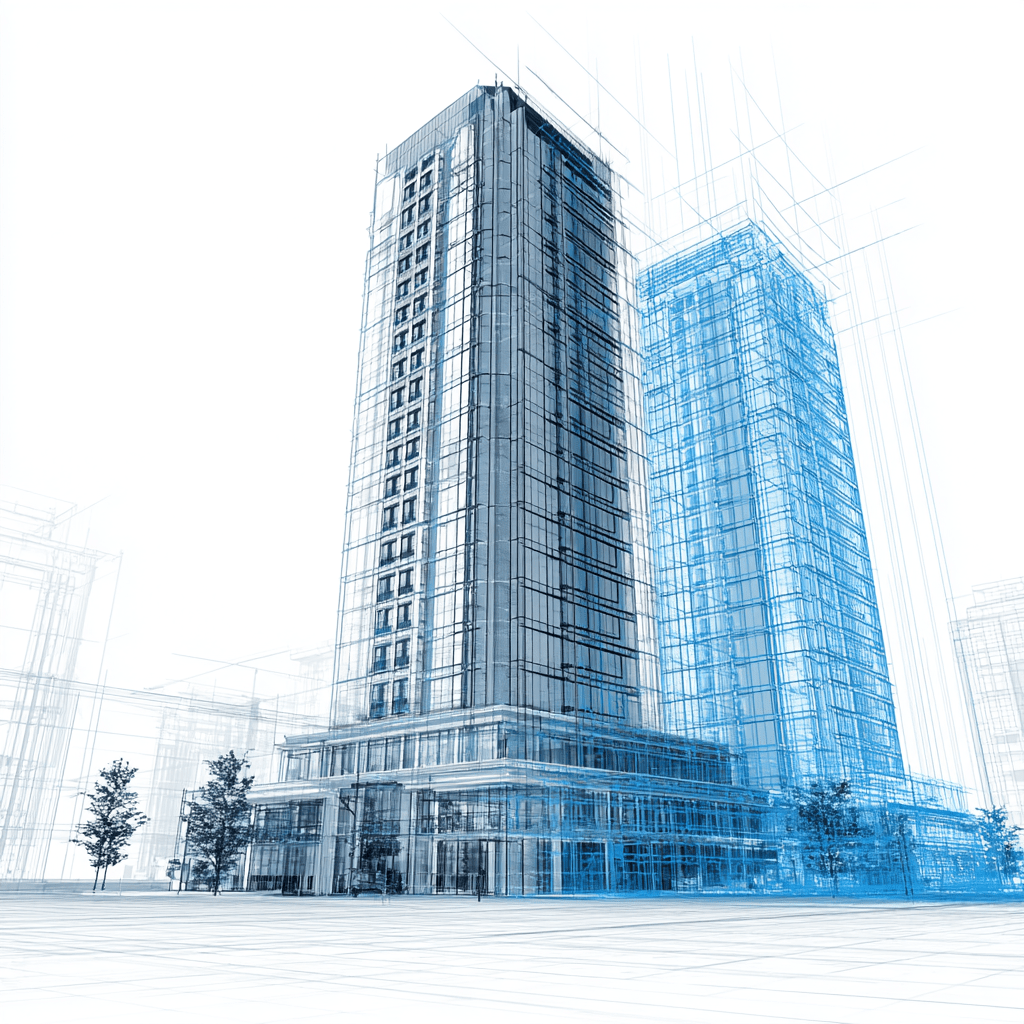
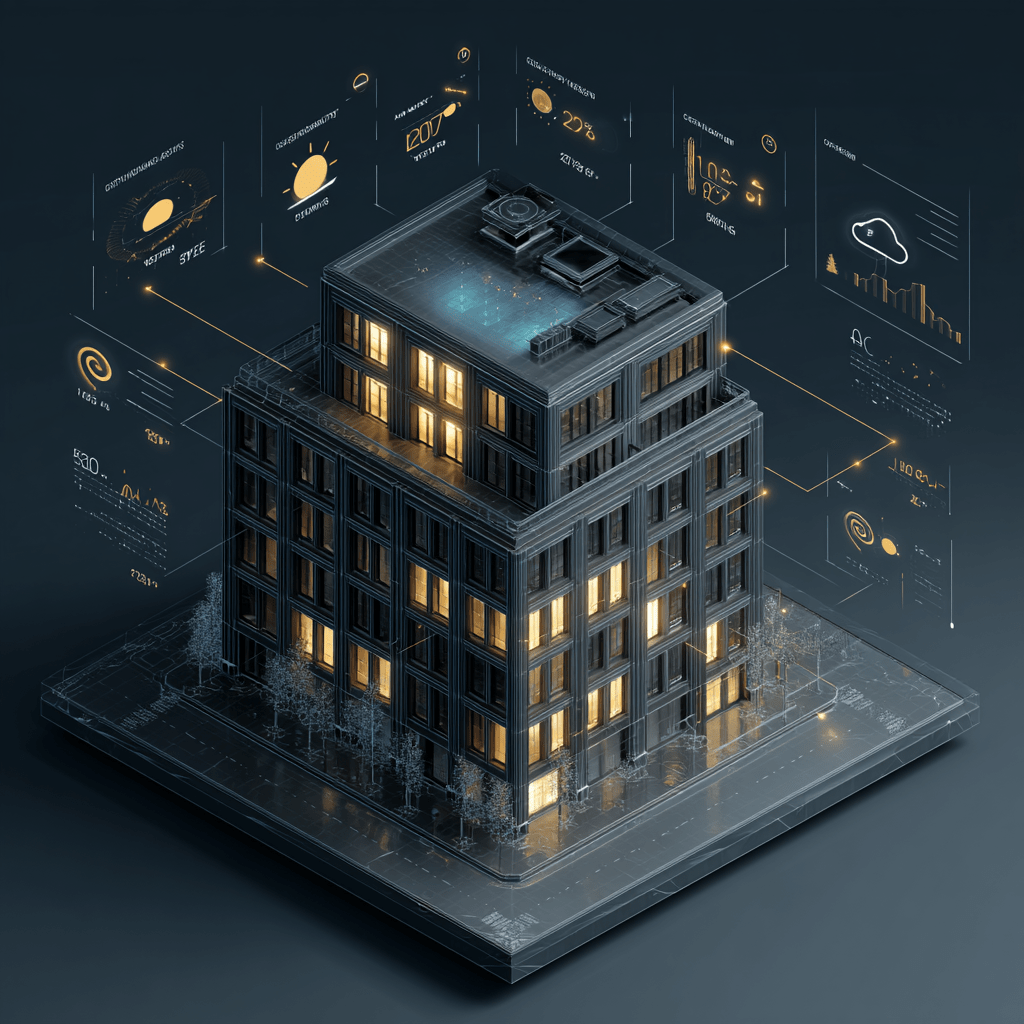
Photo generated using MidJourney/courtesy Alan Scott
Technology invites both fascination and unease in the workplace. It has the potential to unlock extraordinary gains in efficiency and insight, yet tools often fail to meet expectations or overwhelm users with their complexity. Few innovations embody both sides of this tension more than digital twins, which promise near continuous visibility into building performance while demanding new workflows, new skills, and sometimes new ways of thinking.
Still, the needs driving digital twin adoption have not changed: users are swimming in data but hungry for insights. The industry faces mounting challenges, economic pressure, rising tenant expectations, decarbonization, circularity, and escalating natural hazards.
Digital twins are emerging not as a flashy add-on but as a practical tool to manage these pressures and help build teams convert information into action. This article examines emerging applications, addresses adoption barriers, and highlights key considerations for metal buildings, a sector particularly well-positioned to benefit from this technology.
What is a digital twin?
A digital twin is a synchronized virtual representation of a real-world facility, system, or process.
Unlike static building information modeling (BIM) models, digital twins continuously update through two-way data flows, using real-time Internet of Things (IoT) signals, analytics, and simulations to mirror the behavior of a building. They analyze, predict, and sometimes act autonomously, helping owners and operators optimize performance throughout the building’s lifecycle.
Digital twins are typically composed of four interdependent layers:
- A geometric model, usually originating in BIM.
- Simulation and analytics, including predictive performance modeling.
- A data platform, or “data lake,” combining historical data and real-time sensor inputs.
- Performance requirements and constraints, such as design criteria, codes, and operating priorities.
This structure enables digital twins to support decision-making across multiple project stages, including design, construction, operations, and end-of-life, spanning predictive maintenance, resilience, and circularity.
Expanding the value proposition
Energy and carbon optimization: a continuous commissioning engine
Running buildings efficiently is no longer a luxury; it is a climate and financial necessity. A growing trend is the use of digital twins as a continuous commissioning platform, comparing real-time performance against predicted baselines to identify faults, adjust controls, and optimize energy use on an hourly basis. Digital twins can adjust HVAC start-up logic based on predicted indoor conditions, rather than adhering to a set schedule.
Opportunities for reducing embodied carbon complement the operational carbon benefits. During the design phase, digital twins can model structural and cladding quantities more accurately, thereby reducing over-specification and waste. During construction, they can optimize sequencing and logistics to reduce transport emissions.
Indoor environmental quality: precision control
As occupant expectations grow, static setpoints and time-of-day control strategies are falling short of meeting these expectations. New digital twin applications allow buildings to dynamically balance energy efficiency with thermal comfort and indoor air quality (IAQ). These systems can integrate occupancy sensing with weather forecasts to optimize performance. The result is fine-tuned environmental control that is difficult to achieve with traditional automation systems.
Resilience: real-time hazard navigation
Demand for resilience and hazard preparedness is rising across the built environment. Digital twins support this through both forecasting and real-time response. Hazard-oriented simulations can help a building respond to extreme conditions:
- Wildfire smoke: Digital twins can automatically and dynamically adjust HVAC operating modes (filtration and recirculation) to protect occupant health during wildfire smoke events and other poor outdoor air quality conditions.
- High-wind events: Sensors embedded in roofs or walls can detect unusual uplift movement or fastener deformation, informing predictive maintenance before a failure occurs.
- Flooding: Systems can de-energize vulnerable equipment, monitor water infiltration behind cladding, and trigger protective barrier deployment based on rising waters.
- Extreme heat: Digital twins can adjust shading, ventilation, and cooling to compensate for major thermal changes.
These capabilities reduce the risk to people and property, and support faster recovery after hazardous events.
Circularity: material passports and future value recovery
Circularity in the building industry is moving from concept to requirement. Digital twins support the circular economy by functioning as digital material passports, tracking the characteristics, quantities, and expected lifespans of building components. Metal buildings are especially well-suited because their materials hold substantial residual value. Digital twins can:
- Catalog material and component types, dimensions, coatings, and fastener systems.
- Track maintenance histories to inform replacement and reuse decisions.
- Identify which components are bolted versus welded for easier disassembly.
- Connect future owners with recyclers or secondary markets.
Material passports transform building materials and systems from one-time capex costs into future resources.
New applications in construction: smarter, safer, leaner
The construction phase remains a fertile ground for digital twin innovation. Pioneering contractors are increasingly adopting digital twins for:
- Clash detection, quality assurance/quality control (QA/QC), and sequencing, reducing rework and material waste.
- Critical path and supply-chain visualization, especially for key project long-lead components.
- On-site safety simulations, including crane paths, panel installation strategies, and fall-protection planning.
- Tracking prefabricated assemblies, ensuring wall and roof modules arrive and are installed in optimal order.
Metal-clad buildings often rely on prefabrication and precise tolerances, making digital twins a natural complement to their delivery models.
Adoption challenges
Upfront cost and return on investment (ROI) uncertainty
Digital twins require initial investment in modeling, data infrastructure, and sensors. Although returns often materialize through operational savings, the timeline can be slow and difficult to quantify during budgeting.
Data interoperability and siloed systems
A recurring challenge is that sensors, building automation system (BAS) platforms, and software tools do not all speak the same language. Building portfolios often mix old and new systems, complicating integration.
Skill gaps and organizational readiness
Workforces trained on traditional BAS interfaces may not feel equipped to manage AI-driven platforms. Digital twin governance—who owns the data, maintains the model, and decides what gets shared—can also stall adoption.
Cybersecurity concerns
As with any connected system, digital twins introduce risk. Owners worry about exposing building infrastructure to cyber-attacks.
Cultural barriers
Perhaps most underestimated is resistance to transparency. Digital twins expose underperforming systems, as well as underperforming processes or decisions, creating friction between humans and technology.
Overcoming these barriers requires a phased approach: starting small, focusing on a high-value use case, establishing governance protocols early, and expanding as internal competency grows.
Metal buildings: a high-potential testing ground
Metal buildings, with their predictable structural grids, standardized components, and increasingly modular delivery models, are naturally aligned with the implementation of digital twins.
Specific opportunities include:
- Facade performance monitoring: IoT sensors can track thermal movement, moisture intrusion, panel deflection, and corrosion risk. Digital twins can compare real and predicted performance to
identify anomalies. - Roof condition forecasting: Metal roofs are durable but susceptible to fastener failure, coating degradation, or seam separation. Digital twins can evaluate cumulative stress loads from wind, temperature cycling, and foot traffic.
- End-of-life value recovery: Metal components retain high recycling value, making material passports especially powerful. Digital twins can streamline deconstruction planning decades in advance.
The future of digital twins
The next stage of digital twin evolution includes:
- AI-driven prediction and autonomous operation.
- Standardization across industry sectors.
- Cross-lifecycle integration, from design through deconstruction.
- Broader adoption across scales from individual buildings to
smart-city ecosystems.
This means moving beyond individual building twins toward portfolio-level or district-scale insights, shared specification libraries, and circularity-focused material exchanges.
Time to double down
Digital twins are no longer futuristic abstractions; they are pragmatic tools for decarbonization, resilience, and enhanced building stewardship. They help owners and operators turn data into action, designers turn intent into performance, and contractors turn plans into efficient delivery. For metal buildings in particular, digital twins amplify the strengths of the material, durability, precision, and modularity, while helping mitigate challenges such as rapid thermal response and long-term envelope maintenance. Adoption will take commitment, but doubling down on digital twins can foster a built environment that is smarter, more adaptable, and
more circular.
Alan Scott, FAIA, LEED Fellow, LEED AP BD+C, O+M, WELL AP, CEM, is an architect and consultant with over 36 years of experience in sustainable building design. He is the director of sustainability with Intertek Building Science Solutions in Portland, Ore.
This column originally appeared in the March/April 2026 edition of Metal Architecture, which you can find in our Digital Edition Archives.