The U.S. solar market is entering a new phase, one defined less by incentives and more by economics, resilience, and necessity. Solar is no longer a niche sustainability strategy; it is becoming core infrastructure. Metal construction, especially metal roofing, lends itself well to the integration of rooftop solar arrays and solar-ready construction.
While the expiration of residential tax credits and the phased reduction of commercial incentives have created uncertainty in parts of the market, the demand for solar continues to grow because the underlying drivers are stronger than ever.
Electricity costs are rising rapidly, with U.S. rates increasing significantly in recent years and expected to continue climbing. At the same time, grid constraints are intensifying, driven by electrification, data centers, and aging infrastructure.
Resilience is now a priority, not a luxury.
The case for solar-ready design
Not every project can include solar and energy storage at the time of construction. However, designing for future integration is both practical and cost-effective, and the use of metal in these designs can create buildings that are ideally adaptable for integrated solar systems.
Metal materials, such as standing seam panels, enable roofing additions and attachments using clamps. This avoids penetrating the roof, a relatively costly endeavor that can lead to additional concerns. Designing roof structures to accommodate the future loads of solar arrays and installing conduit pathways from roofs to electrical rooms are key forward-thinking steps toward making a roof solar-ready.
Other steps include allocating space for inverters and battery systems and aligning electrical infrastructure with the National Electric Code (NEC) and net-zero-ready design best practices.
These relatively minor steps can significantly reduce the cost and disruption of future installation, protecting long-term asset value.
Where solar works now
One of the most important shifts discussed across the industry is the growing limitation of the electrical grid itself. Transmission infrastructure is aging, constrained, and expensive to expand. This reality is accelerating the shift toward distributed energy resources (DERs), with generation located close to the loads they serve.
Commercial integration
Commercial rooftop solar is particularly well-positioned. Mark Schottinger, president and chief legal officer at Solar Landscape, says it “represents one of the most immediate and scalable solutions to provide rate relief by increasing generation where electricity is consumed.” It avoids land-use conflicts and NIMBY resistance, can be deployed quickly, makes energy proximal to its load, and reduces transmission losses and interconnection delays”.
Front-of-the-meter rooftop solar has become increasingly attractive to commercial real estate owners due to its low operational complexity. In this model, the developer owns and operates the system, while the property owner receives predictable income without investing capital or managing the asset.
Solar and storage: multiplying value
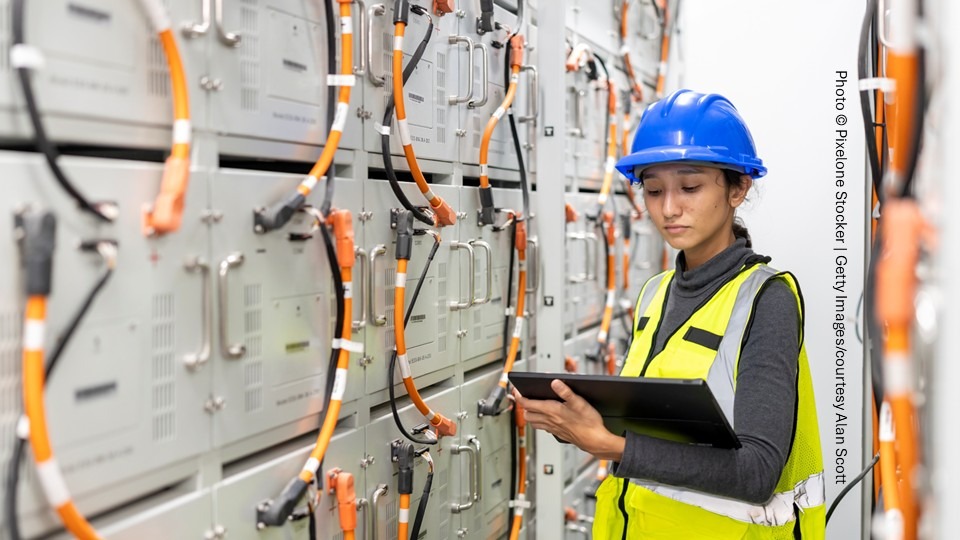
While solar alone is compelling, the real transformation happens when it is paired with battery energy storage. This combination unlocks multiple, stacked benefits from energy savings, returns from net metering rates, preparedness for grid outages, and additional revenue streams. This combination unlocks multiple, stacked benefits, which architects can use to inform their designs and tailor them to the optimal performance needs of building owners.
Demand and time-of-use savings
Commercial energy bills often include demand charges and time-of-use pricing. Battery storage allows building owners to store excess solar production and deploy it during peak periods, flattening demand spikes and reducing costs.
Reduced reliance on net metering
As utilities reduce net metering rates, storing and using energy on-site often provides a higher return than exporting it to the grid.
Resilience and continuity
Integrated solar and storage systems provide on-site backup power, enabling buildings to maintain operations during outages and public safety power shutoffs (PSPS). As extreme weather events and grid disruptions increase, this function alone is often enough to justify investment.
Grid support and new revenue streams
Utilities increasingly view distributed storage as an asset. Aggregated systems can provide voltage support, frequency regulation, and peak load reduction.
Jon Miller, development director of renewables with McKinstry, explains, “Combining solar with storage multiplies the benefits; it transforms a static generation asset into a flexible energy resource”.
Angela Crowley-Koch, executive director of Oregon Solar + Storage Industry Association (OSSIA), highlights the rise of virtual power plants, where distributed systems are aggregated to support grid stability, creating new value streams while improving resilience.
Aligning with LEED v5: solar as core strategy
The emergence of LEED v5 further reinforces the role of solar and storage in high-performance buildings. The new
framework emphasizes:
- Decarbonization: Onsite renewable energy directly reduces operational carbon emissions.
- Electrification: Solar supports the transition away from fossil
fuel-based systems. - Grid-interactive buildings: Solar with storage enables buildings
to respond dynamically to grid conditions. - Resilience: Distributed energy supports continued operation
during outages.
In LEED v5, climate risk assessment and resilience strategies are integrated into early design phases. Solar and storage systems are no longer optional add-ons; they are increasingly central to achieving certification goals and meeting owner expectations.
A clear direction forward
The solar market is becoming more economically grounded, more resilient, and more integrated into the built environment. The implications are clear:
- Solar and storage should be considered early in design
- Buildings should be designed as energy assets
- Distributed energy systems are becoming core infrastructure
Despite policy shifts and market adjustments, the fundamentals of solar have never been stronger. Costs are down, demand is rising, the grid is constrained, and resilience is no longer optional. Solar, especially when paired with storage, uniquely addresses all of these challenges at once. It reduces operating costs, lowers carbon emissions, enhances resilience, and increases asset value.
In the U.S. solar landscape, the expiration of residential tax credits and the phased reduction of commercial incentives have created uncertainty.
While still relevant, federal incentives are no longer the primary driver of investment decisions.
As noted by Mark Schottinger, president and chief legal officer at Solar Landscape, “the energy landscape is being reshaped by geopolitical volatility, affordability challenges, and surging demand from AI, data centers, and electrification.”
In tandem with the shift in market needs, state and utility programs continue to support growth, with robust programs in California, Massachusetts, New Jersey, New York, and other states. Some unique programs include:
- Illinois’s Community-Driven Community Solar Program.
- Oregon’s Community Renewable Energy Grant Program.
- Washington State’s community energy resilience initiatives.
- Utility-led programs like Portland General Electric’s CBRE program.
More than a dozen states are actively exploring policies to expand commercial rooftop solar and storage to address affordability and capacity challenges, while other markets, such as California, Hawaii, and Alaska, are approaching a tipping point where solar competes directly with utility power without incentives, driven by high electricity rates. As state policies develop, designing buildings with standing seam metal roofing can mean designing with solar adoption in mind. This can prevent the necessity for roof perforations and retrofit costs as photovoltaic panels can be attached using roof clamps.
The economics of solar have fundamentally improved. Installed solar costs now typically range from about $2.00 per watt for commercial systems and $2.50–$3.50 per watt for smaller projects. Over the past decade, costs have dropped dramatically, while performance has improved.
Battery storage is following a similar trajectory. Lithium-ion battery prices have fallen nearly 90 percent from 2010 levels, with installed systems commonly ranging between $200–$400 per kWh depending on scale and application.
North of the border, Canada is also expanding support for distributed solar through a mix of federal tax credits, provincial rebates, and net metering programs, particularly in provinces such as Ontario, British Columbia, and Alberta. These programs are accelerating adoption in both commercial and residential markets and reinforcing a broader North American trend toward localized energy generation.
The opportunity now is not simply to install solar and storage, but to integrate it into the DNA of building design and construction. Projects that do so will not only perform better but also be more adaptable, more resilient, and better aligned with the realities of a rapidly changing energy landscape.
For the metal building sector, the opportunity is especially compelling. Long service life, adaptable structural systems, and durable roof assemblies provide an ideal platform for integrating solar systems, while also supporting simplified maintenance, future flexibility, and long-term compatibility with evolving electrification and resilience strategies.
For the design and construction community, the question is no longer whether solar makes sense, but how quickly it can become standard practice.
Alan Scott, FAIA, LEED Fellow, LEED AP BD+C, O+M, WELL AP, CEM, is an architect and consultant with over 38 years of experience in sustainable building design. He is director of sustainability with Intertek Building Science Solutions. To learn more, follow Alan on LinkedIn at www.linkedin.com/in/alanscottfaia/.