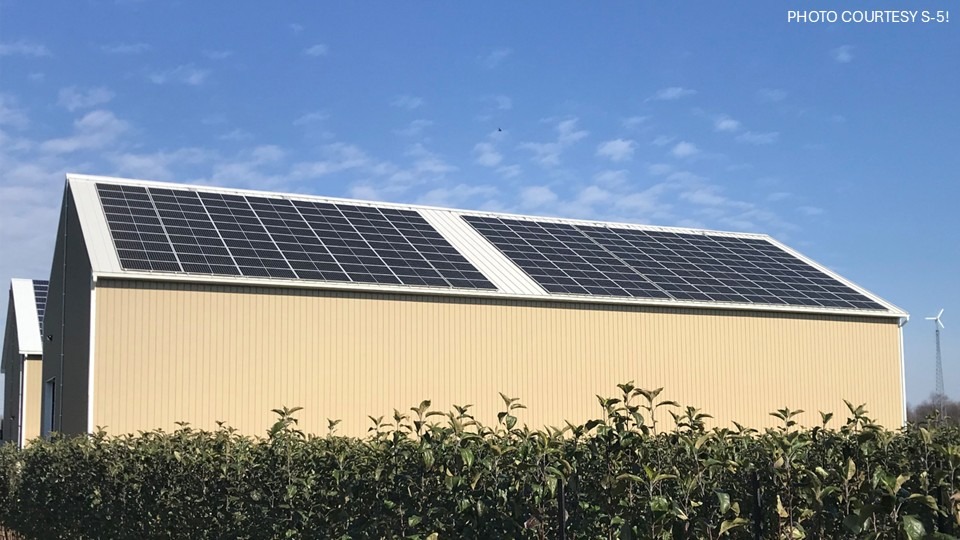
As solar development expands across rural America, agricultural projects are finding value in an overlooked asset: the roofline. Ground-mounted systems can generate significant electricity, but can also place solar infrastructure in direct competition with productive acreage. Rooftop applications offer a way to increase energy production without asking the land to do more.
This is where agricultural metal buildings enter the conversation. Rather than converting open land to energy production, farms can use existing buildings and infrastructure to support onsite generation.
Barns, storage buildings, and support structures are often topped with corrugated or trapezoidal roof panels and, in some cases, standing-seam systems. Metal roofs are widely used in agricultural settings because they are durable, weather-resistant, environmentally friendly, and easy to install. As a result, they are a logical platform for rooftop solar, allowing agricultural buildings to play a larger role in onsite generation while making more efficient use of the built environment.
Maximizing spaces with rooftop solar
Rooftop solar in agricultural settings places generating capacity on underutilized surfaces. That matters on working farms, where land supports production, access, and the flexibility needed for daily operations. A ground-mounted system may generate clean energy, but can also create conflicts with machinery movement, storage, loading, and future site changes.
Roof-mounted systems eliminate much of that tension. Instead of asking a farm to dedicate separate acreage to energy production, they allow solar to be integrated into existing structures already central to the operation. In practical terms, that can simplify system placement, preserve flexibility at grade, and reduce the likelihood that solar infrastructure will disrupt the farm’s operations over time.
At Leas Family Farms in Indiana, that logic shaped the project from the start.
Preserving and enhancing productive land
The Leas operation wanted to generate its own electricity without giving up productive land or creating conflicts with equipment, vehicles, and day-to-day farm operations. The solution was a 100-kW grid-tied solar photovoltaic (PV) system installed on the south-facing metal roofs of two hog barns rather than on a separate ground-mounted structure.
That kept the solar installation out of the way of everyday activity, underscoring a basic truth of agricultural design: where a system is placed can influence movement through the site, operational flexibility, and day-to-day efficiency as much as energy output.
Metal roofing for sensible solar solutions
Those same qualities make metal roofs well-suited to rooftop solar installations. Their long service life and compatibility with direct-attach mounting can simplify installation while helping preserve roof integrity.
Metal roofs can accommodate direct-attach solar PV systems, eliminating the need for rails and additional mounting hardware. That means fewer components, lower labor demands, and less added weight, while helping preserve roof integrity and simplifying installation.
In the Leas Family Farms project, the use of a rail-less system reduced installation time by 40 percent compared with a conventional rail-mounted approach. For agricultural owners balancing upfront cost with long-term operating performance, that kind of efficiency can be decisive.
With a recyclability rate of 98 percent, metal roofs can help reduce waste and support a cleaner built environment. When solar is paired with a material already valued for its long life and low maintenance, the roof becomes part of a broader strategy for resource efficiency and lifecycle performance.
The roof as a part of building performance
At KC Bailey Orchards in New York, the roof takes on a more active role.
The orchard uses multiple metal buildings for apple storage and distribution, with five roofs supporting direct-attach solar PV systems. In these cold storage buildings, the roof directly affects refrigeration demand and operating costs.
Before solar was added, the reflective metal roof surfaces were already helping to reduce heat gain and improve cooling efficiency. The space between the installed solar panels and the roof provides shading that can lower roof surface temperatures.
For architects, engineers, and contractors working on agricultural facilities with controlled interior environments, the question is no longer just whether a roof can support solar panels, but how the combined roof-and-panel assembly affects the building below.
Looking beyond the barn
The same mindset can extend beyond occupied buildings. Agricultural infrastructure can also become a platform for energy generation when the design approach focuses on adding value to surfaces already in use.
In Santa Paula, Calif., a 1.73-MW irrigation project put that idea into practice by integrating solar into a metal canopy roof structure built over a reservoir. The result combines power generation with essential water system infrastructure, rather than requiring a separate solar field on open land.
The common thread in these examples—from apple orchards to hog farms to irrigation systems—is that solar is most effective when it is integrated into the everyday structures and systems that already support agricultural operations.
A practical alternative to field conversion
Rooftop solar is not the only way renewable energy is integrated into agriculture. Agrivoltaics, which combines farming and solar energy generation on the same land, has generated growing interest in recent years. Rooftop systems offer a different path, one that removes the question of field conversion altogether.
Roof-mounted solar preserves acreage for production, avoids creating a separate energy zone in the site plan, and uses buildings already central to the farm. It can also reduce some of the visual and operational disruption associated with ground-mounted installations, especially in settings where access, maneuvering room, and flexibility at grade remain essential.
This does not mean rooftop solar is the right answer for every project. Most farms do not have enough roof space to support the same scale of generation as a ground-mounted system. Roof orientation, structural capacity, electrical demand, utility interconnection, and return on investment still shape what is feasible. Even so, where metal buildings are already in place, rooftop solar offers a clear and often underused opportunity.
Expanding the role of agricultural buildings
For the metal building industry, the greater point is not simply that agricultural roofs can carry solar, but that solar expands the role of the agricultural buildings themselves.
These structures have long been valued for economy, speed of construction, durability, and low maintenance. Rooftop solar adds another layer of performance to those same strengths. A metal roof can protect livestock, shelter stored crops, improve thermal efficiency, and generate electricity simultaneously. This fundamentally changes how the building contributes to the operation.
For architects, fabricators, and contractors designing the next generation of rural facilities, rooftop solar offers the opportunity not to expand the farm’s energy footprint, but to increase the value of the structures and systems already in place.
Fiona Maguire-O’Shea is a seasoned writer for S-5!, the inventors of the world’s first rail-less solar mounting system for metal roofs.