Water will find its way into a building enclosure. The challenge isn’t necessarily keeping every drop out, but designing walls that can manage moisture and dry out before damage occurs.
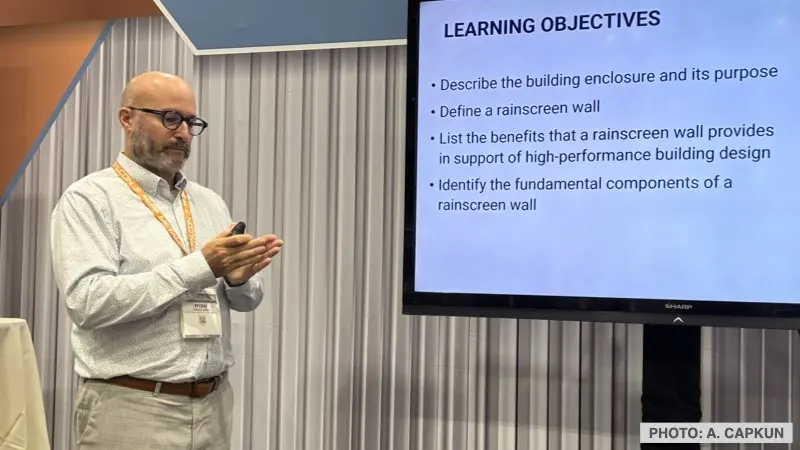
That was the message from Ryan Dalgleish, director of education at the Rainscreen Association in North America (RAiNA), during his session “Designing walls for reality, not perfection” at Metalcon 2026.
He offered a simple analogy: Trees get wet, but they don’t necessarily rot. They dry out. Building walls, he explained, need the same ability to manage moisture.
The building enclosure separates conditioned from unconditioned spaces, controlling water, airflow, heat transfer, and other environmental conditions. When it comes to rainwater, however, even a well-designed enclosure must account for the possibility of water getting past the exterior cladding.
And water doesn’t necessarily enter a wall on its own. Forces such as wind pressure, capillary suction, and momentum can push or draw moisture through openings and joints.
This is where rainscreen wall assemblies come into play.
Rather than relying on a single supposedly perfect barrier, a rainscreen assembly uses an outer cladding layer, an inner protective layer, and a cavity between them to help manage water intrusion.
Dalgleish discussed several approaches, including vented, ventilated, and pressure-moderated rainscreens. A vented cavity provides limited air circulation, while a ventilated assembly uses openings that allow greater airflow and encourage drying.
But more space isn’t necessarily better. An excessively large cavity can create a pathway for fire to spread within the wall assembly.
Dalgleish also addressed cladding attachment methods, noting that conventional Z-furring can create significant thermal bridges through the insulation. Alternative attachment systems can help reduce heat transfer and improve overall wall performance.
As illustrated in his presentation, properly designed rainscreen walls can contribute to durability, resilience, energy efficiency, occupant health, safety, and design flexibility.
Anthony Capkun is the editor-in-chief of Metal Architecture and Metal Construction News magazines.