Built in 1899, the Toronto Carpet Factory campus once housed one of the largest broadloom carpet manufacturers in North America. For more than 100 years, this area, known as Liberty Village, has defined the landscape of the historic district in Toronto. The area’s recent redevelopment has attracted a variety of tenants to the complex of buildings that occupy about two city blocks. It includes restaurants, interior design firms, graphic design firms and some dot-com companies.
One of the last buildings to be completed is one that housed the carpet factory’s boiler and generator. On Dec. 6, 2007, the redesigned and reinvigorated building officially opened as the Allsteel Resource Center. The one-story building houses the 7,800-square-foot (724-m2) showroom and a mezzanine level with meeting space.
Designed by figure3, a Toronto-based interior design firm, the center serves as the first Canadian showroom for Allsteel Inc., headquartered in Muscatine, Iowa, and The Gunlocke Co. LLC, based in Rochester, N.Y. Both are companies of Muscatine-based HNI Corp., which represents seven companies serving the office and home furnishing environments.
 According to project manager Eric Yorath, senior team leader for figure3, Allsteel has a corporate mandate that all its showrooms acquire some accreditation of LEED standards. So the project was designed by figure3 in accordance with the Canada LEED-CI Version 1.0, which follows the Washington, D.C.-based U.S. Green Building Council’s LEED for commercial interiors. The LEED consultant was Jacques Whitford in Ottawa, Ontario, Canada.
“The Allsteel and Gunlocke project is seeking a LEED Silver certification. This certification would be a significant achievement as it illustrates that although challenging, historical buildings can be designed to meet the environmental standards of today,” Yorath noted.
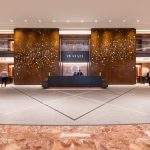
In designing Allsteel’s showroom, figure3 carefully considered the historical roots of the carpet factory and the boiler house building. Environmentally sensitive carpet floor tiles were arranged within the showroom to mimic a magnified pattern of an axminster carpet, a style of carpet pattern and texture originally produced in the factory.
 The existing structure, exposed structural metal and brick were left exposed and integrated contemporary elements and large graphic brand features, including corporate logos. The structural metal and ceilings in the showroom and mezzanine were painted white with low-VOC paint. The result is a modern design that references traditional roots. Additional structural metal work was done to the mezzanine-level board room.
Exposed galvanized steel panels were used as accents around the fireplace and on the wall of the reception area, which is approximately 20-feet (6-m) wide by 30-feet (9-m) high. The wall was built using 4- by 5-foot (1.2- by 1.5-m) metal panels wrapped around boards made from recycled materials. Toronto-based Rae Brothers installed the wall system and Ste-alco Ltd., Mississauga, Ontario, fabricated the metal panels, which were supplied by Sheridan Metal Products, also of Mississauga.
The outdoor Allsteel signage is made from a curved piece of 3/4-inch (19-mm) brushed aluminum accented with backlighting. Produced by KSI signage, Toronto.
“This was one of the most challenging projects figure3 has designed. We have succeeded in creating a space that is environmentally sustainable and successfully represents the Allsteel and Gunlocke brands, all while capturing the roots of the building and the historical importance of the Liberty Village area. We are proud to have worked on this project as Allsteel, Gunlocke and figure3 strongly believe that great design can also be sustainable,” commented Christopher Wright, figure3 design partner.
 Michael Barr is a Toronto-based freelance writer with Parallel Communications.