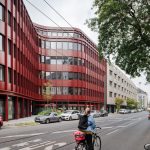
Located on the edge of Birmingham, Mich.’s evolving downtown, 735 Forest is the first building to use Midland, Mich.-based Dow Building Solutions’ THERMAX Wall System. The 35,000- square-foot (3,252-m2), three-story mixed-use building features a bistro, Class A office space, 11 loft-style residences and covered parking.
“We were seeking a company that both understood the technical nature of our product and could offer a solution to rising energy costs and the high costs of building materials and building systems; Dow was a sure fit,” said Steve Marszalek, a principal with Birmingham-based Mosher, Dolan, Cataldo & Kelly Commercial, the general contractor and owner of 735 Forest. “Through one-on-one consultations and a dramatic dew point illustration, our Dow architectural specialist presented a better building-science approach to wall construction and different wall assembly options. The THERMAX Wall System clearly addressed the challenges we faced.”
735 Forest is located in Birmingham’s Triangle District, which is guided by a master plan to create an open, vibrant and pedestrian-friendly downtown environment. The vision of architect Victor Saroki of Birmingham-based Victor Saroki & Associates Architects PC extends to the greater environment, as well.
“As architects, we are concerned that our building designs are energy efficient because this reduces theimpact on our resources,” Saroki said. “Likewise, our clients share this agenda. With the THERMAX Wall System, we’re designing a more responsible building for today and for the future.”
“We’re not in the disposable building business,” said John Kelly, president of Mosher, Dolan, Cataldo & Kelly Commercial. “From the building materials to the amenities to the finishes, we select every detail with care. Then we ask: Is it good design? Is it good business? Is it good for the environment? Our perspective on this project mirrors our approach to every building- one founded on overall performance.”
“The THERMAX Wall System is truly innovative because it reduces the number of trades involved in erecting the wall assembly and, because of the sprayapplied interior wall insulation, the smallest penetrations are eliminated,” Saroki added.
The THERMAX Wall System is a systematic approach to achieving efficiency at every level-simplified design, streamlined construction and optimized energy consumption for a reduced carbon footprint.
“The THERMAX Wall System provides a better quality exterior shell package with greatly improved vapor and moisture seal,” said Bruce Schihl, owner of Shelby Township, Mich.-based Dun-Rite Finish Systems Inc., the carpentry and drywall firm. “The dew point is moved to the exterior finish of the wall area, virtually eliminating condensation behind the brick line. The ultimate outcome is significantly less labor and material costs, while providing a higher-quality end product. This increases overall productivity and efficiency, resulting in a win-win for the contractor and the building owner.”
The three-in-one THERMAX Wall System enables an energy-efficient, moisture-managed wall with fewer materials and fewer installation steps.
When sprayed on the interior of the THERMAX Exterior Insulation in the stud cavity, the STYROFOAM Brand Spray Polyurethane Foam (CM Series) effectively fills gaps, cracks and penetrations for moisture management and elimination of air infiltration in the wall. The closed-cell spray foam also provides additional insulation. MAG Insulation, Mt. Pleasant, Mich., was the spray foam insulation contractor.
Dow supplied 15,000 board feet (4,572 m) of the THERMAX Exterior Insulation, in addition to WEATHERMATE Flashing and STYROFOAM Brand SPF (CM Series) for the wall assemblies. The roof insulation is 4- inch- (102-mm-) thick STYROFOAM Brand DECKMATE Plus Insulation. Dow also supplied STYROFOAM Brand CAVITYMATE Ultra Insulation for use on the stairwells.
735 Forest has received LEED Gold certification and includes a variety of green features to complement the energy-efficient wall system, including FSC-certified veneers, abundant daylight openings, water-saving plumbing fixtures, energy-efficient heating and cooling, and reflective roofing.
“The THERMAX Wall System helped our project earn significant LEED credits,” Marszalek said. “More important, we’re projecting 30 to 40 percent energy savings in the first year over the original design.